
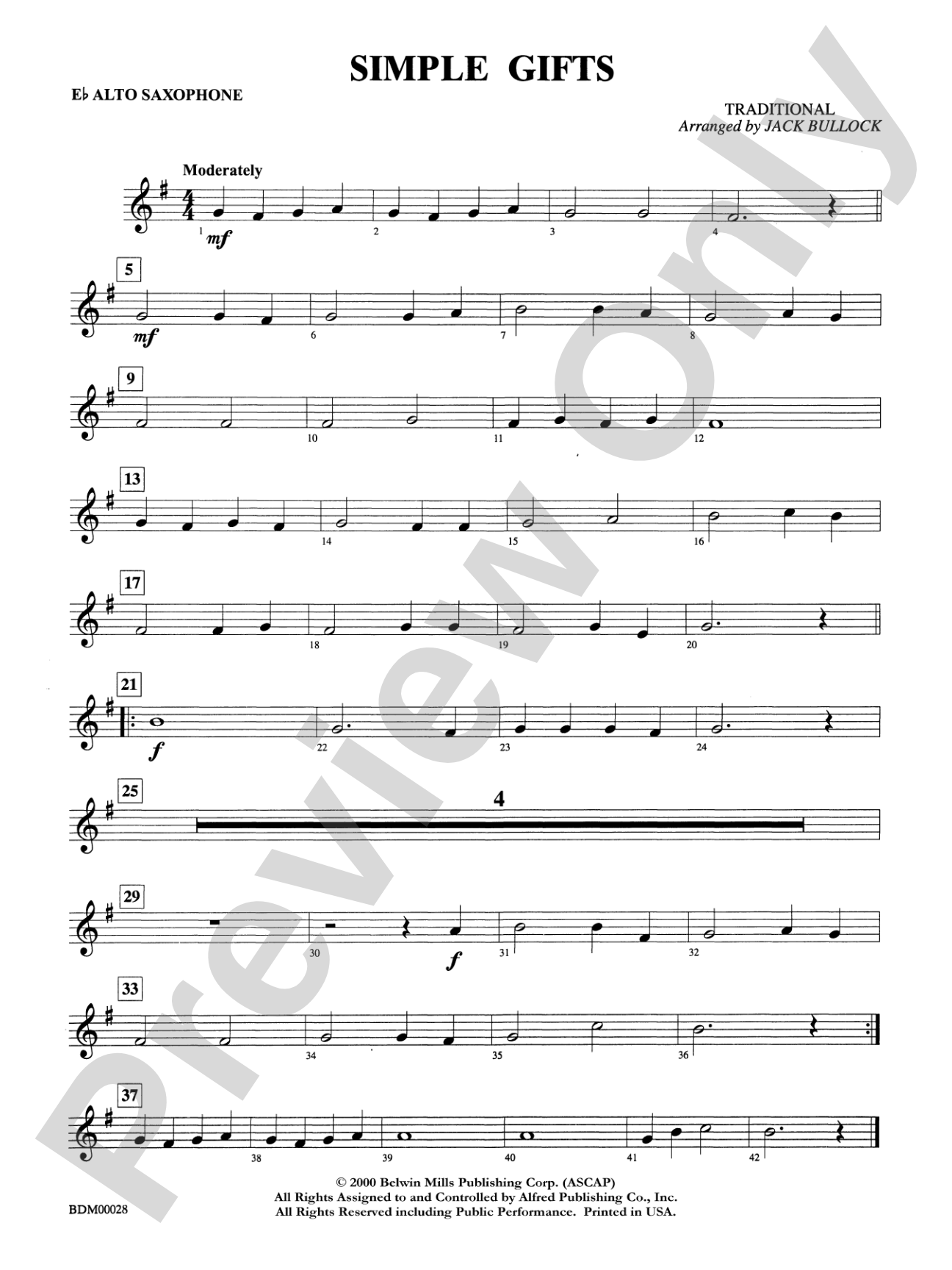

Simple Gifts: E-flat Alto Saxophone
Traditional / arr. Jack Bullock
Grade: 0.5 (Very Easy)
Item: 00-PC-0002122_AX1
$3.00
Pickup currently not available
Description
This grand traditional American folk song is suitable for every beginning band. The concrete scoring of the melody in a straightforward manner allows the flowing melody of sheer spender to dominate. Although it is set in 4/4 time, this arrangement, once mastered, would serve as a splendid introduction to cut-time. (2:00)


Don't just read it, hear it, play along with it, and watch your students grow with it. In MakeMusic Cloud, Simple Gifts: E-flat Alto Saxophone comes alive with professional accompaniment, adjustable tempo, and built-in practice tools that turn solo practice into real progress.
Open in the Player
Jump straight in and assign it today.
Start Your Free Trial
Open this title and explore the full library in minutes.
Sample Audio
1
Audio File
--:--
0:00
0:00
Sample Video
Additional Details
Series:
Belwin Very Beginning Band
Publisher:
Alfred Music
Page Count:
146
SKU:
00-PC-0002122_AX1
More about this title
About the Arranger: Jack Bullock

Jack Bullock is a composer and arranger whose work spans performance, education, and publication across multiple ensemble types. He earned degrees in music education through undergraduate, graduate, and doctoral study, and spent two decades teaching instrumental music in schools. His performance background includes study with prominent trumpet pedagogues and work with the Miami Philharmonic Orchestra and Miami Opera Company, alongside regional and touring ensemble experience.
Bullock's publishing catalog exceeds 600 arrangements and compositions for concert band, orchestra, jazz ensemble, and marching band. He served as assistant band director and chair of the Music Education Department at Ithaca College's School of Music, co-authored the Belwin 21st Century Band Method, and contributed arrangements to Alfred Music's Music Expressions curriculum. He has conducted clinics throughout North America and the United Kingdom and holds ASCAP membership since 1980.
Why we love this
This arrangement captures everything that makes "Simple Gifts" enduring: a melody so clear that even the youngest players hear themselves making music on day one. Bullock's scoring trusts the tune itself rather than burying it under counterpoint, which means your band sounds confident and musical immediately, something especially valuable at the start of a band program. The notation explicitly supports the transition from 4/4 to cut-time, turning a traditional folk melody into a bridge for an important conceptual leap.
What to expect
Familiar and uncluttered, like learning a folk song around a campfire rather than wrestling with a textbook exercise. The arrangement lets the melody breathe with an almost hymnal quality, giving players room to listen to their own sound and feel part of something whole from the very beginning.
Who it's for
Beginning concert bands in their first year, particularly those new to reading standard concert band notation and ensemble balance. This Grade 0.5 arrangement works equally well for younger players starting band and for adult community ensembles building foundational skills.
How to get the most out of it
- Shape the melody with consistent phrasing across sections; the simplicity of the writing means your students must create continuity through breath placement and dynamic control.
- Balance the accompaniment voices so the main line carries throughout; less is more with straightforward scoring like this, and restraint from the inner parts lets the melody shine.
- Once students master the 4/4 version, use it as the foundation for understanding cut-time by having them tap the half-note pulse while reading the existing part, building confidence before formally switching meters.
How to use it
Assign this early in the semester once students have basic instrument control and can read simple notation together; the accessibility makes it ideal for a first full-band rehearsal or an early concert. It also serves naturally as a bridge to more complex meters and arrangements later in the year, and its short duration (2:00) makes it a reliable festival or contest entry for developing bands.
Skills your students will build
- Reading parts written in concert band instrumentation and balance
- Sustaining long, flowing melodic lines with consistent tone
- Understanding ensemble blend between melody and accompaniment voices
- Foundational preparation for reading cut-time signatures
- Rhythmic precision in 4/4 time before meter transitions