Silverado: E-flat Baritone Saxophone Sheet Music Preview

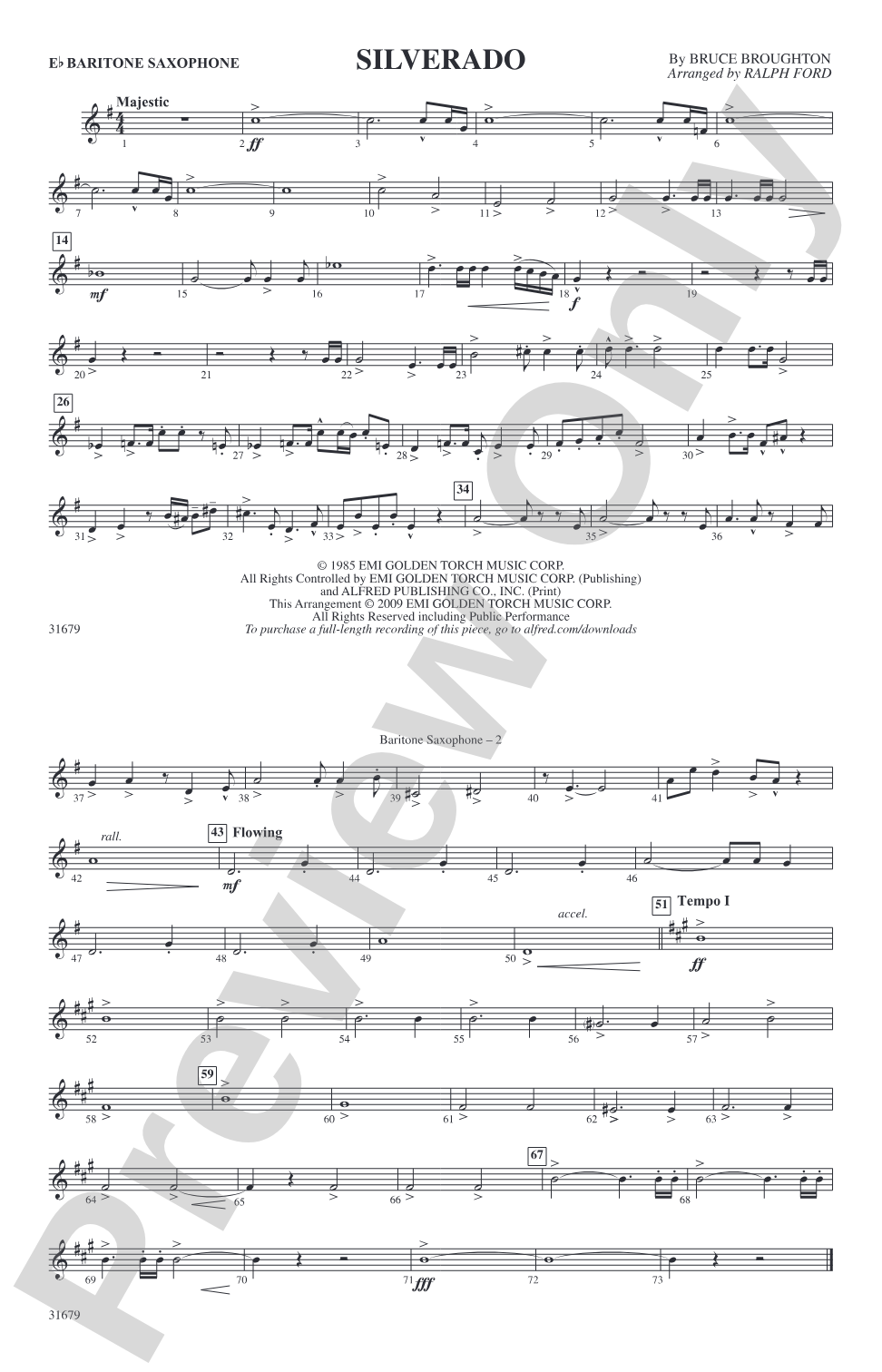
Silverado: E-flat Baritone Saxophone

By Bruce Broughton / arr. Ralph Ford

Grade: 4 (Advanced)

Item: 00-PC-0018200_BTX

Digital Download
$3.00
Description
Bring your show to a stunning conclusion with the spectacular music from the movie Silverado. Bruce Broughton's brilliant score really shines in the arranging hands of Ralph Ford! (3:15)

Don't just read it, hear it, play along with it, and watch your students grow with it. In MakeMusic Cloud, Silverado: E-flat Baritone Saxophone comes alive with professional accompaniment, adjustable tempo, and built-in practice tools that turn solo practice into real progress.

Sample Audio
0:00
0:00
Sample Video
Additional Details
Series: Diamond Series
Publisher: Alfred Music
Page Count: 244
SKU: 00-PC-0018200_BTX

More about this title

About the Composer: Bruce Broughton

Bruce Broughton

Bruce Broughton has spent decades creating music for film and television, from Oscar-nominated work on Silverado and Tombstone to Emmy-winning scores for series like JAG and The Orville. His catalog spans Disney theme park attractions, Steven Spielberg television projects, and concert works performed by major orchestras including the Cleveland Orchestra and Chicago Symphony.

Broughton's influence extends beyond the screen and stage. He serves as a board member of ASCAP and has held leadership roles in the Academy of Television Arts and Sciences and the Academy of Motion Picture Arts and Sciences. As a founding member and past president of The Society of Composers and Lyricists, he has shaped the profession itself.

Why we love this

Ralph Ford's arrangement captures the driving energy and cinematic sweep of Broughton's original Silverado theme while respecting the strengths of an advanced marching band. At Grade 4, the piece demands real musicianship from your ensemble while remaining achievable; this is music that sounds like a major motion picture moment when played well. The 3:15 duration gives you a finale that lands with genuine impact, not something that overstays its welcome.

What to expect

Riding fast across open country with purpose and determination. The music swells with heroic momentum, built on a foundation of Western imagery and Broughton's gift for creating themes that stick with you. There's a sense of adventure and forward motion throughout, punctuated by moments of orchestral grandeur that remind you this music came from a major film score.

Who it's for

Advanced high school marching bands and college ensembles with strong section leaders and solid intonation across all voices. This is ideal for groups comfortable with Grade 4 technical demands who want to program a recognizable, cinematic moment that audiences will respond to immediately.

How to get the most out of it

  • Balance the brass melody line with care. The theme needs clarity, but avoid letting the trumpets or French horns overpower the ensemble; use dynamic contrast to shape the phrasing rather than raw volume.
  • Keep the rhythmic foundation locked between percussion and low brass. The propulsive energy of this score depends on a rock-solid pulse, especially during faster passages.
  • Shape the opening bars to establish the Western character immediately. Broughton's orchestration calls for a sense of adventure, so let the ensemble breathe with the music rather than rushing.
  • Mark key dynamic transitions in rehearsal. This arrangement has considerable range, and your students need to understand where the piece builds and where it pulls back for maximum theatrical effect.

How to use it

Silverado works beautifully as a show finale or the centerpiece of a Western-themed program section. Pair it with other film or Americana repertoire, or let it stand alone as a high-energy closer that sends audiences home satisfied. The runtime and technical level make it equally suitable for spring concert finales or marching season feature spots.

Skills your students will build

  • Balancing melodic clarity with harmonic support in a large ensemble
  • Executing dynamic control across a wide range of volume and intensity
  • Maintaining ensemble rhythmic precision during syncopated and driving passages
  • Shaping phrasing in cinematic context (film music fundamentals)
  • Reading complex conductor scores with multiple instrument combinations

You May Also Like