
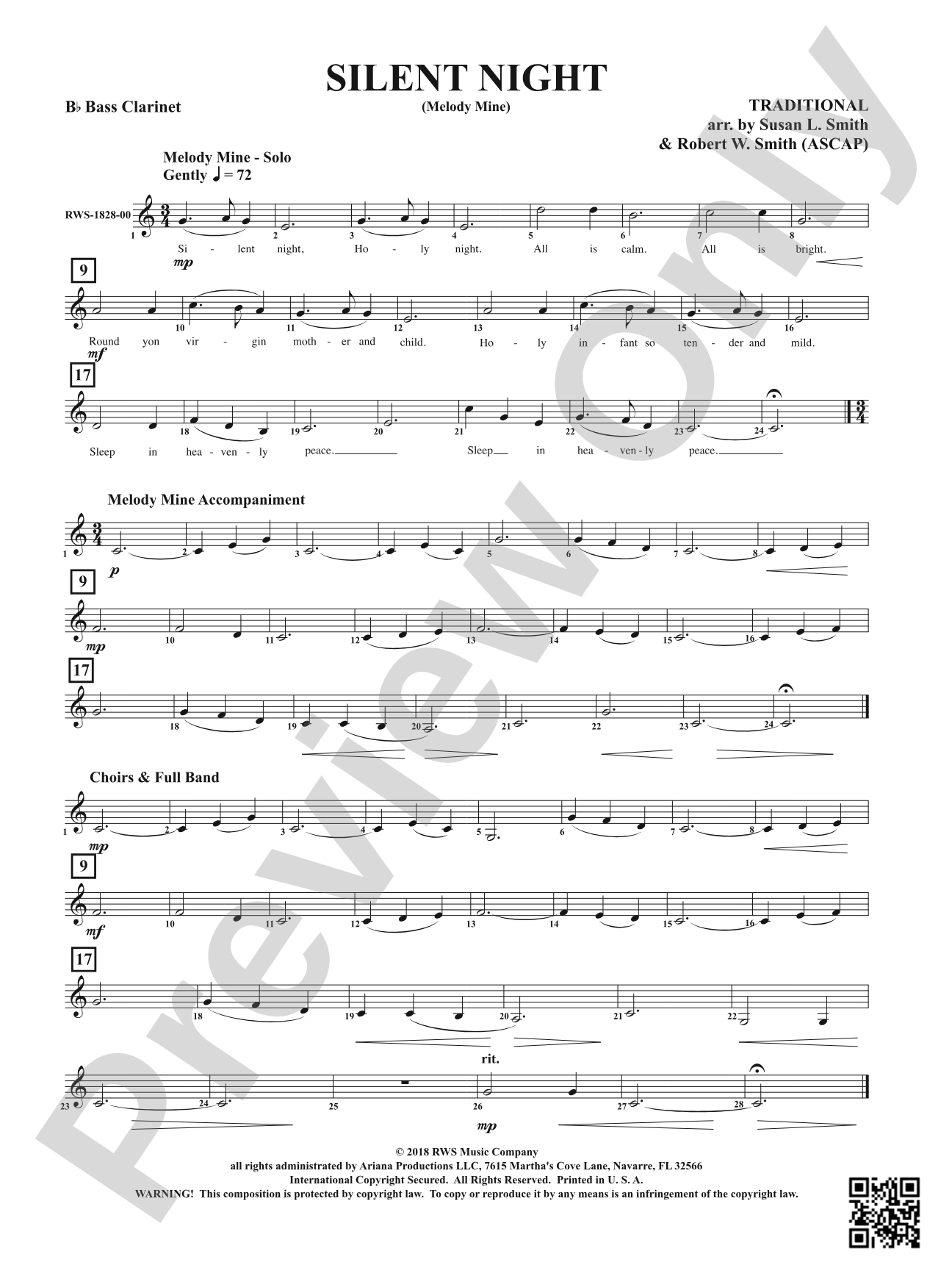

Silent Night - Melody Mine: B-flat Bass Clarinet
Melody Mine
Arranged by Robert W. Smith, Susan L. Smith
Grade: 1.5
Item: 98-PC-RWS1828_BC
$3.99
Pickup currently not available
Description
The "Melody Mine" gives each member of the band the opportunity to play the melodic line while the teacher focuses on phrasing, shaping and other core musical concepts. The full band arrangement provides a lush chorale setting of the Holiday classic. Teaching creativity is also a feature of each "Melody Mine" publication. The student and/or director has the option to craft their own arrangement to feature soloist(s), instrumental choirs and full band. Master teacher Susan L. Smith has created a powerful teaching resource for use in any young band program.
Original Item#: RWS-1828-00


Original Item#: RWS-1828-00
Silent Night - Melody Mine: B-flat Bass Clarinet isn't in MakeMusic Cloud just yet...but it could be. Let us know you'd like to see it, and you'll help shape what comes next. In the meantime, start a free trial and dive into thousands of interactive titles your students can play along with today.
Request This Title
Tell us you want it.
Start Your Free Trial
Explore everything that's ready to play right now.
Sample Audio
1
Alto Sax
--:--
2
Brass
--:--
3
CB
--:--
4
Euphonium
--:--
5
Flute
--:--
6
Full
--:--
7
Horn
--:--
8
Trumpet
--:--
9
Winds
--:--
Alto Sax
0:00
0:00
Sample Video
No sample videos found.
Additional Details
Series:
RWS - Beginning Band
Publisher:
RWS Music Company
SKU:
98-PC-RWS1828_BC
More about this title
About the Arranger: Robert W. Smith

Robert W. Smith has become a defining voice in American concert band and orchestral composition, with over 400 published works now central to repertoire in schools and performance halls worldwide. Educated at Troy State University (AL) and the University of Miami (FL), he has established himself as a clinician and conductor across North America, Europe, Australia, Asia, and beyond. His symphonies, including The Divine Comedy and The Odyssey, have reached audiences on multiple continents, while his works for developing ensembles have become foundational teaching materials in band programs everywhere.
Smith's versatility extends far beyond the concert hall. His compositions and arrangements have appeared on major television broadcasts, from ceremonial broadcasts honoring presidential visits to the Macy's Thanksgiving Day Parade, the Olympic Games, and Opening Day at Dodger Stadium. This combination of artistic depth and cultural reach makes his approach to arranging both musically rich and pedagogically grounded.
Why we love this
Smith and his collaborator Susan L. Smith have designed this arrangement to do something rare: it rotates the melodic line through the entire band rather than locking it in one section, which means every student experiences musical leadership at some point during rehearsal. The full chorale setting supports young musicians' understanding of harmony and voicing without overwhelming them, and the built-in flexibility to create custom arrangements with soloists or instrumental choirs transforms this single carol into a springboard for your own creative programming.
What to expect
A gentle, warm arrangement that lets the familiar melody shine through while surrounding it with supportive harmonic voices. The Grade 1.5 level keeps technical barriers low, so students can focus on listening to each other, responding to dynamic shaping, and understanding how a solo line lives within a full ensemble.
Who it's for
Beginning band directors who want their students to experience phrasing and musical leadership without sacrificing the joy of playing a recognizable holiday standard. This works equally well for a winter concert, a holiday assembly, or a shorter community performance where technical demands won't overshadow musicianship.
How to get the most out of it
- Rotate who plays the melody across different rehearsals so each section gains ownership of the line and understands how the supporting voices must respond dynamically
- Shape the phrase endings by having the melody player lead a slight ritard or diminuendo; the rest of the band should follow that gesture, creating cohesion without explicit conducting
- Use the chorale texture to teach blend by having each harmonic section focus on matching tone color with adjacent parts rather than standing out individually
How to use it
Feature this in a winter concert by pairing it with a non-holiday opening number; the tonal shift to a carol provides a natural moment for audience connection. If your band is still solidifying fundamentals in early December, this piece gives you a meaningful concert goal without requiring extended rehearsal time on complex rhythmic or technical material.
Skills your students will build
- Playing a sustained melodic line with clear phrasing
- Listening to and supporting a featured voice in an ensemble setting
- Understanding harmonic function (how supporting parts relate to the melody)
- Responding to dynamic and expressive shaping cues from the melody player
- Rotating leadership roles within an ensemble