
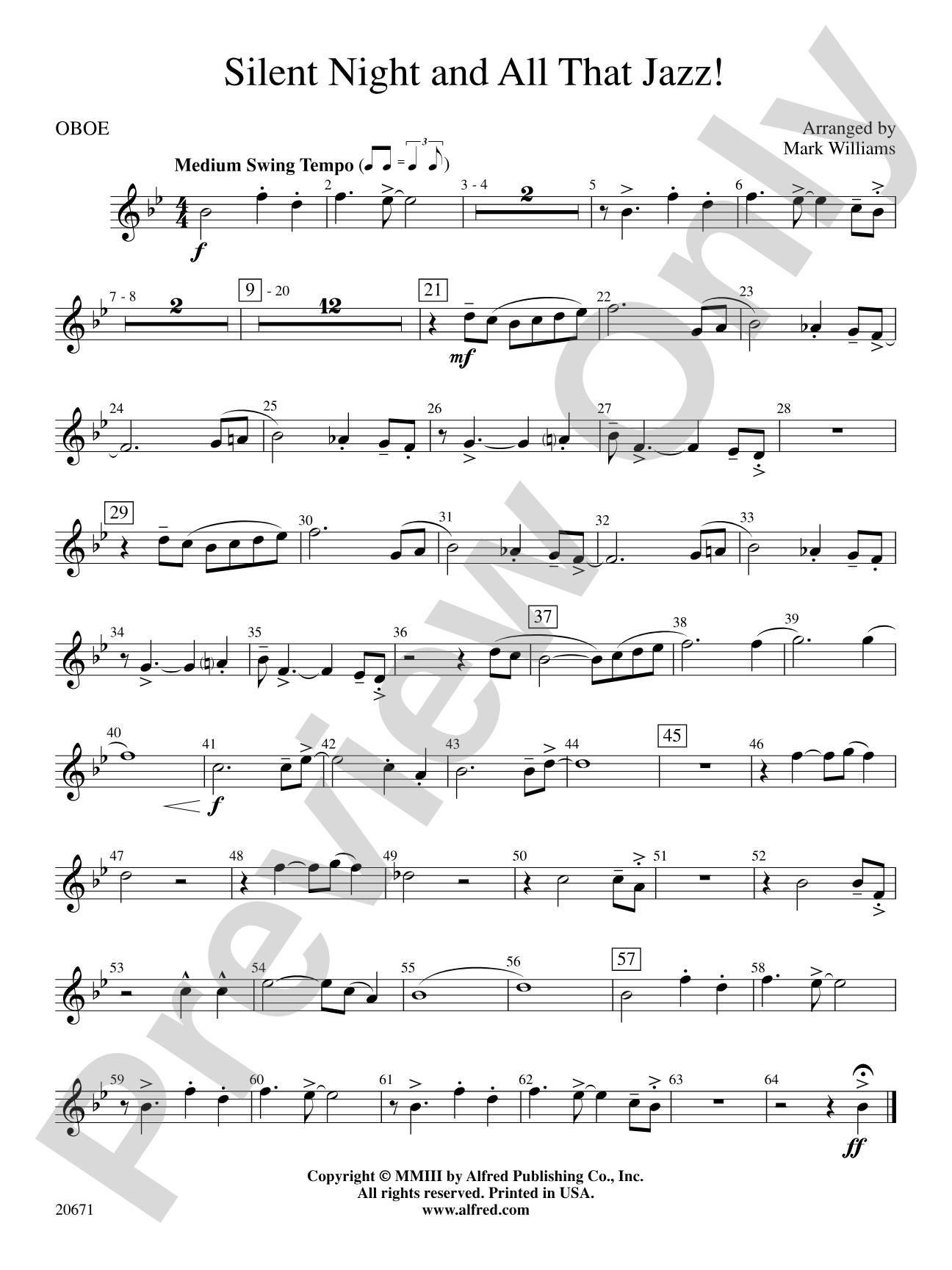

Silent Night & All That Jazz!: Oboe
Arr. Mark Williams
Grade: 1.5 (Easy)
Item: 00-PC-0000426_O1
$3.00
Pickup currently not available
Description
Ho, ho, ho and feel that swingin' beat! "Silent Night" and "The First Noel" really swing in this creative treatment of those favorite Christmas carols. Your students will love the jazz rhythms and harmonies, while your audiences will be tappin' their toes! A great introduction to swing eighth notes for the young band.


Don't just read it, hear it, play along with it, and watch your students grow with it. In MakeMusic Cloud, Silent Night & All That Jazz!: Oboe comes alive with professional accompaniment, adjustable tempo, and built-in practice tools that turn solo practice into real progress.
Open in the Player
Jump straight in and assign it today.
Start Your Free Trial
Open this title and explore the full library in minutes.
Sample Audio
1
Audio File
--:--
0:00
0:00
Sample Video
No sample videos found.
Additional Details
Series:
Challenger Band Series
Publisher:
Alfred Music
Page Count:
118
SKU:
00-PC-0000426_O1
More about this title
About the Arranger: Mark Williams

Mark Williams built his reputation as one of the most prolific and respected voices in school band composition, with more than 200 published works spanning band, orchestra, and choir. His co-authorship of the Accent on Achievement Band Method established his influence on instrumental pedagogy, and his career included appointments as clinician and guest conductor across 34 states, five Canadian provinces, and Australia. Williams spent his teaching years in Washington state, where he focused on elementary band instruction and earned recognition including the Gralia Competition award and multiple ASCAP Special Awards.
Beyond the page, Williams was an active performer on bassoon and served as conductor and artistic director for the Spokane British Brass Band. His military service as woodwind performer and arranger for the 560th Air Force Band shaped his understanding of ensemble balance and orchestration. A graduate of Eastern Washington University with degrees in Education and Music Education, Williams combined his classroom experience with his compositional voice to create works that meet young musicians where they are.
Why we love this
Williams has crafted an arrangement that makes swing feel natural rather than forced for young players. The Grade 1.5 scoring keeps technical demands low while the jazz harmonies and rhythmic treatment give your band something genuinely fresh to perform, not just a holiday obligation. Your students will discover swing eighth notes through real music they actually want to play.
What to expect
The familiar comfort of two beloved Christmas melodies collides with the energy and syncopation of a jazz club. The harmonies are warm and recognizable but playful, swinging with the kind of ease that makes both players and listeners feel the groove immediately. It's church hymns trading their formality for a tuxedo and a grin.
Who it's for
Young concert bands (middle school and early high school) encountering jazz styles for the first time, particularly ensembles seeking approachable yet stylistically authentic repertoire. This arrangement works equally well for conductors introducing swing eighth notes and jazz harmonies in a full ensemble context.
How to get the most out of it
- Establish the swing feel in rehearsal by conducting the subdivision; get your students hearing the triplet-based eighth note pattern before they play a note.
- Balance the melody with the supporting harmony voices so the familiar carol melodies stay front and center even with the jazz harmonization underneath.
- Encourage the rhythm section to lock the groove early; a solid foundation in drums and low brass makes the swing feel confident and releases the rest of the band to relax into the style.
- Let the audience hear the contrast between pieces. The arrangement's arrangement invites a brief textural shift, so shape each carol with attention to dynamics and ensemble color.
How to use it
Program this as the centerpiece of a winter concert when you want to showcase your band's range, placing it between a traditional march and a lyrical ballad to demonstrate versatility. The accessibility and audience appeal make it an excellent choice for holiday fundraisers, pep assemblies, or community performances where you need something joyful, stylistically interesting, and immediately engaging.
Skills your students will build
- Swing eighth-note interpretation and feel
- Jazz harmony and chord movement
- Rhythmic independence within syncopated contexts
- Ensemble balance with non-traditional voicing and texture
- Stylistic flexibility and genre awareness