Silent Night Sheet Music Preview

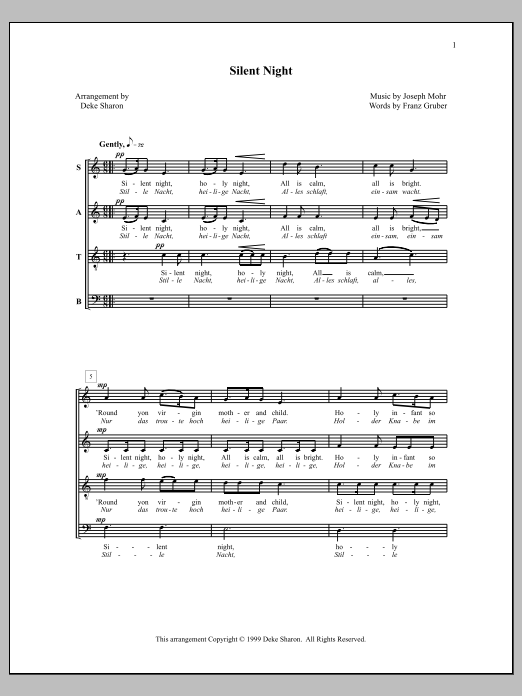
Silent Night: SATB Choral Octavo

As performed by Joseph Mohr / As performed by Franz Gruber / As performed by Anne Raugh / Arranged by Deke Sharon

Item: 35-DS00295152

Digital Download
$2.99
Description

Silent Night: SATB Choral Octavo isn't in MakeMusic Cloud just yet...but it could be. Let us know you'd like to see it, and you'll help shape what comes next. In the meantime, start a free trial and dive into thousands of interactive titles your students can play along with today.

Sample Audio
No sample audio found.
Sample Video
Additional Details
Publisher: Hal Leonard
Page Count: 4
SKU: 35-DS00295152

More about this title

About the Artist: Joseph Mohr

Joseph Mohr was an Austrian Catholic priest who wrote the text to 'Silent Night' on Christmas Eve 1818, just hours before the piece premiered at St. Nicholas Church in Oberndorf. His poem emerged from a moment of spiritual reflection, capturing the peace and reverence of the nativity with language both simple and profound. Though Mohr spent most of his ministry in small Alpine parishes, his words have become central to how millions of people experience Christmas.

Why we love this

Deke Sharon's arrangement strips this beloved carol to its essential emotional core, letting the SATB voices create intimacy rather than grandeur. The a cappella setting demands genuine musicianship from singers; there's nowhere to hide, which makes it an excellent litmus test for blend, intonation, and phrase shaping. If you're programming a concert that needs a moment of authentic stillness, this delivers it without relying on production values.

What to expect

There's a crystalline quality to this setting; every note counts, and the four voices create a gentle luminescence rather than a wash of sound. Singing it feels meditative, almost like an act of listening as much as performing. The simplicity of the arrangement paradoxically deepens the text's emotional resonance.

Who it's for

SATB choirs at intermediate to advanced levels who want to include a meaningful carol without relying on instrumental support. This arrangement suits holiday concerts, winter programs, or any concert that benefits from a reflective moment with strong musical substance.

How to get the most out of it

  • Shape each phrase as though it's a single breath, even where commas might tempt you to fracture the line. The melody should feel continuous and unhurried.
  • Anchor the soprano line lightly; let other voices support rather than accompany. This balance determines whether the arrangement feels like four voices singing together or four voices backing up a melody.
  • Resist the urge to make dynamics lush. A cappella 'Silent Night' works best when each voice is singing with intention rather than volume; soft doesn't mean indistinct.
  • Lock in the harmonic rhythm as an ensemble before rehearsing interpretive choices. Once the chord changes are secure, musicality emerges naturally.

How to use it

Place this late in your concert, after more energetic repertoire. Its effectiveness depends on contrast and on an audience that's ready to receive something quiet. It also works beautifully as an encore or as the opening gesture if your concert is built around a theme of reflection or spirituality.

Skills your students will build

  • A cappella intonation and blend in four-part harmony
  • Phrase shaping without instrumental reference
  • Balancing soprano melody against supporting voices
  • Sustained vowel consistency across dynamic changes
  • Harmonic awareness and vertical listening

You May Also Like