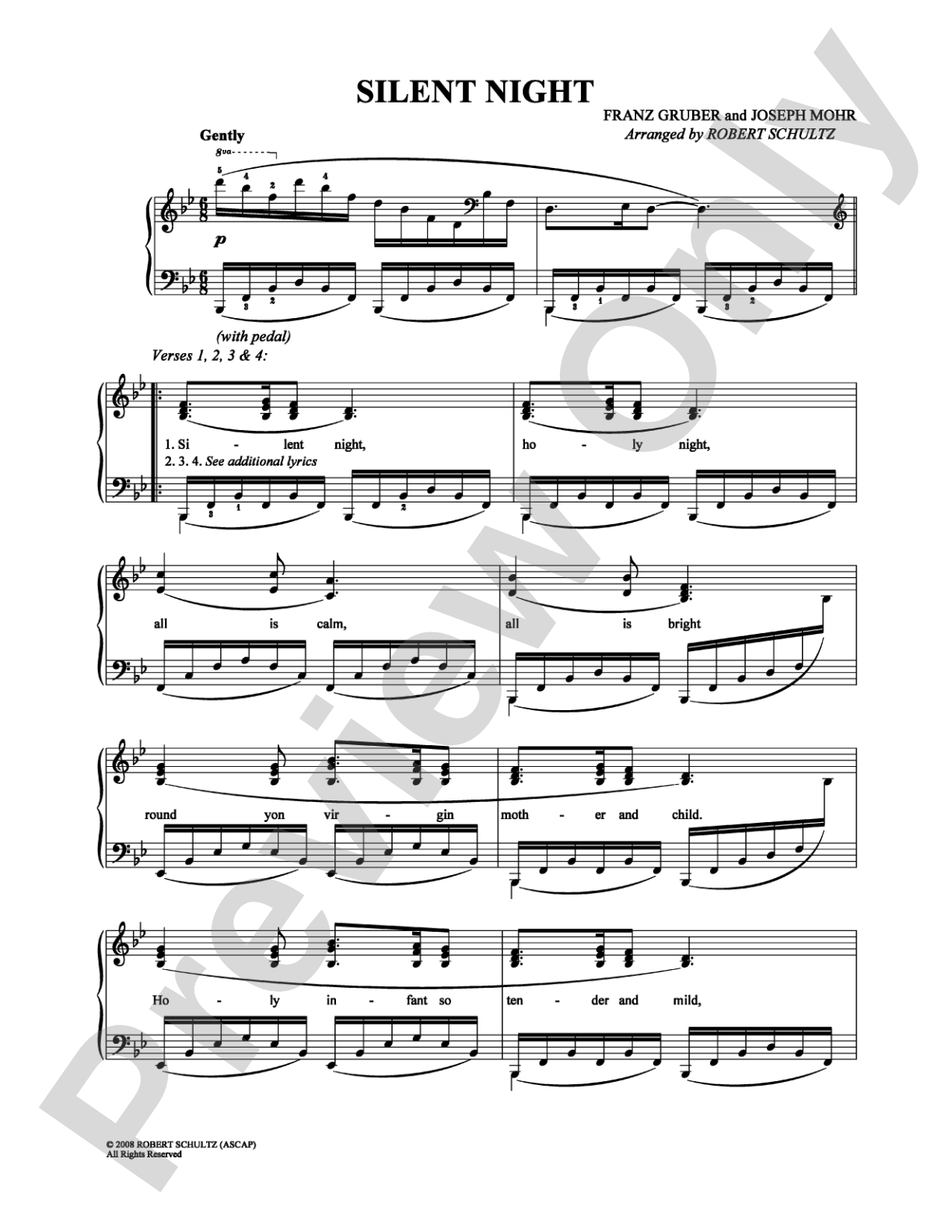
Silent Night: Piano/Vocal/Chords Digital Sheet Music

Silent Night: Piano/Vocal/Chords Digital Sheet Music

Franz Gruber, Joseph Mohr

Item: 00-PS-0001286

Digital Download
$3.99
Description

Silent Night: Piano/Vocal/Chords Digital Sheet Music isn't in MakeMusic Cloud just yet...but it could be. Let us know you'd like to see it, and you'll help shape what comes next. In the meantime, start a free trial and dive into thousands of interactive titles your students can play along with today.

Sample Audio
No sample audio found.
Sample Video
Additional Details
SKU: 00-PS-0001286

More about this title

About the Creator: Franz Xaver Gruber

Franz Xaver Gruber composed "Silent Night" in 1818 for a small parish church in Oberndorf, Austria, creating one of the world's most beloved Christmas melodies. Written in just a few hours to accompany Joseph Mohr's poem, the carol emerged from genuine pastoral need and has since become a cornerstone of holiday music across cultures and denominations.

Why we love this

This arrangement gives singers and pianists immediate access to one of the most universally recognized melodies in the holiday repertoire, with chord symbols that make transposition and accompaniment flexibility straightforward. The piano/vocal format works equally well for a featured soloist, small ensemble, or as a congregational resource where accompaniment support is essential.

What to expect

Serene and reverent, with the gentle simplicity that has made this carol endure for nearly two centuries. The melody floats naturally above straightforward harmonic support, inviting singers to shape the phrase with warmth rather than technical display.

Who it's for

Solo singers preparing a holiday recital solo or church service feature, piano teachers looking to pair singers with accompaniment, and pianists who want a reliable, portable arrangement for seasonal performances.

How to get the most out of it

  • Balance the vocal line so it sits comfortably above the piano texture without overwhelming the intimate quality the piece demands.
  • Use the chord symbols to explore rubato in the accompaniment; slight flexibility in the piano part can enhance the reflective character while keeping the singer anchored.
  • Consider the range and tessitura for your vocalist; transposition using the chord symbols allows you to find the optimal key without rearranging.

How to use it

Slot this into a holiday concert as a restful contrast to more elaborate seasonal selections, or use it as a flexible opening or closing number where a small group of singers and a single pianist can create an effective moment without elaborate staging. It works beautifully in worship settings, holiday gatherings, and recitals where intimacy matters more than spectacle.

Skills your students will build

  • Reading chord symbols and understanding harmonic function
  • Balancing melody and accompaniment in a piano/vocal texture
  • Phrasing and breath management in a legato melodic line
  • Interpreting and executing transposition using chord charts

You May Also Like