
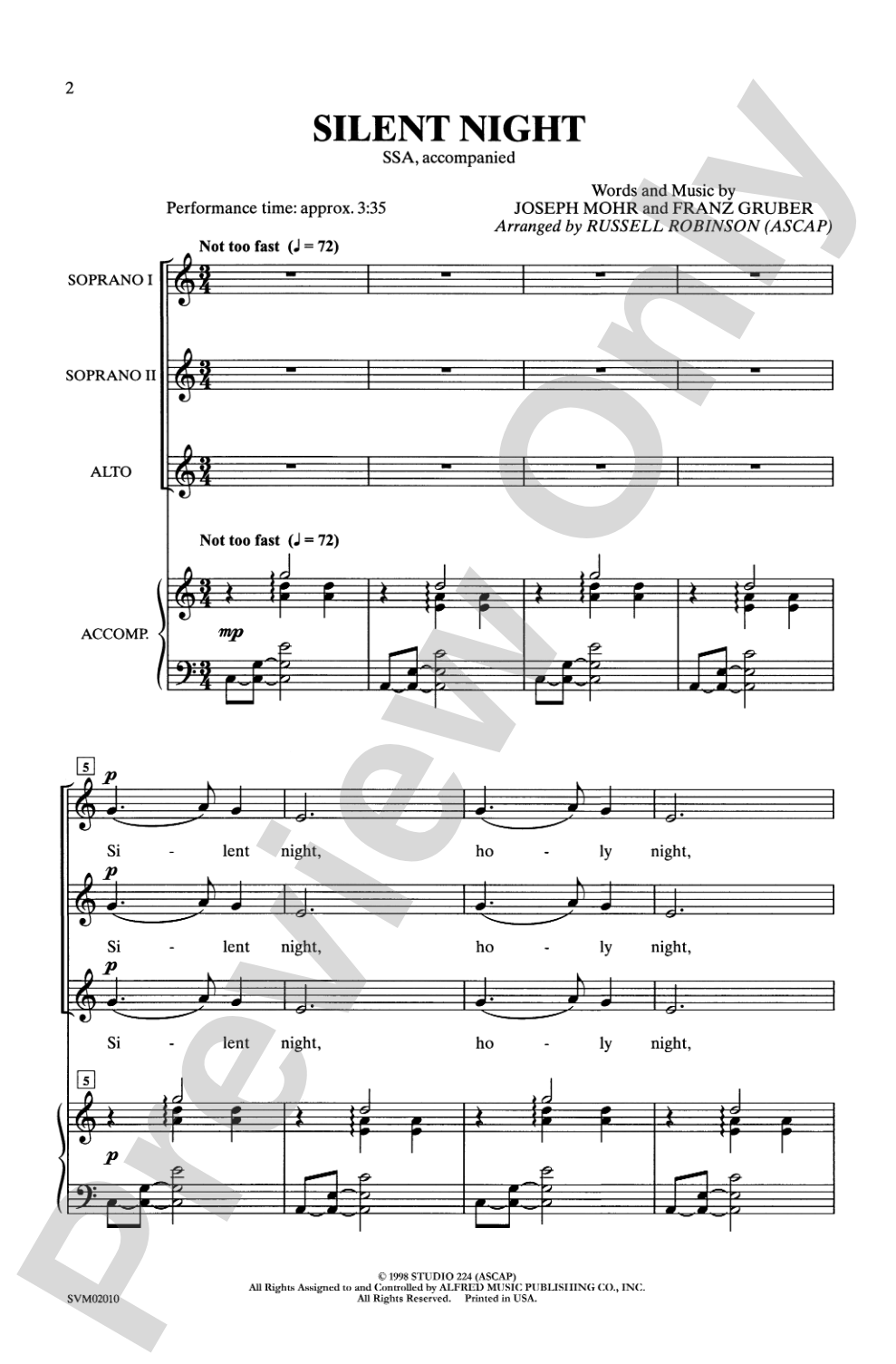
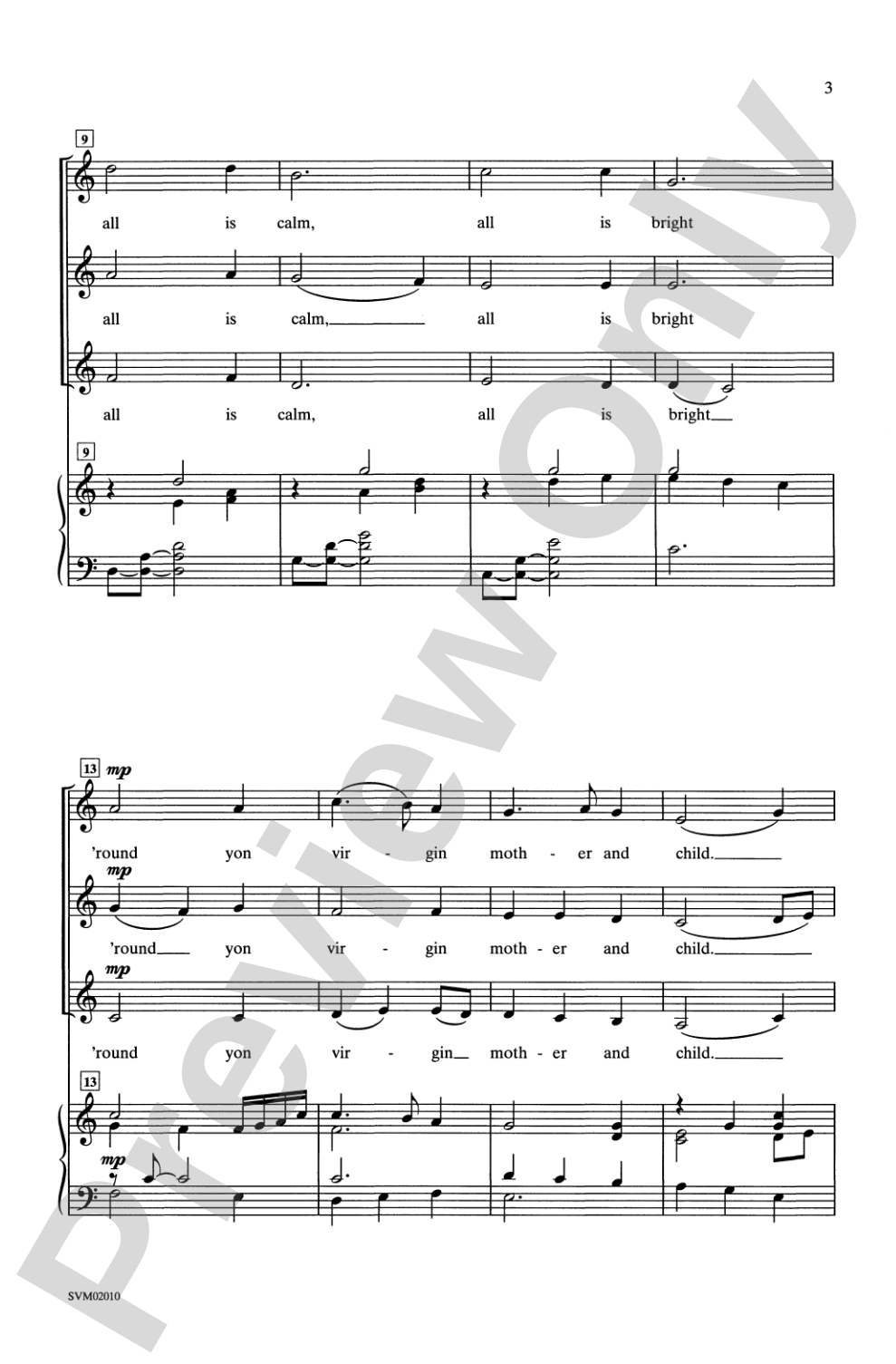
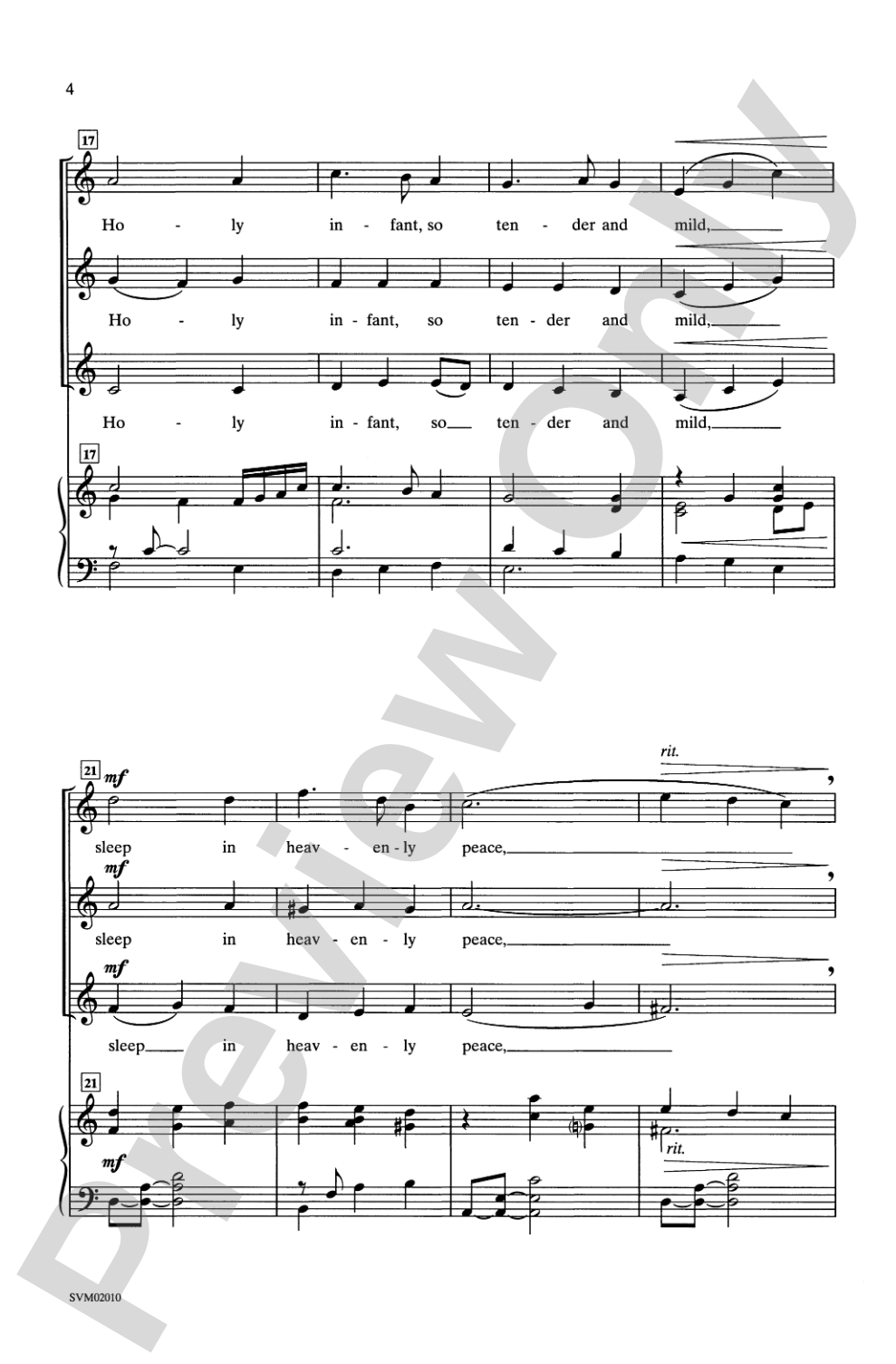

Silent Night: SSA Choral Octavo
Words and music by Joseph Mohr and Franz Gruber / arr. Russell Robinson
Level: Moderate
Item: 00-PO-0002790
$2.25
Minimum order quantity: 20 copies
Pickup currently not available
Description
"Silent Night" is one of the most widely performed standard Christmas carols. Russell Robinson's arrangement offers wonderfully rich scoring that showcases all voices. At last he introduces a SSA version that is sure to be performed by choirs all around the world like his previous voicings. Don't perform a holiday concert without it!


Silent Night: SSA Choral Octavo isn't in MakeMusic Cloud just yet...but it could be. Let us know you'd like to see it, and you'll help shape what comes next. In the meantime, start a free trial and dive into thousands of interactive titles your students can play along with today.
Request This Title
Tell us you want it.
Start Your Free Trial
Explore everything that's ready to play right now.
Sample Audio
1
Audio File
--:--
0:00
0:00
Sample Video
No sample videos found.
Additional Details
Series:
Alfred Archive Edition: Studio PR Catalog
Publisher:
Alfred Music
Page Count:
12
SKU:
00-PO-0002790
More about this title
About the Composer: Joseph Mohr
Joseph Mohr (1792-1848) was an Austrian Catholic priest whose literary gift extended to sacred poetry. On Christmas Eve 1816, he wrote the text for "Stille Nacht" as a gift for his church in Oberndorf, Austria. His words captured the quiet reverence of the nativity with an economy of language that has made the poem enduringly singable across centuries and cultures.
Franz Gruber (1787-1863) was an Austrian organist and schoolteacher who composed the melody just hours after receiving Mohr's poem. The simple, haunting tune Gruber created transformed Mohr's words into one of the world's most recognizable melodies. Together, their collaboration produced a carol that transcends denominational and linguistic boundaries.
Why we love this
Russell Robinson's SSA arrangement strips away the overstuffed orchestrations you often hear and returns to what makes this carol essential: clarity and warmth across all three voices. The scoring genuinely serves the text rather than burying it, which means even your youngest singers feel like they're making something beautiful rather than reading notes. This is the version that justifies programming "Silent Night" at all.
What to expect
Hushed and reverent, the opening lines settle into the stillness of a winter night. Warm harmonic color fills each phrase without fussiness; the arrangement lets the familiar melody speak while surrounding it with gentle support. By the final verse, you feel less like you're performing and more like you're witnessing something sacred.
Who it's for
This arrangement serves choirs with treble voices ranging from emerging middle school singers to experienced adult ensembles. At Grade 3, it sits comfortably for groups with basic sightreading skills and secure intonation, yet remains musically dignified enough for concert performance. Any choir looking for a "Silent Night" that honors both the text and the singers' voices belongs here.
How to get the most out of it
- Shape the opening phrases with a single warm breath; resist the urge to chop between poetic lines, letting the melody breathe as one continuous thought.
- Balance the vocal lines by allowing the altos to anchor the harmony without pushing; they support, not compete with, the sopranos' line.
- Sustain the final cadence fully and let the diminuendo happen in the last two beats rather than bleeding tone away measure by measure.
- If the arrangement includes divisi passages, rehearse both parts simultaneously so singers understand the harmonic context and blend remains unified when parts split.
How to use it
This belongs in the middle or near the closing of a holiday concert, where its gentleness can settle an audience after more energetic carols. It pairs naturally with a brief instrumental prelude or follows a brief spoken reflection. Consider it your moment of communal stillness before the final celebratory send-off.
Skills your students will build
- Sustaining tone through long phrases without break
- Blending voices in close harmony across three parts
- Shaping a familiar melody with renewed musical intention
- Balancing SSA divisi passages for unified sound