

Sigh No More, Ladies: TBB Choral Octavo
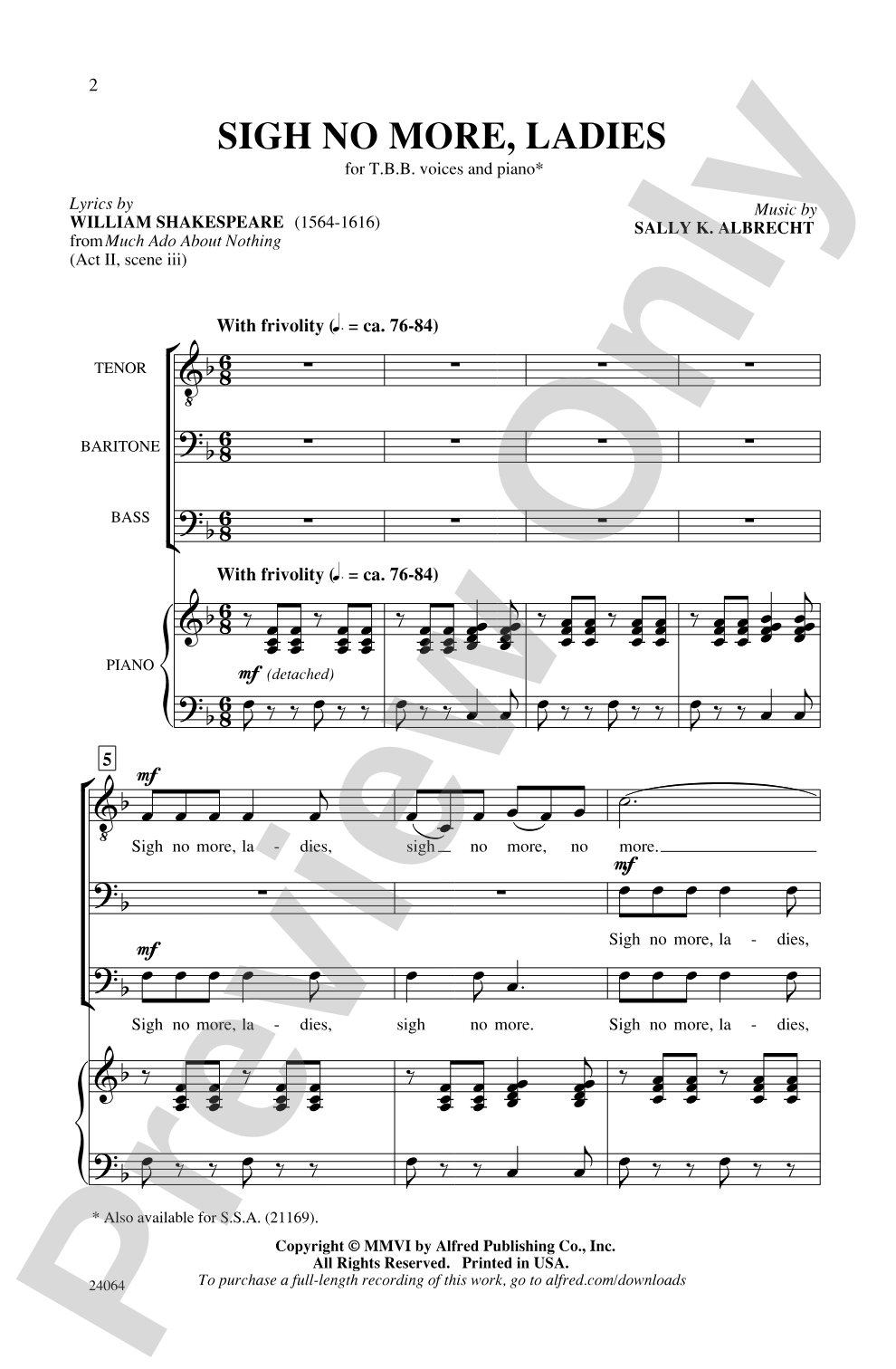
Text from William Shakespeare’s "Much Ado About Nothing," music by Sally K. Albrecht
Item: 00-PO-0000097
$2.25
Minimum order quantity: 20 copies
Pickup currently not available
Description
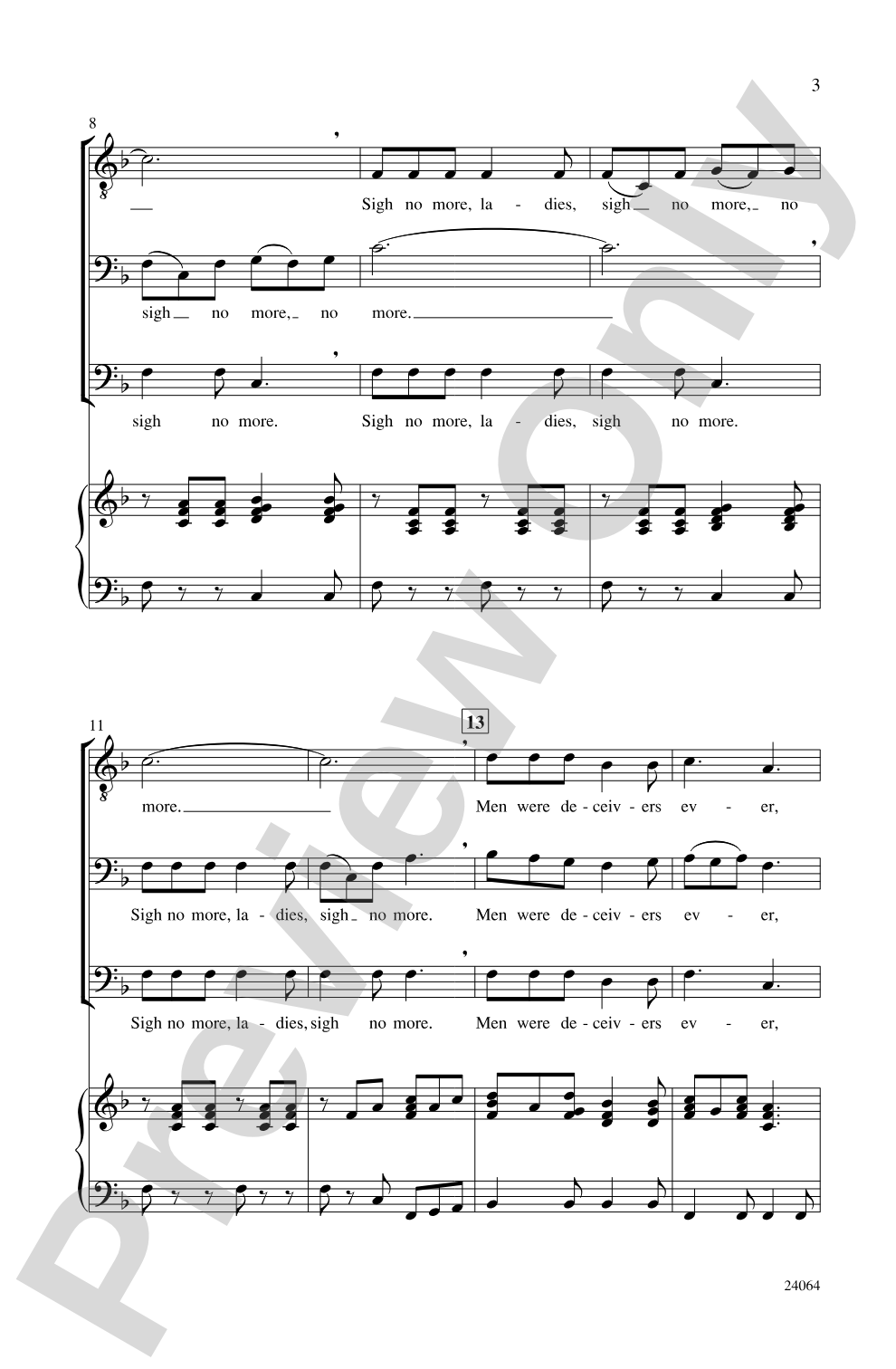
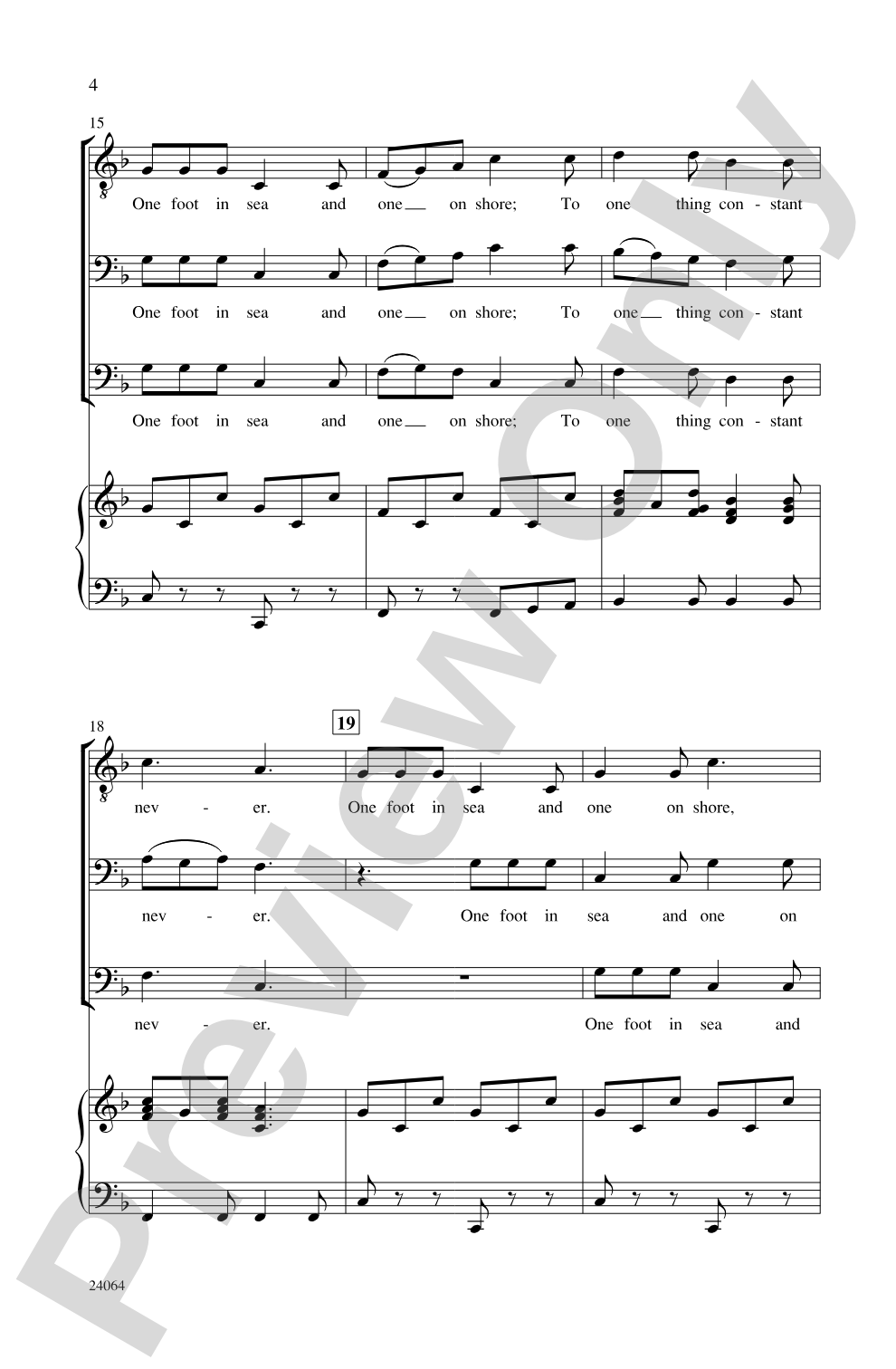
Sally Albrecht has taken a famous text from Much Ado About Nothing and set it to a charming, original melody for SSA voices. The piece has a madrigal-like quality, complete with a "hey nonny, nonny" section. It's a light commentary on men who are "deceivers ever; one foot on sea and one on shore." Fresh choral writing for SSA groups of any age.


Sigh No More, Ladies: TBB Choral Octavo isn't in MakeMusic Cloud just yet...but it could be. Let us know you'd like to see it, and you'll help shape what comes next. In the meantime, start a free trial and dive into thousands of interactive titles your students can play along with today.
Request This Title
Tell us you want it.
Start Your Free Trial
Explore everything that's ready to play right now.
Sample Audio
1
Audio File
--:--
0:00
0:00
Sample Video
No sample videos found.
Additional Details
Series:
Alfred Archive Edition: Alfred Choral Designs
Publisher:
Alfred Music
Page Count:
12
SKU:
00-PO-0000097
More about this title
About the Composer: Sally K. Albrecht

Sally K. Albrecht stands among the most prolific and respected voices in choral music education. Since 1987, she has received the ASCAP Special Music Award annually and currently has over 600 choral works in print, along with 75 larger musicals and songbooks. Her work as Director of School Choral, Vocal, and Elementary Publications at Alfred Music shaped the landscape of accessible, engaging choral literature for decades.
Beyond her compositional output, Albrecht has distinguished herself as a conductor and clinician, leading honor choirs at major venues including Lincoln Center, Carnegie Hall, and The Kennedy Center. She holds degrees from Rollins College (B.A. in Music and Theater, 1976) and the University of Miami (M.A. in Drama, 1977; M.M. in Accompanying, 1979). Her leadership extends to service as Chair of the Board of Trustees for the Omicron Delta Kappa National Leadership Honor Society, for which she received the Pillar of Leadership award. In 2021, both the University of Miami Frost School of Music and Rollins College honored her with Distinguished Alumna Awards.
Why we love this
Albrecht brings genuine theatrical flair to Shakespeare's text without overshadowing the poetry. The madrigal-style setting, complete with its playful "hey nonny, nonny" refrain, captures the comic bite of the original while remaining accessible to singers of varying ages and experience levels. This is the kind of piece that reminds students why they love singing together.
What to expect
Light and witty, with an old-world madrigal sensibility that never feels stuffy. The melody draws you in with its charm, while the "hey nonny, nonny" refrain invites singers into a knowing conversation about love and deception. There's real joy in the music, along with a subtle satirical edge that rewards careful attention to the text.
Who it's for
TBB choirs seeking fresh, modern arrangements of classical texts will find immediate appeal here. The piece works equally well for middle school ensembles discovering madrigals and high school or community choirs that want something charming without being precious. Singers of any age benefit from exploring Shakespeare through music that respects both his language and contemporary choral aesthetics.
How to get the most out of it
- Shape the "hey nonny, nonny" sections with clear articulation and rhythmic precision; these moments are where the madrigal character really comes alive.
- Balance the three treble parts so that the text remains intelligible, especially during the commentary on men's deceptiveness.
- Allow time in rehearsal to unpack Shakespeare's wit. Singers who understand the satirical edge will perform with greater conviction and humor.
- Experiment with light, buoyant tempos that keep the piece moving without sacrificing textual clarity.
How to use it
This pairs beautifully on a program exploring Shakespeare in music, or alongside other secular choral works with literary roots. Consider it for spring or winter concerts where you want to balance heavier repertoire with something that audiences will find immediately accessible and entertaining. The piece also works well in educational settings where you're teaching madrigal tradition and style.
Skills your students will build
- Madrigal style and historical performance conventions
- Clear diction in English text with literary context
- Balancing three independent voice parts while maintaining text clarity
- Interpreting satirical humor and dramatic intent through music