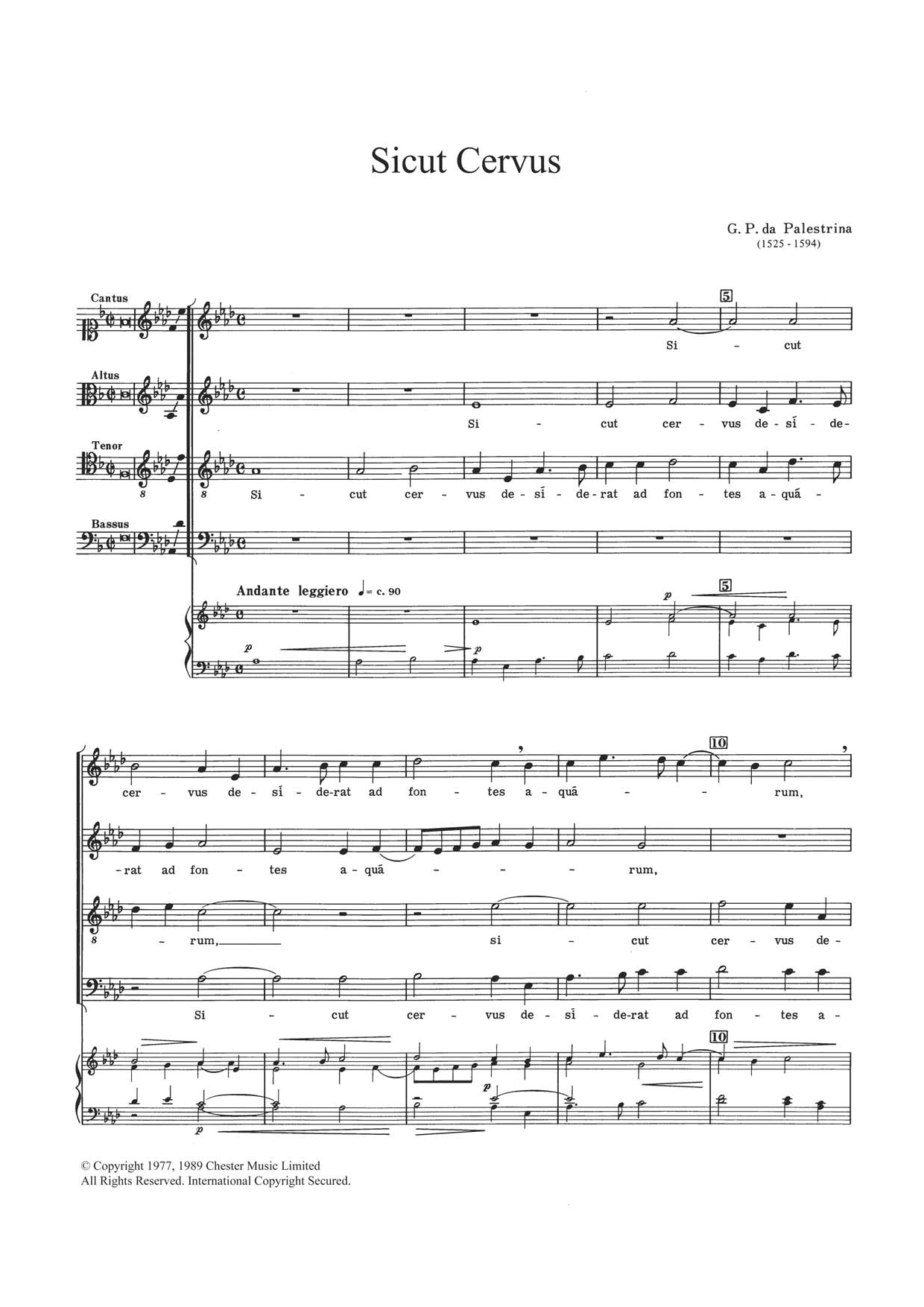
Sicut Cervus Sheet Music Preview

Sicut Cervus: Choral Octavo

As performed by Giovanni Palestrina

Item: 35-DS00338097

Digital Download
$2.99
Description

Sicut Cervus: Choral Octavo isn't in MakeMusic Cloud just yet...but it could be. Let us know you'd like to see it, and you'll help shape what comes next. In the meantime, start a free trial and dive into thousands of interactive titles your students can play along with today.

Sample Audio
No sample audio found.
Sample Video
Additional Details
Publisher: Hal Leonard
Page Count: 4
SKU: 35-DS00338097

More about this title

About the Artist: Giovanni Palestrina

Giovanni Palestrina (1525-1594) stands as one of the Renaissance's most influential composers, known for his mastery of polyphonic writing and his central role in shaping the Catholic Church's musical aesthetic during the Counter-Reformation. His sacred works, characterized by crystalline voice leading and spiritual clarity, became the model for generations of composers and remain essential to any serious choral program. Palestrina's music exemplifies the principle that contrapuntal sophistication and emotional directness are not mutually exclusive; his pieces speak with profound simplicity while demonstrating technical brilliance.

Why we love this

This motet distills everything remarkable about Renaissance polyphony into four pages of pure musical substance. Your singers will encounter one of the most recorded sacred texts in choral history, and performing it themselves transforms their understanding of how independent lines create harmonic richness without abandonment of line.

What to expect

The opening unfolds with contemplative grace as voices enter in gentle succession, creating a sense of light gradually illuminating a space. By the middle of the piece, the full harmonic palette emerges with a warmth and inevitability that feels both inevitable and surprising, like discovering something essential you always knew.

Who it's for

This octavo works equally well for high school honor choirs, collegiate singers developing Renaissance technique, and adult community ensembles seeking accessible yet musically substantial repertoire. Singers need secure musicianship and comfort with four-part writing but do not require advanced sight-reading skills.

How to get the most out of it

  • Shape each voice's arc independently; resist the urge to interpret this as homophonic or block-like, even when voices move together. Each line has its own narrative arc that must breathe.
  • Balance the lower voices carefully, particularly the entries that appear later in the piece. Under-rehearsed bass and tenor sections often disappear into the accompaniment.
  • Find the natural breathing points at phrase endings rather than at bar lines. Renaissance phrasing follows text and musical gesture, not measure structure.

How to use it

Pair this with other Renaissance motets to create a focused liturgical or concert segment, or use it as a centerpiece in a program exploring polyphonic writing across centuries. It also functions beautifully as a shorter, more accessible alternative to longer sacred choral works when time constraints demand something substantive but efficient.

Skills your students will build

  • Independent voice leading in four-part polyphony
  • Sustaining long phrases without rhythmic collapse
  • Balancing equal importance among four voice parts
  • Singing Renaissance text underlay with proper phrasing
  • Listening horizontally while maintaining harmonic awareness

You May Also Like