Sicilienne: Violin 2 Sheet Music Preview

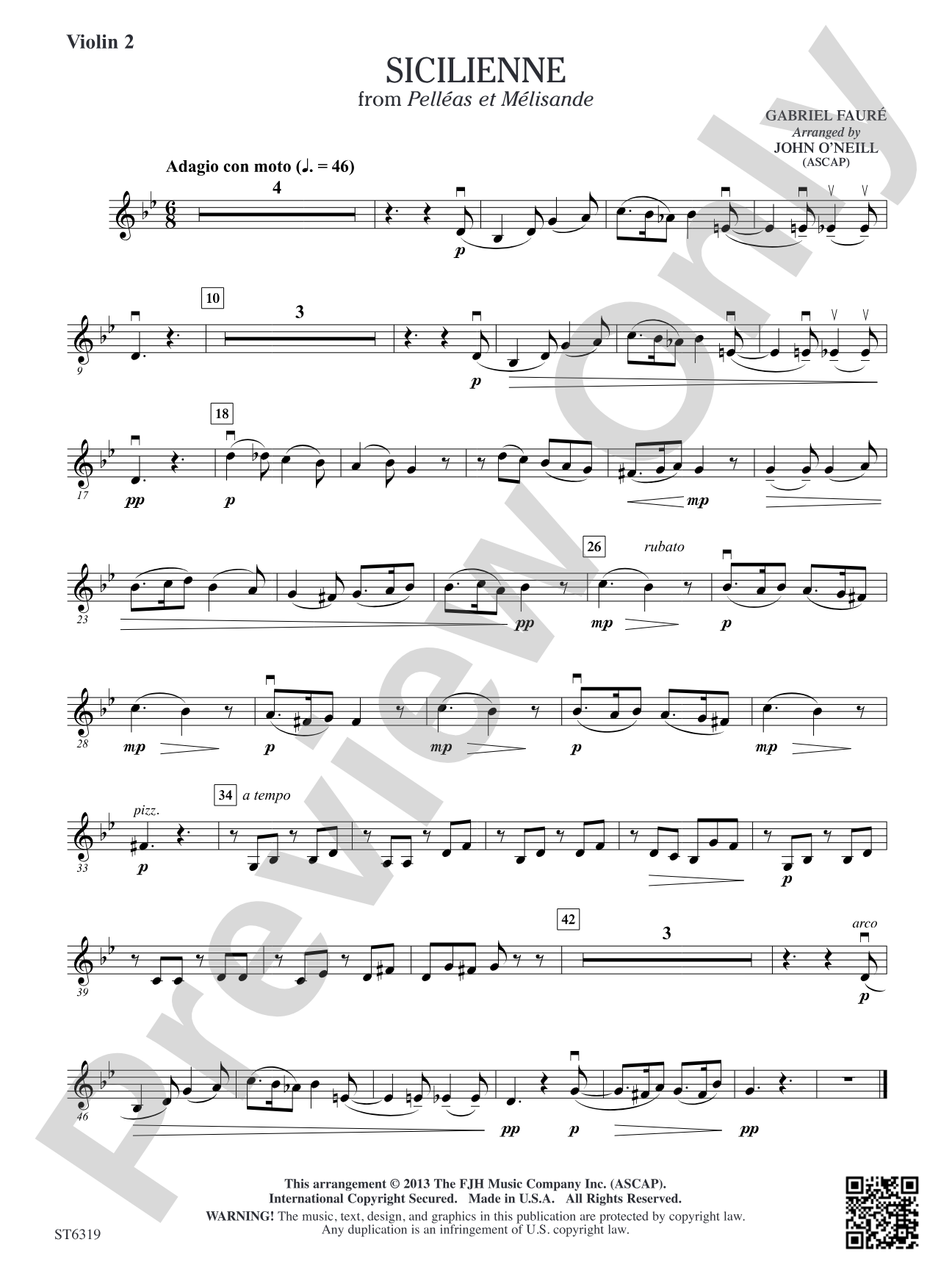
Sicilienne: Violin 2

By Gabrielle Faure / arr. John O'Neill

Grade: 3.5

Item: 98-PC-DST6319_VN2

Digital Download
$7.00
Description
One of Fauré's best known melodies, the haunting Sicilienne lends itself extremely well to string orchestra. Scored in the original key of G minor, the melody effortless weaves throughout the ensemble while the unique harmonies add an incredible dimension of color. Simply beautiful.

Sicilienne: Violin 2 isn't in MakeMusic Cloud just yet...but it could be. Let us know you'd like to see it, and you'll help shape what comes next. In the meantime, start a free trial and dive into thousands of interactive titles your students can play along with today.

Sample Audio
0:00
0:00
Sample Video
Additional Details
Series: FJH String Orchestra
Publisher: The FJH Music Company, Inc.
SKU: 98-PC-DST6319_VN2

More about this title

About the Composer: Gabrielle Faure

Gabriel Fauré (1845-1924) shaped French musical culture across five decades as a composer, pedagogue, and eventually director of the Paris Conservatoire. His gift for melody and harmonic innovation defined the late Romantic era in France, and his works remain central to both instrumental and vocal repertoire. Fauré's ability to blend accessibility with sophisticated compositional technique makes his music particularly valuable in ensemble settings where students encounter genuine artistry at every level.

Why we love this

This arrangement transforms a beloved concert piece into an ideal gateway to orchestral color and phrasing for younger ensembles. The scoring preserves Fauré's lyrical voice while distributing the melodic material intelligently across the ensemble, giving every section moments to shine and take ownership of the line. At Grade 3.5, it sits perfectly for groups ready to move beyond technical exercise into interpretive nuance.

What to expect

Haunting and contemplative, the Sicilienne unfolds with the inevitable grace of a folk melody passed down through generations. The harmonic language creates pockets of unexpected color that shift the listener's perception of the familiar tune, making it feel both immediately approachable and mysteriously complex. There is stillness here, and dignity.

Who it's for

String orchestras at the intermediate level who are ready to work with genuine concert literature and explore how orchestration shapes musical storytelling. This piece rewards groups that can maintain steady intonation across sections and commit to the emotional arc of a sustained melodic line. Directors seeking repertoire that sounds ambitious and polished without overwhelming younger players will find this essential.

How to get the most out of it

  • Shape the melody with long, connected phrasing rather than playing section by section; this piece breathes as a single line even when different instruments carry it.
  • Balance the inner voices carefully so the harmonic color emerges without obscuring the primary melody; this is where the "incredible dimension of color" lives.
  • Let the G minor tonality inform your approach to tone quality; a slightly darker, more introspective quality serves the Sicilian character.
  • Rehearse ensemble entrances and transitions when the melody passes between sections; smooth handoffs preserve the effortless weaving Fauré achieves.

How to use it

Program this as a concert centerpiece or as part of a thematic program exploring Romantic melody and orchestration. It pairs effectively with lighter character pieces or works that explore similar harmonic language, and its moderate length and reflective nature make it ideal for festivals where interpretive maturity matters as much as technical precision. Consider using it mid-program where the audience is settled and ready to listen deeply.

Skills your students will build

  • Sustaining long melodic lines without wavering intonation or phrasing clarity
  • Balancing ensemble texture so inner voices support rather than obscure the primary melody
  • Listening for harmonic color and adjusting tone quality to match the emotional intent
  • Recognizing and executing smooth section handoffs when the melody moves between instruments
  • Interpreting Romantic-era orchestral writing with sensitivity to lyrical phrasing

You May Also Like