Sicilienne - Piano Duo (2 Pianos, 4 Hands) Sheet Music Preview

Sicilienne - Piano Duo (2 Pianos, 4 Hands): Piano Duets & Four Hands

By Johann Sebastian Bach / transcr. Guy Maier

Level: Late Intermediate

Item: 00-PB-0000798

Digital Download
$5.95
Description
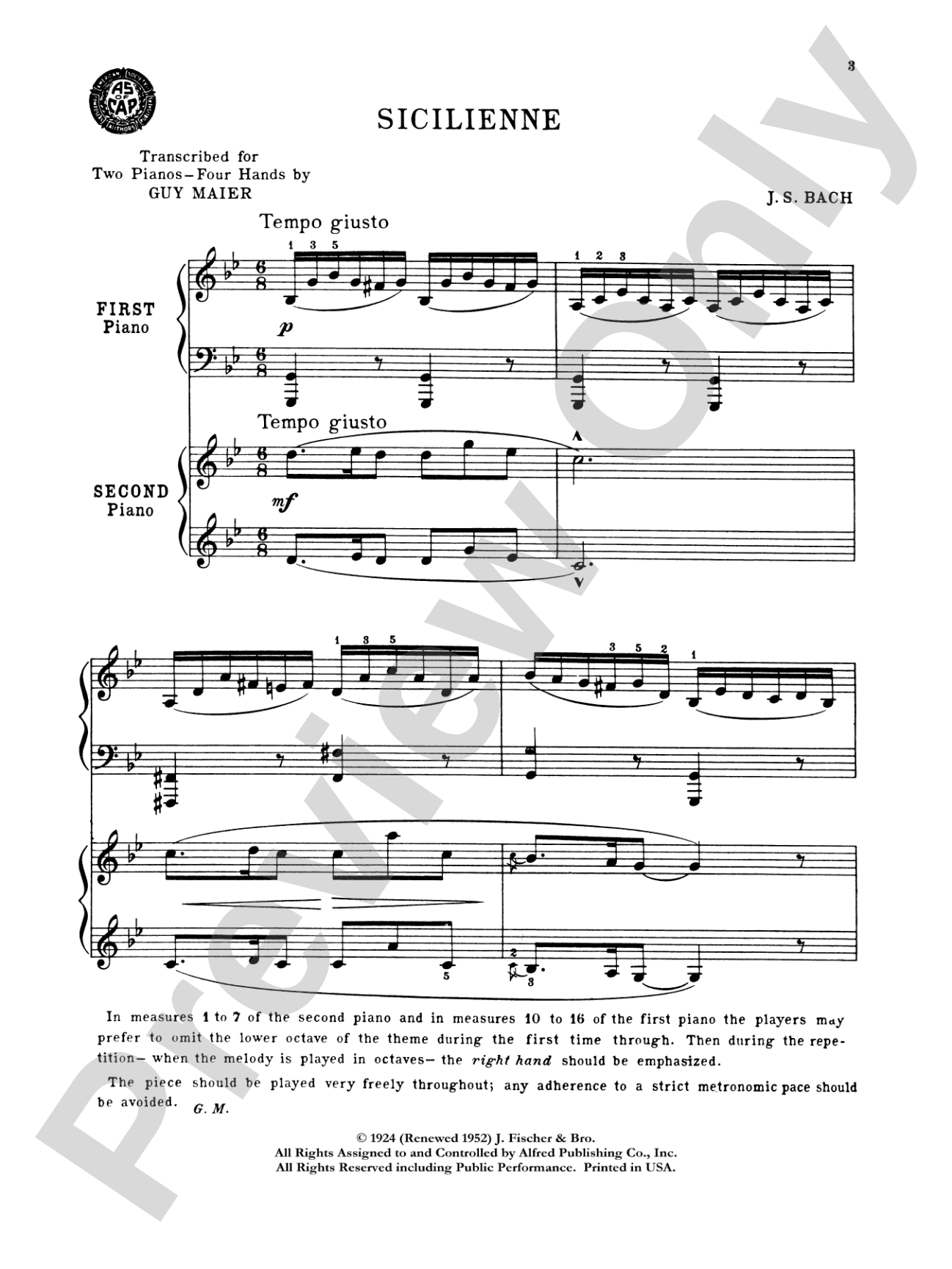
Arranged by Guy Maier for two performers at two separate pianos, this famous and beautiful piece is transcribed from the 2nd movment of Bach's second flute sonata. Originally published in 1924, this arrangement features a gentle, flowing sixteenth note accompaniment and melodic duties shared nicely between the two parts. Two copies are included. A Federation Festivals 2016-2020 selection. A Federation Festivals 2020-2024 selection.

Sicilienne - Piano Duo (2 Pianos, 4 Hands): Piano Duets & Four Hands isn't in MakeMusic Cloud just yet...but it could be. Let us know you'd like to see it, and you'll help shape what comes next. In the meantime, start a free trial and dive into thousands of interactive titles your students can play along with today.

Sample Audio
No sample audio found.
Sample Video
Additional Details
Publisher: Alfred Music
Page Count: 8
SKU: 00-PB-0000798

More about this title

About the Composer: Johann Sebastian Bach

Johann Sebastian Bach (1685-1750) stands as one of history's most consequential composers, synthesizing German, Italian, and French musical languages into works of architectural precision and spiritual depth. His output spans sacred and secular genres, from the monumental Mass in B minor and the Well-Tempered Clavier to intimate chamber works. Bach's influence on musical structure, harmonic language, and contrapuntal technique remains foundational to music education and composition practice.

Why we love this

Guy Maier's arrangement captures the essential character of Bach's flute sonata while giving both pianists genuinely musical material to play. The shared melodic writing prevents either player from fading into pure accompaniment duty, and the flowing sixteenth note texture translates beautifully to the keyboard. Festival selection across two cycles underscores its reliability as a polished, accessible entry point to Baroque chamber music.

What to expect

The piece breathes with the gentle, swaying quality characteristic of the sicilienne dance form, its flowing sixteenth note accompaniment creating a soft current beneath the soaring melody. There's an intimacy here, even across two pianos: the shared musical responsibility creates a dialogue rather than a soloist-and-accompanist relationship.

Who it's for

Late intermediate pianists working toward recital or festival repertoire will find this arrangement rewarding both technically and musically. The two-piano format suits duet partnerships in private studios, pre-college programs, and adult amateur ensembles seeking substantial Baroque literature.

How to get the most out of it

  • Balance the melody and accompaniment by listening carefully to how the sixteenth note figure supports rather than overwhelms the primary voice. Adjust dynamics collaboratively between the two pianos rather than treating them as separate entities.
  • Establish a steady, unhurried pulse in rehearsal; the sicilienne's gentle character depends on confident, even pacing rather than pushing forward.
  • Coordinate pedaling between the two pianos during transitions and sustained harmonies to maintain clarity without creating muddiness across both instruments.
  • Practice the melodic exchanges separately first, identifying exactly where each pianist takes or releases the primary line, so hand-offs feel organic rather than mechanical.

How to use it

Program this alongside other Baroque chamber transcriptions or as an elegant, accessible bridge between student repertoire and more ambitious Bach arrangements. It works particularly well on recitals pairing duet repertoire across different eras, or as a festival selection that showcases musicality and collaborative listening.

Skills your students will build

  • Stylistically informed interpretation of Baroque phrasing and articulation
  • Balance and blend between two independent pianos
  • Coordinating entrances and melodic hand-offs between performers
  • Maintaining steady, dance-like pulse in Sicilienne meter
  • Collaborative listening and ensemble awareness

You May Also Like