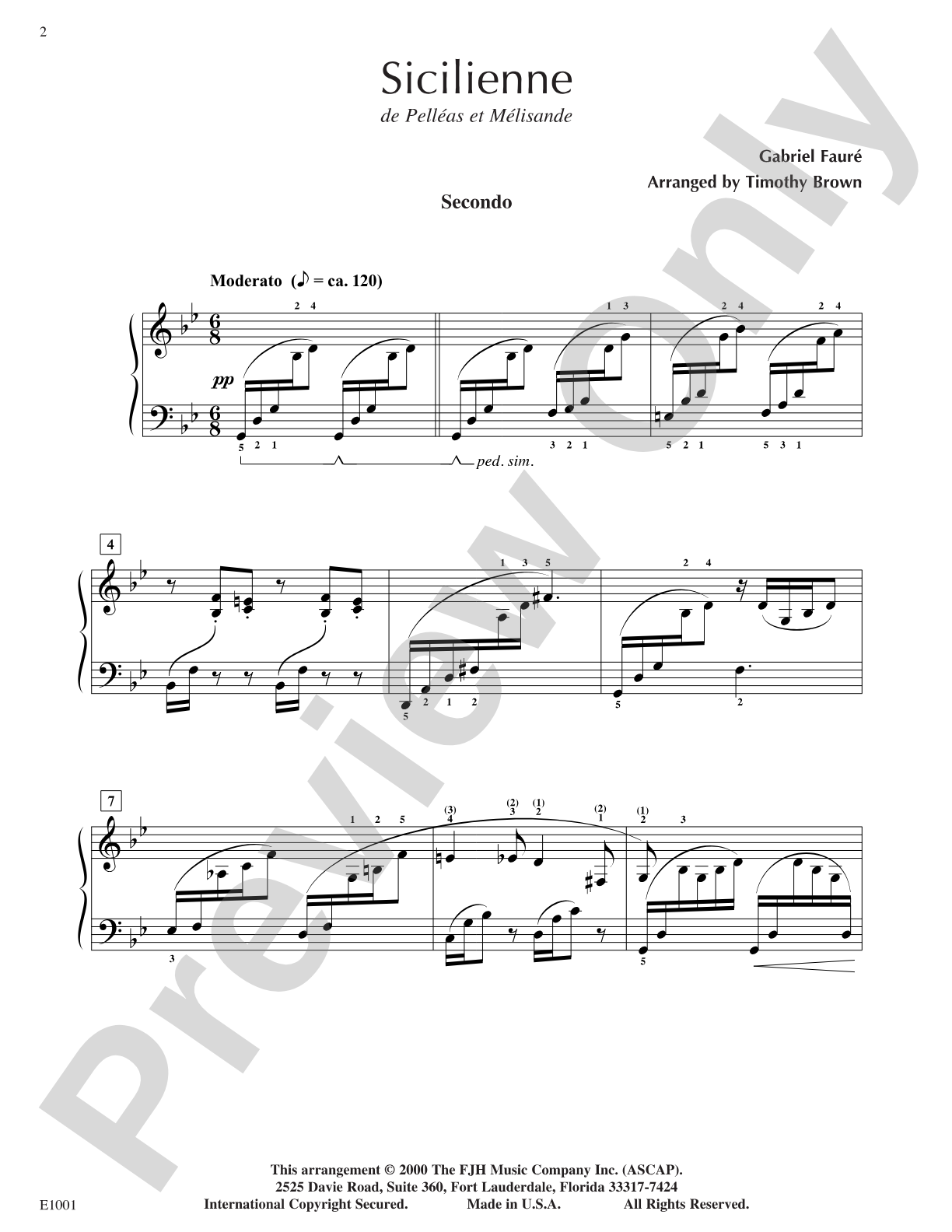
Sicilienne Sheet Music Preview

Sicilienne: Piano

By Gabriel Fauré / arr. Timothy Brown

Item: 98-DE1001

Digital Download
$3.50
Description
Pianistic and playable, this lovely arrangement of Fauré’s lush melody will develop expressiveness and melodic flexibility.

Sicilienne: Piano isn't in MakeMusic Cloud just yet...but it could be. Let us know you'd like to see it, and you'll help shape what comes next. In the meantime, start a free trial and dive into thousands of interactive titles your students can play along with today.

Sample Audio
No sample audio found.
Sample Video
Additional Details
Series: The FJH Piano Ensemble Series
Publisher: The FJH Music Company, Inc.
SKU: 98-DE1001

More about this title

About the Composer: Gabriel Fauré

Gabriel Fauré (1845, 1924) shaped French musical taste across six decades as a composer, organist, and pedagogue. His gift for melody, often intimate and introspective, made him essential to the development of the French art song, yet his instrumental works reveal an equally sophisticated command of harmonic color and structural elegance. Fauré's music influenced generations of composers and remains central to the repertoire precisely because it balances accessibility with artistic depth.

As director of the Paris Conservatoire late in his career, Fauré championed musical education and the cultivation of taste. His works appear in studios and rehearsal rooms worldwide because they reward both the player seeking expressive growth and the listener seeking genuine beauty.

Why we love this

Brown's arrangement preserves the elegance of Fauré's melodic line while crafting writing that sits naturally under the hand. The voicing creates genuine sonority without demanding virtuosity, making this an ideal bridge between technical exercise and genuine artistry. You'll find students engaging with phrasing and nuance because the music invites it.

What to expect

Gentle and introspective, with an unhurried quality that suggests quiet reflection. The melody floats above rippling accompaniment, creating a sense of calm sophistication that feels both approachable and genuinely mature. There's nothing showy here, only the kind of beauty that deepens with familiarity.

Who it's for

Late intermediate pianists ready to move beyond technical studies into repertoire that demands genuine musicality. This works beautifully for students who've mastered consistent pedaling and hand independence but still need guided exploration of long-line phrasing and tonal control.

How to get the most out of it

  • Shape the melodic line as a vocalist would, allowing breath points between natural phrases rather than adhering rigidly to bar lines.
  • Explore the harmonic color in the accompaniment; subtle dynamic shifts in the supporting voices can deepen the sense of expressiveness.
  • Pay particular attention to the transitions between sections. A slight ritardando approaching a key moment will enhance the lyrical quality without disrupting flow.
  • Record yourself periodically and listen for places where the melody sits too far back. This piece reveals immediately when a student is playing accompaniment instead of singing.

How to use it

Pair this with other French Romantic piano works for a recital segment on lyricism and salon tradition, or use it as a bridge piece between technical repertoire and more demanding contemporary work. It also serves as a perfect encore, substantial enough to feel complete but intimate enough to leave audiences in a reflective mood.

Skills your students will build

  • Long-line phrasing across harmonic changes
  • Pedal technique for blending and sustaining color
  • Melodic flexibility and rubato within a stable harmonic foundation
  • Voice independence (melody and accompaniment balance)
  • Expressive control without excessive dynamics

You May Also Like