Sibelius's 2nd Symphony, 4th Movement: 3rd Trombone Sheet Music Preview

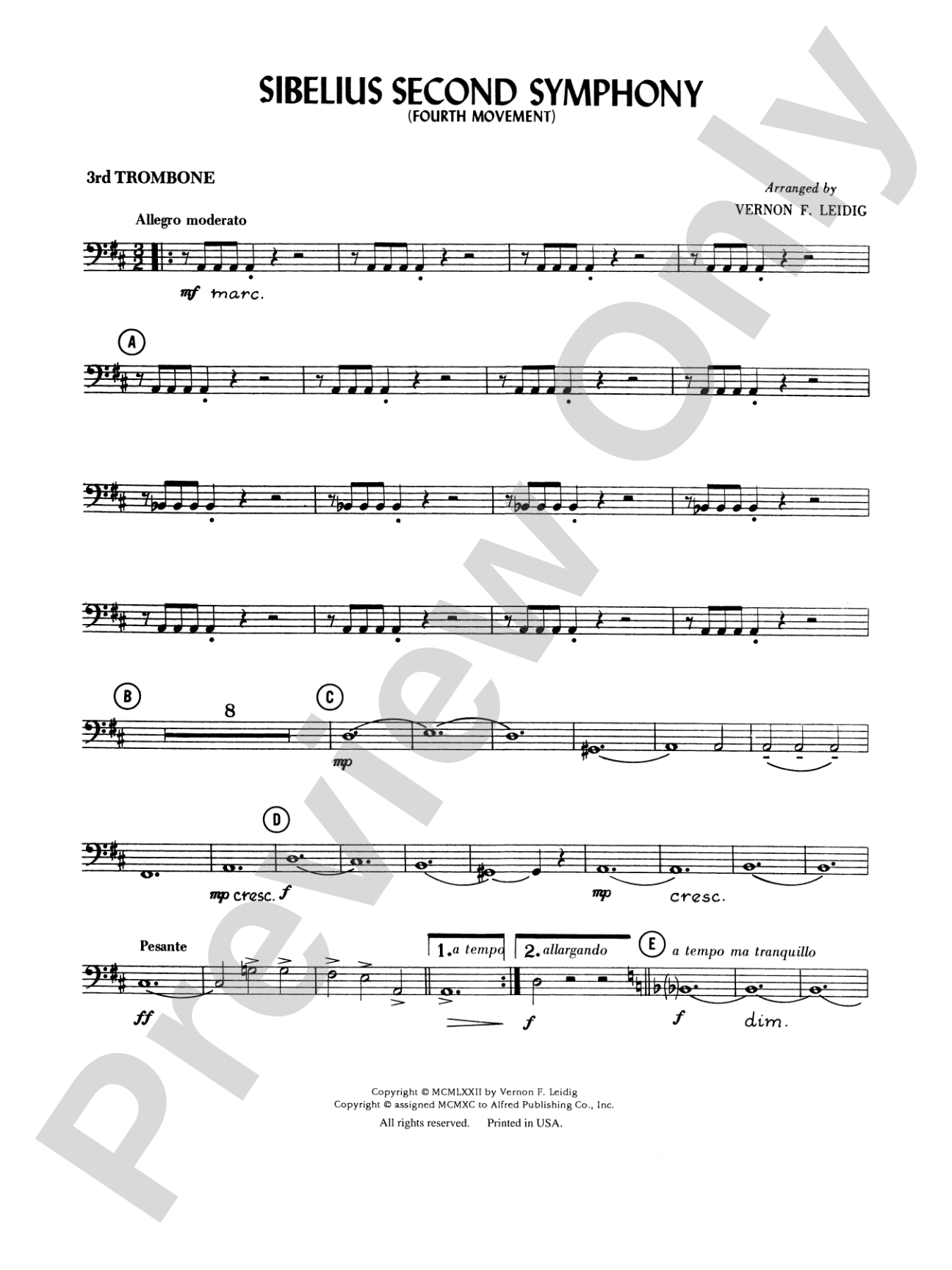
Sibelius's 2nd Symphony, 4th Movement: 3rd Trombone

By Jean Sibelius / arr. Vernon Leidig

Grade: 3

Item: 00-PC-0000064_TN3

Digital Download
$3.00
Description

Don't just read it, hear it, play along with it, and watch your students grow with it. In MakeMusic Cloud, Sibelius's 2nd Symphony, 4th Movement: 3rd Trombone comes alive with professional accompaniment, adjustable tempo, and built-in practice tools that turn solo practice into real progress.

Sample Audio
No sample audio found.
Sample Video
Additional Details
Series: Highland/Etling Full Orchestra
Publisher: Alfred Music
Page Count: 204
SKU: 00-PC-0000064_TN3

More about this title

About the Arranger: Vernon Leidig

Vernon Leidig has spent decades creating accessible arrangements of orchestral masterworks for student ensembles. His arrangement philosophy prioritizes musical authenticity while scaling the technical demands to match developing orchestras, making canonical works performable at the Grade 3 level without compromising their essential character.

Why we love this

Leidig's reduction captures the sweeping inevitability of Sibelius's finale without requiring virtuosic string passages or extreme register demands. Grade 3 orchestras can deliver a genuine symphonic experience rather than a watered-down approximation, and the scoring preserves the dramatic arc that makes this movement so powerful.

What to expect

Monumental and inevitably forward-moving. The movement unfolds with the relentless logic of a winter landscape, building from stark simplicity to overwhelming orchestral force. The ending carries the kind of finality that leaves audiences breathless.

Who it's for

Grade 3 full orchestras ready to program a work of genuine artistic substance. This arrangement opens the symphonic repertoire to ensembles that might otherwise lack access to Sibelius while maintaining enough musical integrity that serious student musicians will feel the weight of the original.

How to get the most out of it

  • Balance the sustained string foundation against woodwind and brass lines; the harmonic progression that drives this movement depends on hearing all layers clearly, not just the melodic surface.
  • Conduct the underlying pulse rather than the surface rhythms. Sibelius builds tremendous momentum through cumulative energy, so shape entire phrases toward key structural points rather than stopping at each bar line.
  • Let the dynamics breathe gradually. The movement gains force through deliberate crescendos and subito contrasts, not sudden jumps; this requires discipline from both conductor and ensemble.

How to use it

Position this as a major concert centerpiece, not filler. The single-movement format allows it to stand alone on a concert or act as a powerful concluding work to a program of shorter pieces. Its symphonic gravitas elevates the entire event and demonstrates what your orchestra has learned over a full rehearsal cycle.

Skills your students will build

  • Reading and executing sustained dynamics and gradual crescendos over extended passages
  • Balancing harmonic layers in tonal music while maintaining clarity of individual parts
  • Playing with unified pulse and direction across an entire movement without stopping
  • Responding to large-scale structural gestures and conducting patterns that span multiple measures
  • Coordinating ensemble sound at varying dynamic levels while preserving intonation

You May Also Like