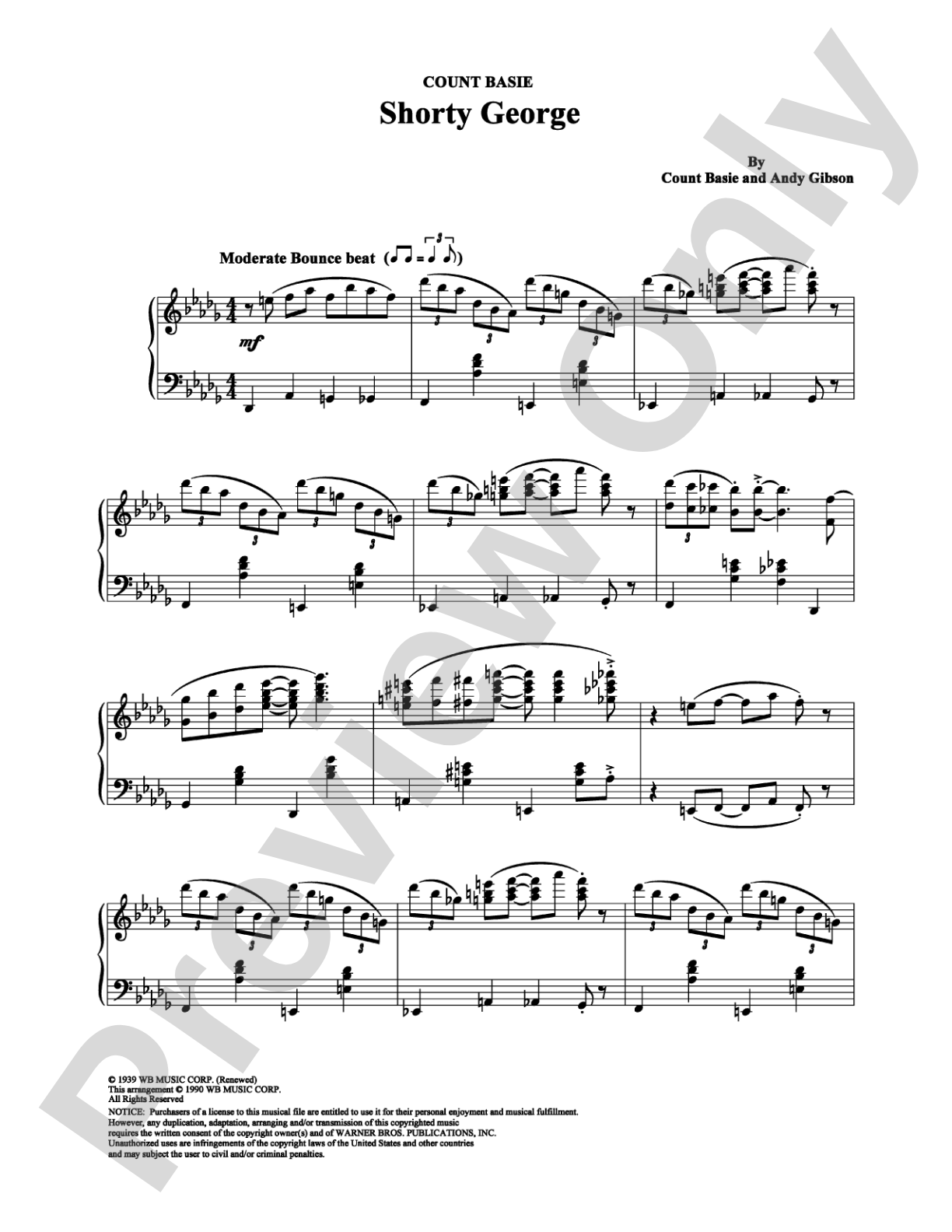
Shorty George: Piano Digital Sheet Music

Shorty George: Piano Digital Sheet Music

Count Basie, Andy Gibson

Item: 00-PS-0000451

Digital Download
$3.99
Description

Shorty George: Piano Digital Sheet Music isn't in MakeMusic Cloud just yet...but it could be. Let us know you'd like to see it, and you'll help shape what comes next. In the meantime, start a free trial and dive into thousands of interactive titles your students can play along with today.

Sample Audio
No sample audio found.
Sample Video
Additional Details
SKU: 00-PS-0000451

More about this title

About the Artist: Count Basie

Count Basie built his orchestra into one of the most influential big bands of the swing era, setting the standard for tight ensemble playing and rhythmic precision. His piano playing was deceptively spare, Basie knew when not to play, letting his left hand anchor the groove while his right hand offered perfectly timed flourishes and comping that gave solists room to breathe.

Why we love this

Shorty George captures everything that makes Basie's playing essential for jazz pianists: a straightforward, swinging groove built on blues sensibility rather than technical showmanship. The head is memorable enough to stick in your students' ears, and the changes are accessible without being simplistic, making it an ideal entry point into authentic jazz piano repertoire.

What to expect

A swinging strut with the confident ease of a bandleader who knows exactly where the groove sits. The piece breathes with a relaxed confidence and bluesy warmth, asking you to play with pocket and intention rather than speed or complexity.

Who it's for

Jazz pianists working to develop their own voice within the swing tradition, and ensemble players who need to understand how to comp within a big band context. It's especially valuable for students who are ready to move beyond fake books into the study of recorded performances and their underlying structures.

How to get the most out of it

  • Keep your touch light and your comping space wide. Basie's sound comes from restraint and perfect timing, not from filling every beat with notes.
  • Lock the left hand groove into a steady pulse that sits slightly behind the beat. This is where the swing lives.
  • Listen to the original recording to absorb the rhythmic phrasing and articulation. Transcribing Basie's actual voicings and rhythms from the recording teaches you more than any notation can.
  • Treat the blues changes as a conversation, not a harmonic puzzle. Find two or three comping rhythms that work and commit to them rather than changing every bar.

How to use it

Use this in a jazz recital or as a solo feature within a big band concert, where it showcases the pianist's ability to solo over changes while maintaining the groove. It also works as a performance study when teaching ensemble members how Basie's rhythm section approach differs from stride piano or classical accompaniment styles.

Skills your students will build

  • Blues changes and terminology in a jazz context
  • Swing comping rhythms and their relationship to ensemble timing
  • Listening to and transcribing recorded solos
  • Blues-based improvisation over a repeating harmonic structure
  • The relationship between sparse voicing and rhythmic pocket

You May Also Like