Short Service (Sidney Sussex) Sheet Music Preview

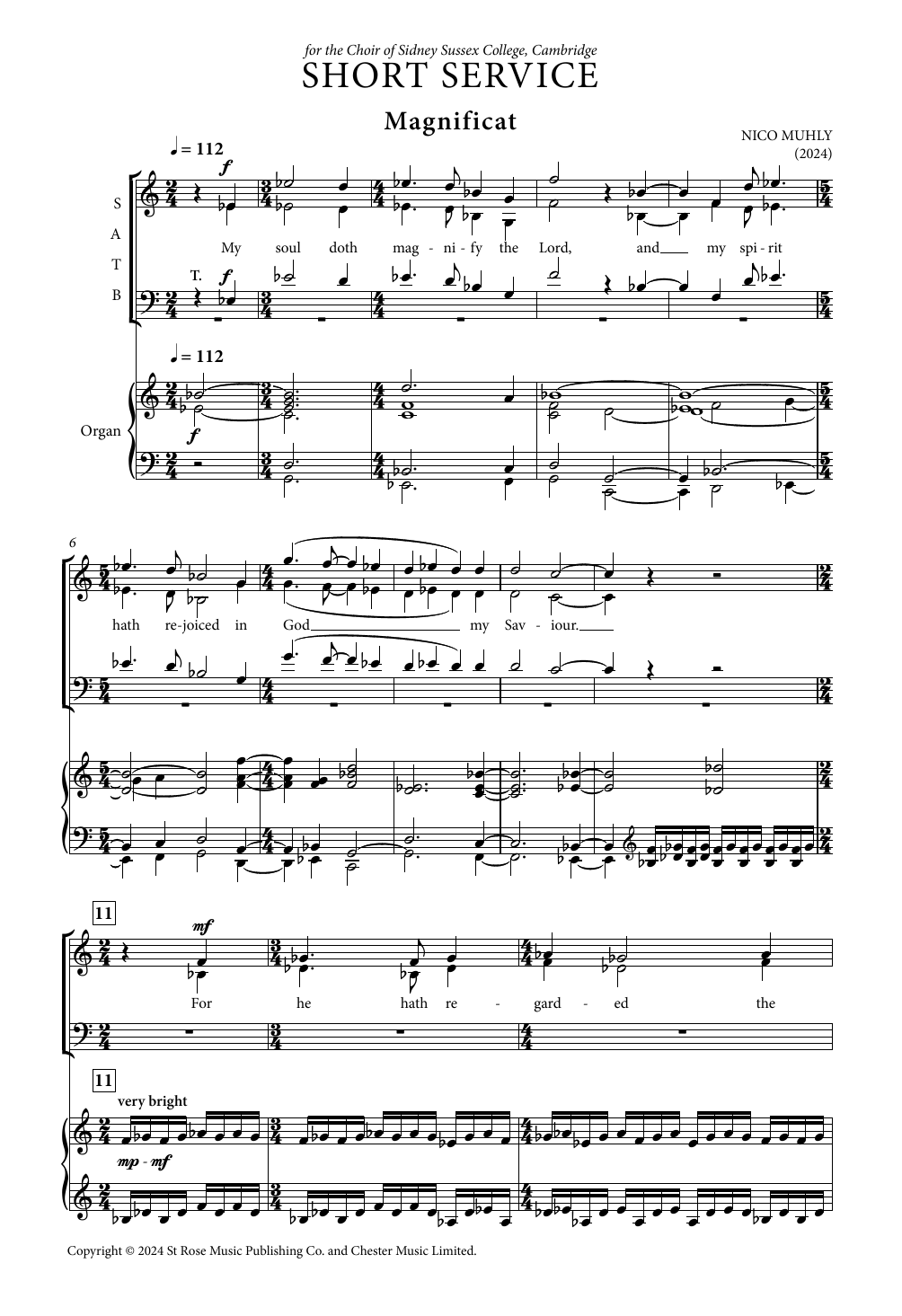
Short Service (Sidney Sussex): Choral Octavo

By Nico Muhly

Item: 35-DS01525324

Digital Download
$5.95
Description

Short Service (Sidney Sussex): Choral Octavo isn't in MakeMusic Cloud just yet...but it could be. Let us know you'd like to see it, and you'll help shape what comes next. In the meantime, start a free trial and dive into thousands of interactive titles your students can play along with today.

Sample Audio
No sample audio found.
Sample Video
Additional Details
Publisher: Hal Leonard
Page Count: 17
SKU: 35-DS01525324

More about this title

About the Composer: Nico Muhly

Nico Muhly is an American composer whose work spans opera, orchestral music, and vocal writing. He studied at Columbia University and has created a substantial body of choral music that balances contemporary harmonic language with clarity and accessibility for performers.

Why we love this

Muhly's harmonic vocabulary feels fresh without alienating singers or audiences. The Short Service sets a liturgical text with modern sensibility, making it equally at home in a concert setting or as part of a sacred music program where you want to move beyond standard Renaissance or Victorian repertoire.

What to expect

The piece carries quiet reverence with underlying harmonic motion that keeps it alive and engaged. There's an intimacy to the writing that invites listeners inward rather than demanding display.

Who it's for

Accomplished amateur and professional choirs will find this work accessible yet sophisticated. It suits programs where you're programming contemporary composers alongside classical traditions, or building a recital that values artistic coherence over historical survey.

How to get the most out of it

  • Balance the soprano line carefully; it sits high and carries melodic weight, but shouldn't overwhelm the inner voices where much of Muhly's harmonic interest lives.
  • Lean into the text naturally. Muhly's phrasing often follows speech rhythms rather than predictable musical cadences, so let articulation and vowel shapes guide you rather than default hymnal conventions.
  • Pay attention to vertical alignment in sections where voices move at different rates. Rhythmic independence between parts is compositional intent, not a coordination problem.

How to use it

This works beautifully as part of a concert exploring contemporary sacred music, or paired with other 21st-century choral works to show how composers approach liturgical texts today. It also serves as an excellent palate-cleansing piece between heavier classical works due to its brevity and reflective character.

Skills your students will build

  • Reading contemporary harmonic language with functional clarity
  • Maintaining independence in non-imitative counterpoint
  • Executing precise vertical alignment across sustained harmonies
  • Interpreting text phrasing that prioritizes speech patterns over musical convention

You May Also Like