Shooting Stars Sheet Music Preview

Shooting Stars: Piano

By Elizabeth W. Greenleaf

Item: 98-DW9215

Digital Download
$2.50
Description
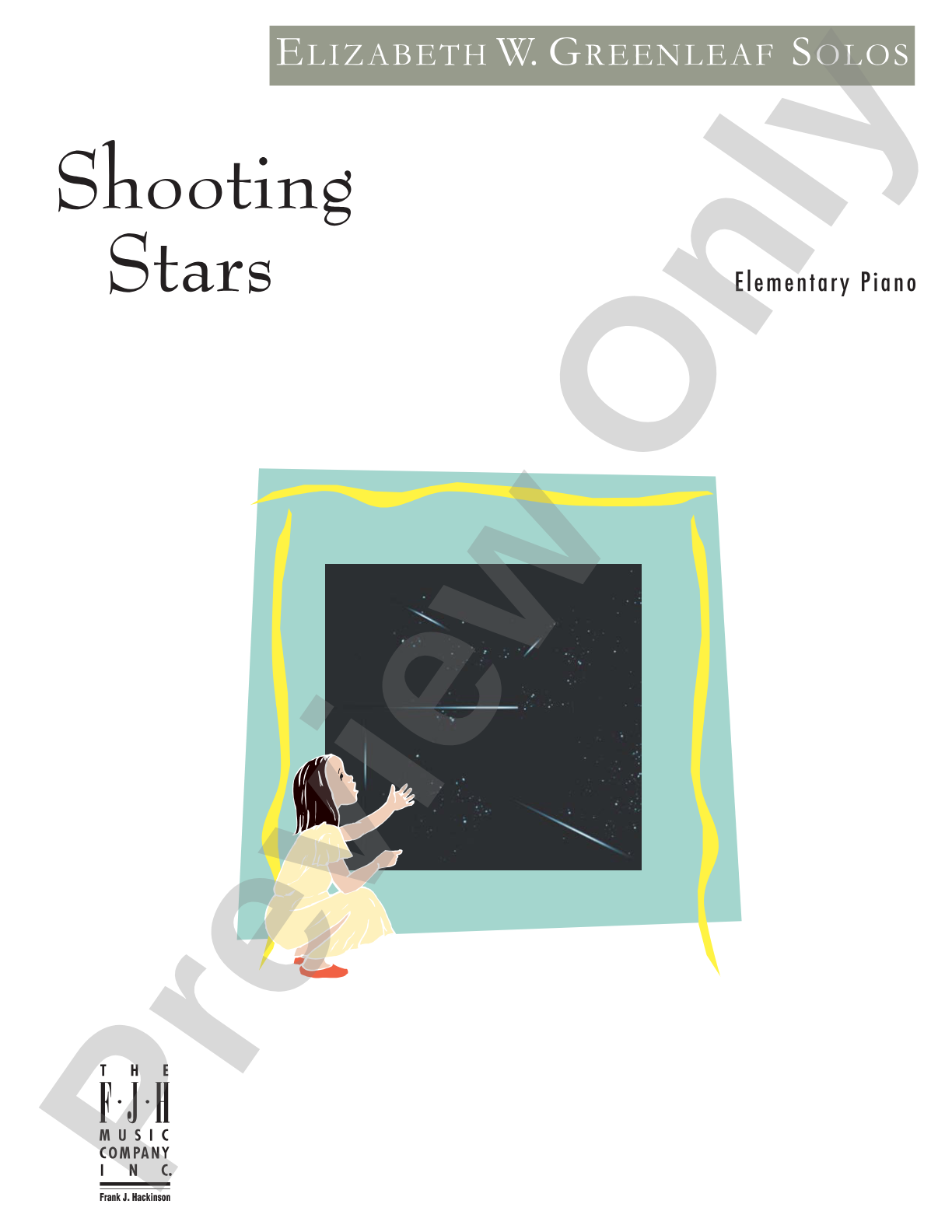
Words and melody together capture the thrill of watching shooting stars at night. Written in G position, with mostly stepping and skipping quarter notes, it is an excellent, easy-to-learn supplementary piece. The ending evokes the motion of stars disappearing across the sky.

Shooting Stars: Piano isn't in MakeMusic Cloud just yet...but it could be. Let us know you'd like to see it, and you'll help shape what comes next. In the meantime, start a free trial and dive into thousands of interactive titles your students can play along with today.

Sample Audio
No sample audio found.
Sample Video
Additional Details
Series: Written For You
Publisher: The FJH Music Company, Inc.
SKU: 98-DW9215

More about this title

Why we love this

Greenleaf captures something real here: the wonder of a moment that vanishes almost as soon as you notice it. The writing is honest about what elementary pianists can do right now, without condescension, and the ending actually delivers on the piece's title instead of just tacking on a coda.

What to expect

Wonder tinged with urgency. The quarter-note motion creates forward momentum that mirrors the speed of a shooting star's passage, while the step-and-skip melody keeps the piece approachable and singable. The ending shifts that energy into stillness, as if the star has disappeared into the vast night sky.

Who it's for

Early elementary pianists ready to move beyond single-note melodies and simple accompaniments. This piece rewards students who've mastered G position and basic quarter-note rhythm with a complete musical thought that actually tells a story.

How to get the most out of it

  • Shape each phrase to follow the arc of a star's path across the sky; let the melody breathe naturally rather than treating every note equally.
  • Maintain steady quarter-note pulse through the step and skip patterns; evenness of touch makes the melody sing clearly without pedal.
  • Listen to how the ending motion suggests fading light; slight ritardando in the final measures enhances that effect without needing written instruction.

How to use it

Pair this with other astronomy or nature pieces for a thematic recital, or use it as a bridge piece between technique-focused studies and repertoire that asks students to think about character and storytelling. Its brevity and clarity make it ideal for student showcases or informal studio performances.

Skills your students will build

  • Reading and playing in G position
  • Distinguishing step motion from skip motion in a melodic line
  • Maintaining steady quarter-note pulse
  • Connecting phrase shapes to musical imagery
  • Right-hand melody independence with simple left-hand support

You May Also Like