
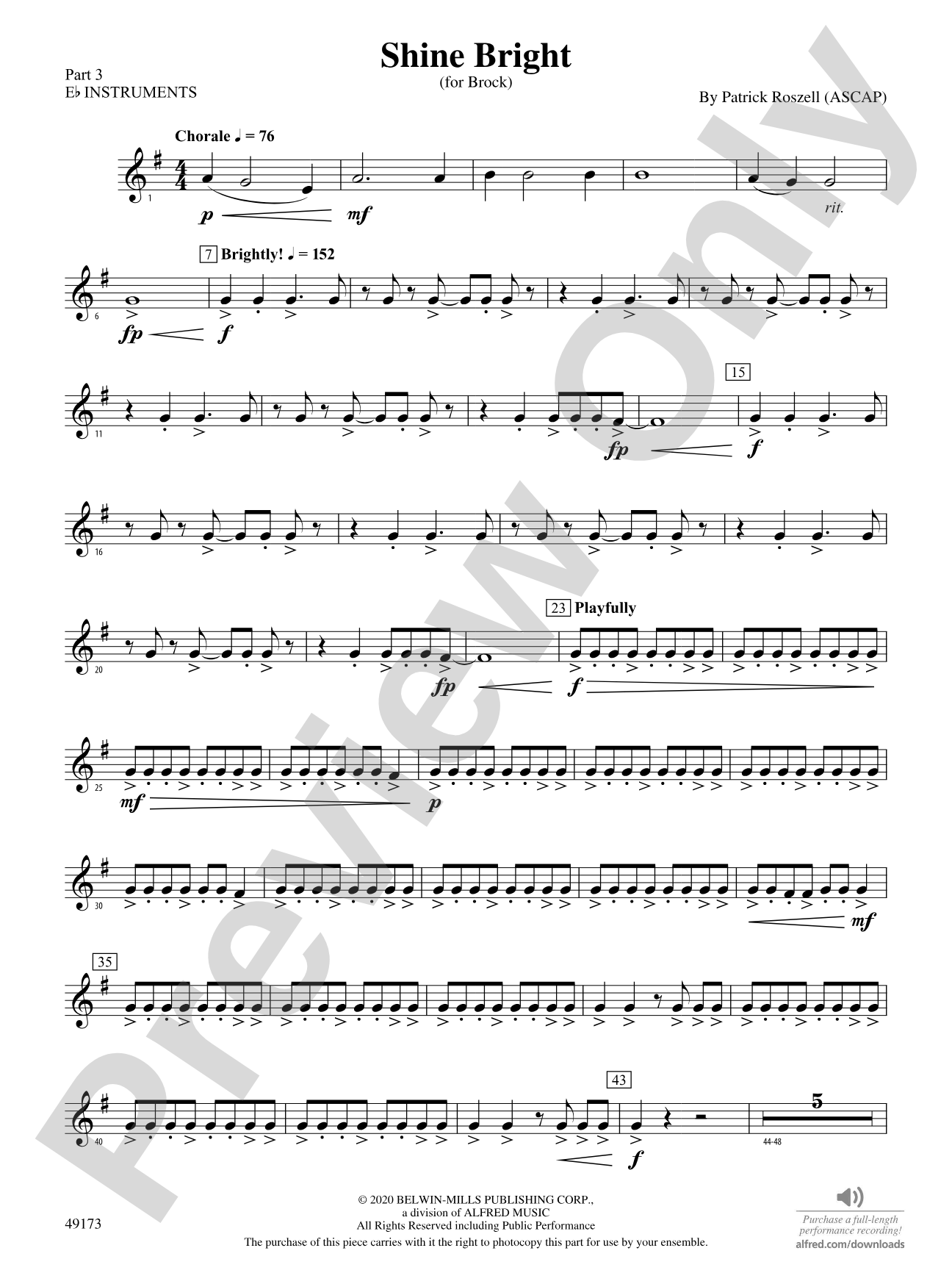

Shine Bright: Part 3 - E-flat Instruments
(for Brock)
By Patrick Roszell
Grade: 2.5 (Easy to Medium Easy)
Item: 00-PC-0018503_PART3_EFLAT
$3.00
Pickup currently not available
Description
This version of Shine Bright by Patrick Roszell is part of our Belwin FLEX offerings and is designed with maximum flexibility for use by any mix of instruments---wind, strings, and percussion, including like- or mixed-ensembles with as few as 5 players. The suggested instrumentation and a customizable Teacher Map will help you plan out how to best assign parts to suit your ensemble's needs. It also comes with supplemental parts for maximum flexibility. With the purchase of this piece, permission is granted to photocopy the parts as needed for your ensemble. A percussion accompaniment track is also available as a free download. String parts have been carefully edited with extra fingerings and appropriate bowings to support students in mixed ensembles playing in less familiar keys.
This musical upbeat celebration of life was inspired in part by the John Steinbeck quote in The Winter of Our Discontent, "It's so much darker when a light goes out than it would have been if it had never shone." Beyond the brief introduction with flute solo, the piece is persistently bright and charismatic. Shine Bright by Patrick Roszell can be used at any event, including graduations, concerts, or contests throughout the year. (3:15)
Percussion Accompaniment Track Downloads:
with click.
without click.


This musical upbeat celebration of life was inspired in part by the John Steinbeck quote in The Winter of Our Discontent, "It's so much darker when a light goes out than it would have been if it had never shone." Beyond the brief introduction with flute solo, the piece is persistently bright and charismatic. Shine Bright by Patrick Roszell can be used at any event, including graduations, concerts, or contests throughout the year. (3:15)
Percussion Accompaniment Track Downloads:
with click.
without click.
Don't just read it, hear it, play along with it, and watch your students grow with it. In MakeMusic Cloud, Shine Bright: Part 3 - E-flat Instruments comes alive with professional accompaniment, adjustable tempo, and built-in practice tools that turn solo practice into real progress.
Open in the Player
Jump straight in and assign it today.
Start Your Free Trial
Open this title and explore the full library in minutes.
Sample Audio
1
Audio File
--:--
0:00
0:00
Sample Video
No sample videos found.
Additional Details
Series:
Belwin Young Band
Publisher:
Alfred Music
Page Count:
165
SKU:
00-PC-0018503_PART3_EFLAT
More about this title
About the Composer: Patrick Roszell
Patrick Roszell has built his reputation writing music that works in real classrooms and rehearsal rooms. His approach to flexible instrumentation reflects decades of understanding what band directors actually face: students with different instruments, varying levels of experience, and the need to make every piece sound complete regardless of who shows up.
Why we love this
This piece solves a genuine scheduling problem for directors managing mixed ensembles of wildly different sizes and instrumentation. The customizable Teacher Map puts you in control, and the supplemental parts mean you're not scrambling to transpose on the fly. What seals it is that the writing never feels compromised by its flexibility—the string parts feature fingerings and bowings tailored to younger players tackling unfamiliar keys, and the overall orchestration sounds full and intentional at any instrumentation level.
What to expect
Upbeat and celebratory throughout, with a moment of lyrical reflection at the opening before the piece launches into persistent brightness. The orchestration feels inclusive and energetic, inviting every player into a shared musical gesture that feels earned rather than plastered on.
Who it's for
Directors managing concert and flex bands with fluctuating attendance or unpredictable instrumentation. This works equally well for a quintet in a small-school setting or a full mixed ensemble in a larger program. Students building comfort reading in less familiar keys will benefit from the carefully edited string fingerings and bowings.
How to get the most out of it
- Balance the opening flute solo carefully so it cuts through without overshadowing the ensemble entrance that follows. This moment sets the piece's lyrical foundation before the brightness takes over.
- Use the free percussion accompaniment track during rehearsals to lock in tempo and feel, especially with younger ensembles still building confidence in mixed settings.
- Assign parts based on the Teacher Map but listen to how individual players sit in the texture. A strong second violin might trade parts with a struggling flute, and the flexibility is built in to support that choice.
- Keep the piece's charismatic energy consistent from start to finish. The brightness should feel genuine and sustained, not forced or frenetic.
How to use it
Program this for any event where you need music that lands with positivity—graduations, spring concerts, or festival appearances all suit its character. It also works as a strong opener or closer that sends audiences out feeling lifted. The manageable 3:15 length and Grade 2.5 difficulty mean you can build it into your year without derailing other repertoire goals.
Skills your students will build
- Reading and performing in keys with accidentals unfamiliar to younger players
- Balancing individual melodic lines within a mixed ensemble texture
- Responding to flexible instrumentation by adapting individual parts to available instruments
- Sustaining musical energy and character across a piece without instrumental or textural variety