
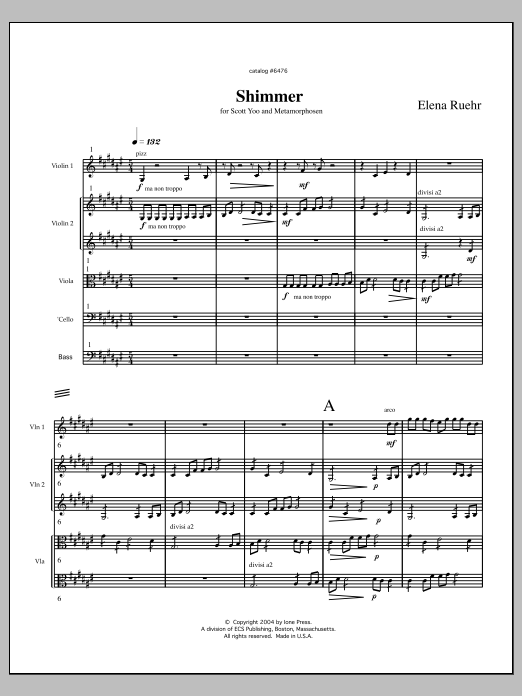

Shimmer: String Orchestra Conductor Score & Parts
Arranged by Elena Ruehr
Item: 35-PK00277827
$15.35
Pickup currently not available
Buy Extra Parts (Digital PDF Download)
| Product | Price | Quantity |
|---|---|---|
| Shimmer - Full Score | $6.60 | |
| Shimmer - Violin | $1.80 | |
| Shimmer - Violin | $1.95 | |
| Shimmer - Violoncello | $1.20 | |
| Shimmer - Viola | $1.20 | |
| Shimmer - Contrabass | $0.60 |
Parts Added to Cart!
Description
Shimmer was commissioned by Metamorphosen for their premiere season in 1994-95 and recorded on their first CD. Strongly inspired by the energetic string music of Vivaldi, Shimmer uses imitative counterpoint as its basis. However, the harmony, rhythm and form is structured using a cyclical 10 note series instead of traditional tonality. The piece starts with a four part canon in mid-range, overlaid with two part counterpoint in the treble and bass. Undergoing constant variation, the music finally culminates in an extended passage of five voice counterpoint. After a brief recapitulation, it continues building to an energetic and percussive end. The name refers to the shimmering texture that is created through bowing, trilling and ornamentation. Duration: 12:00


Shimmer: String Orchestra Conductor Score & Parts isn't in MakeMusic Cloud just yet...but it could be. Let us know you'd like to see it, and you'll help shape what comes next. In the meantime, start a free trial and dive into thousands of interactive titles your students can play along with today.
Request This Title
Tell us you want it.
Start Your Free Trial
Explore everything that's ready to play right now.
Sample Audio
No sample audio found.
Sample Video
No sample videos found.
Additional Details
Publisher:
Hal Leonard
SKU:
35-PK00277827
More about this title
About the Arranger: Elena Ruehr
Elena Ruehr is a composer whose work draws heavily from baroque sources and compositional techniques, particularly the contrapuntal writing of the Renaissance and Baroque periods. Her approach to modern composition often builds on historical musical language while incorporating contemporary harmonic structures, making her work intellectually rigorous without abandoning accessibility for performers.
Why we love this
Ruehr creates a genuine pedagogical challenge while keeping the music viscerally rewarding to perform. The progression from four-part canon through increasingly complex contrapuntal layers builds naturally, allowing players to understand how sophisticated musical architecture develops rather than simply executing it. The 10-note series framework gives the piece real structural sophistication without abandoning the kind of musical momentum that keeps student orchestras engaged.
What to expect
Shimmer captures the brightness and forward momentum of Vivaldi while reconceiving that energy through a modernist harmonic lens. The constant variation and layering of imitative voices create perpetual motion that sparkles rather than settles, building from delicate interlocking lines to a bright, almost percussive climax.
Who it's for
This work suits upper-level string orchestras with confident reading skills and experience with Baroque idioms. The contrapuntal writing demands precision and independence from individual players, making it ideal for orchestras ready to tackle ensemble coordination without a large section of each part.
How to get the most out of it
- Balance the initial four-part canon carefully in the middle voices; it's easy for the texture to muddy when all parts are equal in weight. Let the canonic voices breathe while keeping them present beneath the treble and bass counterpoint.
- Approach the bowing, trilling and ornamentation as compositional material rather than decoration. These elements are what create the titular shimmer, so execute them with precision and rhythmic clarity rather than as embellishment.
- Map out the five-voice counterpoint passage before rehearsals begin. Assign specific players to specific voices so that each line maintains independence through the complexity, preventing the texture from collapsing into homophony.
- Control the arc toward the ending carefully; the piece builds continuously but doesn't have dramatic dynamic peaks until the final section. Resist the urge to surge early; let the energy accumulate through textural density rather than volume.
How to use it
This piece works beautifully as a centerpiece in a concert exploring the relationship between Baroque and contemporary classical languages. Pair it alongside actual Vivaldi to highlight how Ruehr transforms familiar baroque gestures, or position it early in a concert to showcase your orchestra's technical facility with counterpoint before moving to larger works.
Skills your students will build
- Reading and maintaining independent voice lines in multi-voice counterpoint
- Canonic writing and entrances that preserve rhythmic clarity
- Baroque articulation and bowing techniques applied to contemporary harmonic contexts
- Balance and blend in textured passages without conductorial hand-holding
- Understanding cyclical harmonic structures outside traditional tonality