
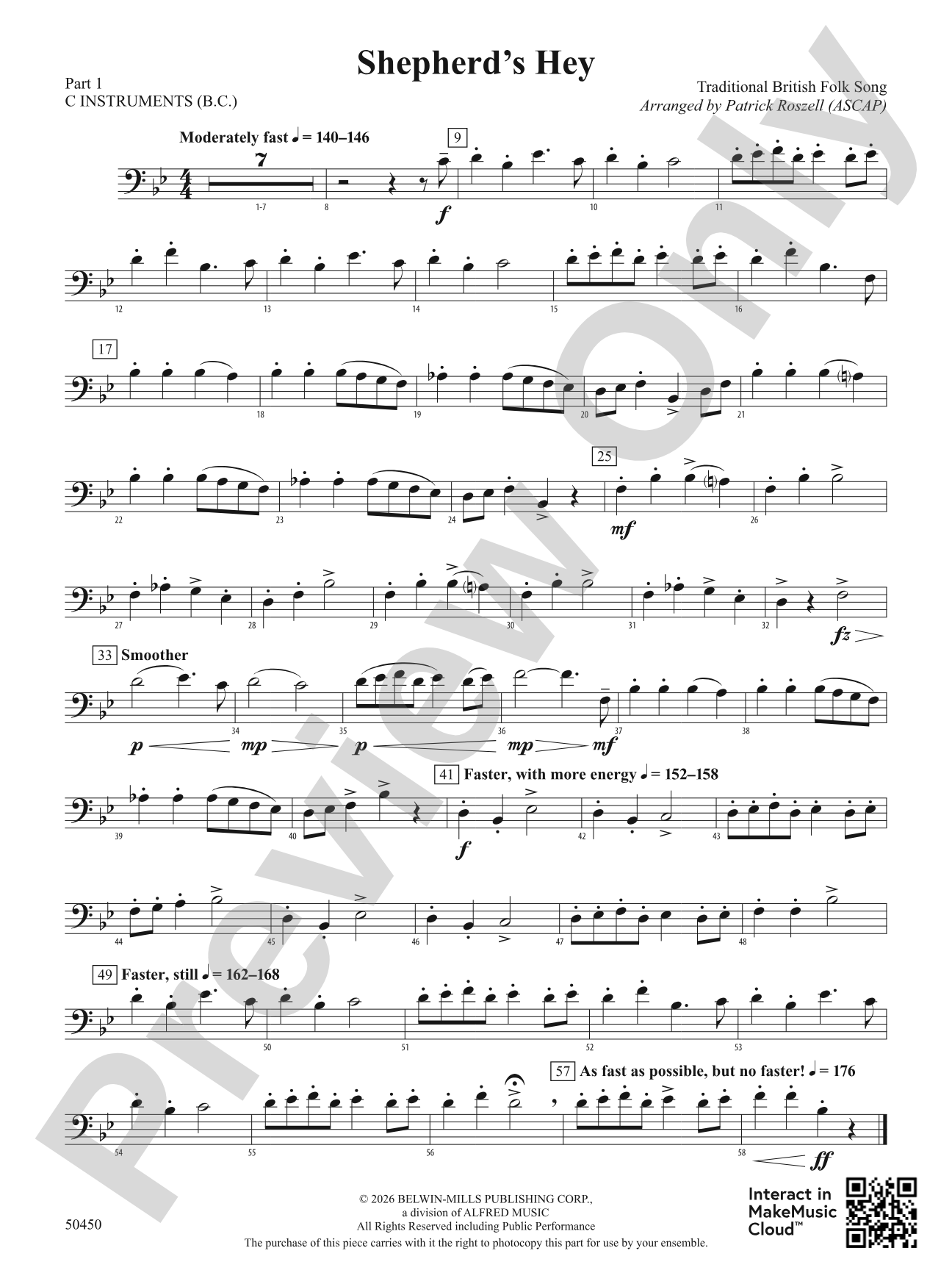

Shepherd's Hey: Part 1 - C Instruments (B.C.)
Traditional British Folk Song / arr. Patrick Roszell
Grade: 1
Item: 00-PC-0019656_PART1_CBC
$3.00
Pickup currently not available
Description
This version of Shepherd's Hey by Partick Roszell is part of our Belwin FLEX offerings and is designed with maximum flexibility for use by any mix of instruments---wind, strings, and percussion, including like- or mixed-ensembles with as few as 5 players. The suggested instrumentation and a customizable Teacher Map will help you plan out how to best assign parts to suit your ensemble's needs. It also comes with supplemental parts for maximum flexibility. With the purchase of this piece, permission is granted to photocopy the parts as needed for your ensemble. A percussion accompaniment track is also available as a free download. String parts have been carefully edited with extra fingerings and appropriate bowings to support students in mixed ensembles playing in less familiar keys.
This very familiar traditional British folk song scored for Belwin's FLEX series, with a simple melodic statement. The arrangement by Partick Roszell builds in intensity and tempo through the final musical punctuation. Subtle intricacies are clearly demonstrated with the addition of characteristic counter melodic material. A solid choice, your band will sound polished and professional! (1:45)
Percussion Accompaniment Track Downloads:
with click
without click


This very familiar traditional British folk song scored for Belwin's FLEX series, with a simple melodic statement. The arrangement by Partick Roszell builds in intensity and tempo through the final musical punctuation. Subtle intricacies are clearly demonstrated with the addition of characteristic counter melodic material. A solid choice, your band will sound polished and professional! (1:45)
Percussion Accompaniment Track Downloads:
with click
without click
Shepherd's Hey: Part 1 - C Instruments (B.C.) isn't in MakeMusic Cloud just yet...but it could be. Let us know you'd like to see it, and you'll help shape what comes next. In the meantime, start a free trial and dive into thousands of interactive titles your students can play along with today.
Request This Title
Tell us you want it.
Start Your Free Trial
Explore everything that's ready to play right now.
Sample Audio
1
Audio File
--:--
0:00
0:00
Sample Video
No sample videos found.
Additional Details
Series:
Belwin Beginning Band
Publisher:
Alfred Music
SKU:
00-PC-0019656_PART1_CBC
More about this title
Why we love this
Patrick Roszell's arrangement respects the simplicity of this beloved folk melody while layering in counter melodic material that keeps the piece engaging for players across skill levels. The careful string editing—with extra fingerings and bowings tailored for mixed ensembles—means your string players won't feel like afterthoughts in a wind-dominated score. Most importantly, the flexibility genuinely works: you can perform this with five players or thirty, and it will sound intentional either way.
What to expect
Shepherd's Hey radiates the cheerful energy of a traditional British village dance, with a melody that sits comfortably in most players' ranges. The arrangement unfolds with gentle momentum, never losing its folk-song character while building subtle texture and complexity underneath the tune. By the final punctuation, the familiar melody has earned real musical weight.
Who it's for
This arrangement fits mixed ensembles and flexible instrumentation groups where instrumentation changes from rehearsal to rehearsal or where you're building confidence in newer players. Grade 1 difficulty makes it accessible for beginning bands, beginning string orchestras, and combined groups just learning to play together. It's also valuable for small school programs where every player matters and missing a section can derail a rehearsal.
How to get the most out of it
- Map out your instrumentation well before the first rehearsal using the provided Teacher Map. Even small ensembles benefit from having melody, harmony, and bass parts clearly assigned so no section feels lost.
- Pay attention to the tempo buildup indicated throughout the arrangement. The piece gains energy through small incremental changes, not sudden jumps, so rehearse these transitions deliberately across several run-throughs.
- Use the free percussion accompaniment track during early rehearsals to lock the ensemble's sense of pulse and phrasing while intonation is still being refined.
- Bring out the counter melodic material in the secondary instruments. These lines prevent the piece from feeling like a simple melody-and-chords exercise and reward the players who support the tune.
How to use it
Program this early in the year when you're still solidifying who plays what in your ensemble. Its straightforward structure and familiar tune make it an excellent anchor piece for a mixed-instrumentation concert, and it pairs well with other Grade 1 folk-based repertoire. The manageable length (1:45) also makes it suitable for festivals or contests where you want to showcase your ensemble's cohesion without overcommitting rehearsal time to a single piece.
Skills your students will build
- Playing confidently in mixed instrumental ensembles
- Reading and responding to written fingerings and bowings on string parts
- Balancing melodic and accompaniment roles within Grade 1 arrangements
- Listening across different instrument families for pitch accuracy and blend
- Recognizing and executing tempo changes that build intensity gradually