
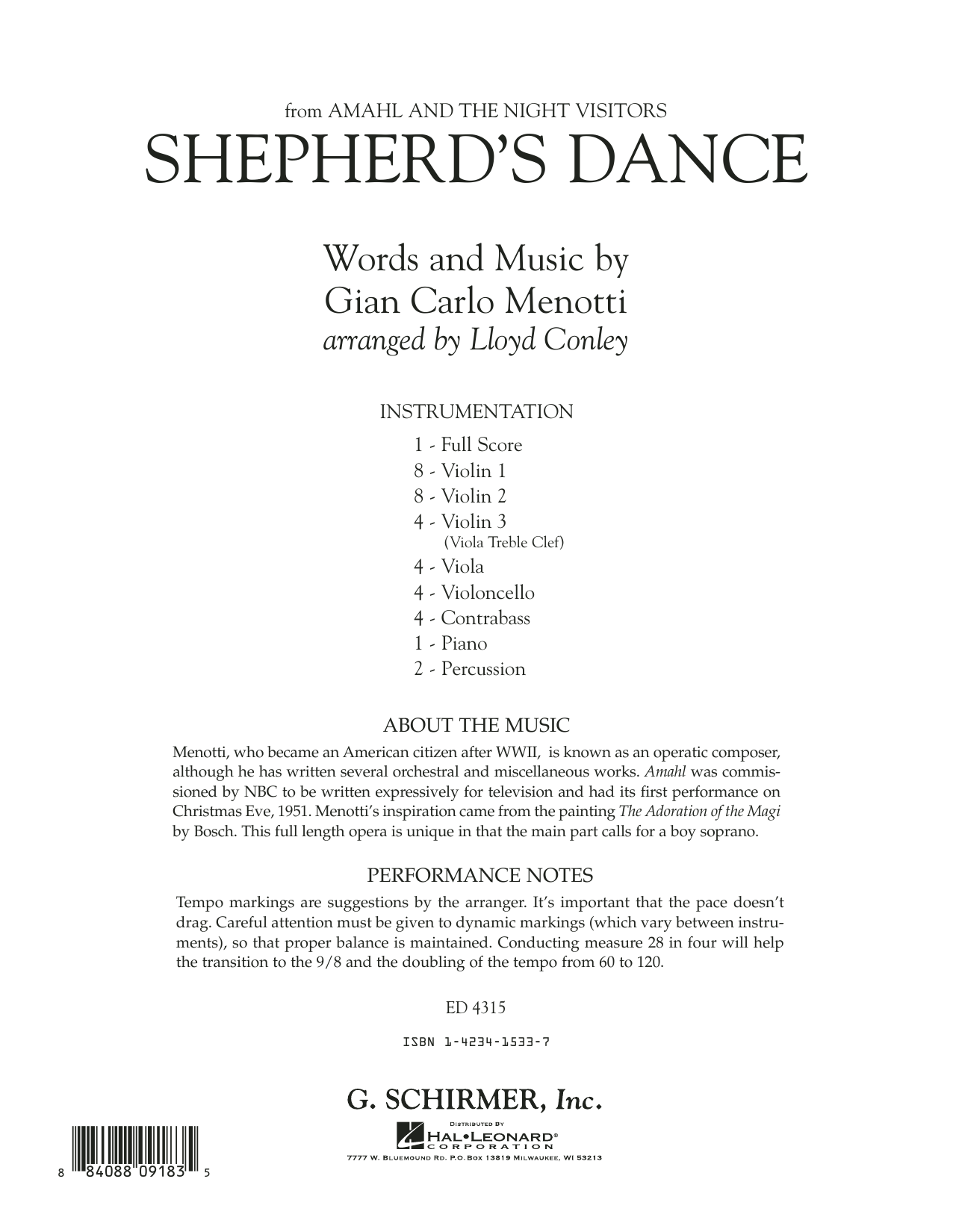

Shepherd's Dance (from Amahl and the Night Visitors): String Orchestra Conductor Score & Parts
By Gian Carlo Menotti / Arranged by Lloyd Conley
Grade: 3
Item: 35-PK00329685
$50.00
Pickup currently not available
Buy Extra Parts (Digital PDF Download)
Parts Added to Cart!
Description
"Amahl and the Night Visitors" was the first opera to be commissioned especially for television and was premiered in 1951. With this well-crafted setting by Lloyd Conley, string orchestras can enjoy the charming stage music from this enduring holiday production. (G. Schirmer, Inc.)


Shepherd's Dance (from Amahl and the Night Visitors): String Orchestra Conductor Score & Parts isn't in MakeMusic Cloud just yet...but it could be. Let us know you'd like to see it, and you'll help shape what comes next. In the meantime, start a free trial and dive into thousands of interactive titles your students can play along with today.
Request This Title
Tell us you want it.
Start Your Free Trial
Explore everything that's ready to play right now.
Sample Audio
No sample audio found.
Sample Video
No sample videos found.
Additional Details
Publisher:
Hal Leonard
SKU:
35-PK00329685
More about this title
About the Composer: Gian Carlo Menotti
Gian Carlo Menotti (1911-2007) was an Italian-American composer who fundamentally changed the landscape of American opera. He wrote primarily for the stage, crafting works that prioritized melody and emotional directness over experimental techniques. His operas became staples of regional companies and educational institutions precisely because they combined accessibility with genuine musical substance.
Menotti's most significant contribution to music education came through his creation of "Amahl and the Night Visitors" in 1951, which introduced millions of listeners to opera through television. The work's enduring appeal lies in its ability to move audiences of all ages while remaining performable by school ensembles. His orchestrations consistently demonstrate careful consideration for the performers, balancing musical integrity with practical accessibility.
Why we love this
Conley's orchestration captures the gentle storytelling magic of Menotti's original without overwhelming younger string players. The charming melodic content and straightforward harmonic language make this an ideal vehicle for developing musicianship during the holiday season, when rehearsal schedules often challenge traditional concert preparation. Programming this piece signals to your community that holiday music can be both accessible and artistically satisfying.
What to expect
The piece evokes a village celebration viewed through a lens of quiet wonder. Flowing melodic lines and gentle rhythmic motion create the sensation of watching something both joyful and intimate unfolding in the distance. The orchestration allows each string section to contribute meaningfully to the overall warmth.
Who it's for
String orchestras at the intermediate level seeking repertoire that connects genuine musical substance with holiday programming needs. Conductors working with players who are developing independence within a section will find this arrangement particularly valuable, as it requires careful listening without demanding advanced technical facility.
How to get the most out of it
- Balance the melody between first and second violins so the pastoral character emerges clearly; the dance rhythms should feel light rather than driving
- Adjust tempo slightly based on your ensemble's comfort with the rhythmic subdivisions; a steady, moderate pace allows younger players to focus on tone quality
- Shape phrases in two or four-measure units to avoid the piece sounding metronomic; conductor cues at phrase beginnings help maintain cohesion
- Keep pizzicato passages (if present in the arrangement) articulate but not percussive; this supports the intimate, storytelling quality
How to use it
Include this as an opening work on a holiday concert, where its moderate energy and immediate melodic appeal engage audiences effectively before shifting to more substantial repertoire. It also serves beautifully as a bridge between fall concert season and winter break, offering your ensemble a chance to explore Menotti's orchestral writing while maintaining holiday thematic connections.
Skills your students will build
- Phrasing across dynamic changes within a consistent harmonic palette
- Sectional balance in sustained melodic passages
- Maintaining consistent articulation across pizzicato and arco textures
- Following a conductor's tempo and interpretive choices in a folk-like melodic context
- Responding to character-based musical direction rather than technical complexity alone