
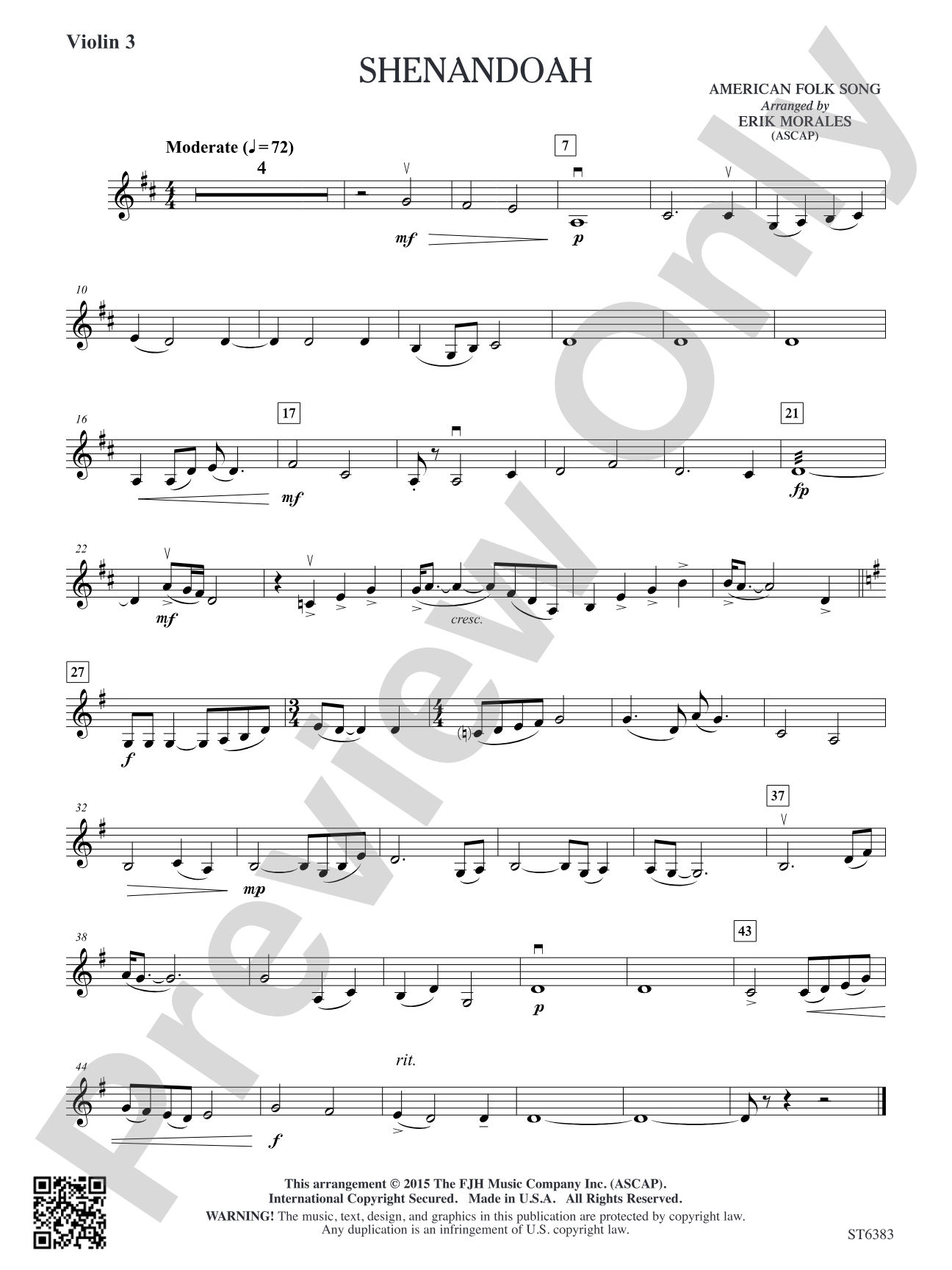

Shenandoah: Violin 3 (Viola T.C.)
Arranged by Erik Morales
Grade: 3
Item: 98-PC-DST6383_VN3
$7.00
Pickup currently not available
Description
A simple, plaintive opening sets the stage for this remarkable arrangement of a classic folk song. Engaging and complex harmonies weave seamlessly with gorgeous countermelodies as the arrangement develops. A stunning and powerful work that will leave your audience breathless.


Shenandoah: Violin 3 (Viola T.C.) isn't in MakeMusic Cloud just yet...but it could be. Let us know you'd like to see it, and you'll help shape what comes next. In the meantime, start a free trial and dive into thousands of interactive titles your students can play along with today.
Request This Title
Tell us you want it.
Start Your Free Trial
Explore everything that's ready to play right now.
Sample Audio
1
Audio File
--:--
0:00
0:00
Sample Video
No sample videos found.
Additional Details
Series:
FJH String Orchestra
Publisher:
The FJH Music Company, Inc.
SKU:
98-PC-DST6383_VN3
More about this title
About the Arranger: Erik Morales

Erik Morales has established himself as a prolific composer and arranger with a gift for balancing artistic integrity with pedagogical value. Born in New York City in 1966, he studied composition at Florida International University and completed his bachelor's degree at the University of Louisiana, Lafayette in 1989. His career took root when a high school band director hired him to arrange music for marching band in 1985, an opportunity that launched decades of work across wind, orchestral, jazz, and chamber settings. His trumpet works have earned particular acclaim, winning first place performances at the 2006 and 2008 National Trumpet Competitions, and his Concerto for Two Trumpets was premiered at the 2013 International Trumpet Guild conference.
With over 150 published works spanning classical, jazz, and commercial genres, Morales has become a fixture in educational music publishing since 2002. His arrangements and compositions are performed worldwide by schools and professional ensembles alike, and he receives regular commissions from institutions nationwide. In 2016, he was inducted into the Louisiana Association for Jazz Education's Hall of Fame, a testament to his sustained impact on music education and performance.
Why we love this
Morales respects the folk melody while building genuine harmonic and contrapuntal interest around it. The arrangement moves beyond accompaniment into genuine orchestration, giving string players real musical work to do without sacrificing the song's emotional core. At Grade 3, it delivers sophistication that students can actually execute, making it ideal for orchestras ready to program something with real substance.
What to expect
The piece begins in stillness, letting the familiar melody breathe in its most naked form. As it develops, harmonies and countermelodies emerge from underneath, creating texture and warmth without overwhelming the folk tune's core identity. By the end, you experience something both timeless and newly discovered.
Who it's for
String orchestras at the intermediate level seeking repertoire that challenges their musicianship without requiring advanced technical facility. This works equally well for community orchestras, school ensembles, and youth orchestras ready to move beyond unison arrangements into genuine multi-part writing.
How to get the most out of it
- Balance the opening simplicity carefully; the plaintiveness depends on restraint in both tone and intonation before the arrangement unfolds.
- Trace the countermelody lines through all sections so every player understands how their part relates to the folk tune.
- Shape the harmonic progressions as deliberately as you would shape a melodic line; Morales's harmonies are the architecture here.
- Use the dynamic markings to highlight how the arrangement builds complexity; they chart the emotional arc of the piece.
How to use it
Program this as a centerpiece for a concert built around American folk traditions, or pair it with contemporary pieces to show how arranged classics sit alongside original works. It also programs beautifully in contests and festivals where Grade 3 orchestras compete, as it demonstrates maturity and musical insight rather than flashy technique.
Skills your students will build
- Balancing multiple independent melodic lines while maintaining textural clarity
- Responding to harmonic color and how it shapes phrasing
- Intonation in sustained harmonies with moving countermelodies
- Understanding how arrangers reimagine familiar material through orchestration