
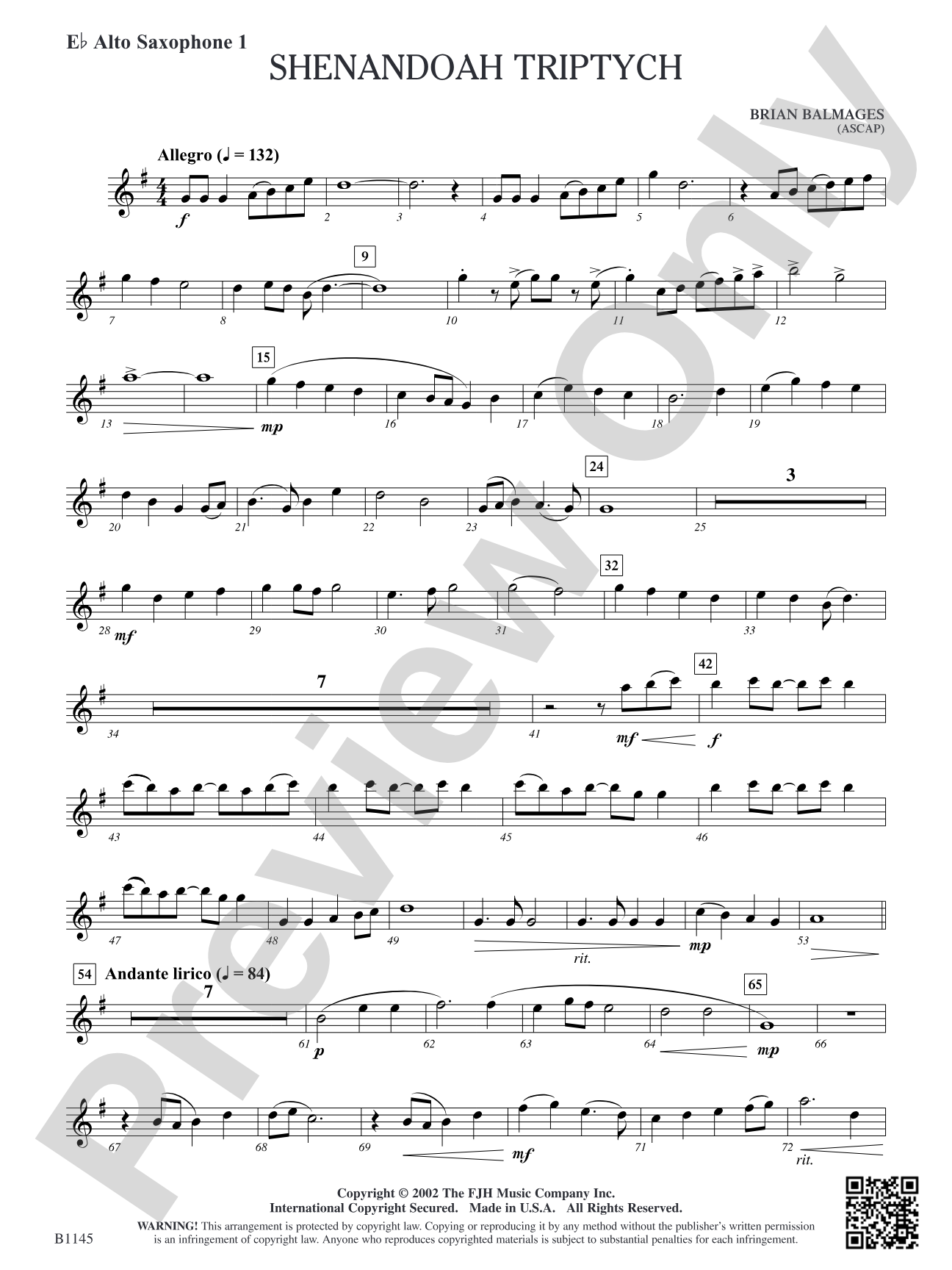

Shenandoah Triptych: E-flat Alto Saxophone 1
By Brian Balmages
Grade: 2.5
Item: 98-PC-DB1145_AX1
$7.00
Pickup currently not available
Description
This three-part fantasy opens with a brisk, light style. The piece moves quickly into a lyrical treatment of Shenandoah. A restatement of the opening motif leads into a slower section in which the original theme is presented both backward and forward in a beautiful harmonic setting. A final section utilizes additional melodic variations and a chorale setting under a woodwind ostinato before coming to a dynamic conclusion. An ideal festival piece! (5:20)


Don't just read it, hear it, play along with it, and watch your students grow with it. In MakeMusic Cloud, Shenandoah Triptych: E-flat Alto Saxophone 1 comes alive with professional accompaniment, adjustable tempo, and built-in practice tools that turn solo practice into real progress.
Open in the Player
Jump straight in and assign it today.
Start Your Free Trial
Open this title and explore the full library in minutes.
Sample Audio
1
Audio File
--:--
0:00
0:00
Sample Video
No sample videos found.
Additional Details
Series:
FJH Young Band
Publisher:
The FJH Music Company, Inc.
SKU:
98-PC-DB1145_AX1
More about this title
About the Composer: Brian Balmages

Brian Balmages has built a career as a composer and conductor working across orchestral, band, and chamber music with equal fluency. His works have reached audiences at Carnegie Hall, the Kennedy Center, Sydney Opera House, and the Toronto Centre for the Arts, performed by ensembles ranging from professional orchestras to school groups. He holds membership in the American Bandmasters Association and received the A. Austin Harding Award from the American School Band Directors Association, along with the 2020 NBA William D. Revelli Composition Contest prize for Love and Light.
Balmages maintains active guest conducting relationships with all-state and regional ensembles, university groups, and professional orchestras worldwide. His work has appeared in significant national contexts, including the 2013 Presidential Inaugural Prayer Service. He currently serves as Director of MakeMusic Publications and Digital Education for Alfred and MakeMusic, and holds the inaugural James Madison University Distinguished Alumni Award from the School of Visual and Performing Arts.
Why we love this
The arc of this piece rewards careful attention to contrast. Balmages understands that Grade 2.5 bands work best when given clear structural signposts and distinct musical landscapes to navigate, and he delivers all three here: a snappy opening, a singing treatment of the folk tune at the heart of the work, and developmental material that lets younger players hear how a melody transforms. The restatement using inversion alongside the original theme is the kind of compositional craft that plants seeds in students' ears about what's possible in their own writing.
What to expect
The opening sparkles with energy and forward motion. When the familiar melody enters, the piece settles into something reflective and graceful, inviting the ear to follow each phrase. The harmonic landscape grows richer as the piece develops, building toward a final section that feels both expansive and triumphant.
Who it's for
Directors working with Grade 2.5 concert bands who need festival repertoire that sounds mature without demanding virtuosic chops. This piece serves well in programs where you want to teach form and thematic development while keeping technical demands reasonable.
How to get the most out of it
- Shape the opening section with precise articulation and light dynamics. The briskness depends on clarity, not speed; let the rhythm section establish a confident pulse that the woodwinds can sit into cleanly.
- Bring out the Shenandoah melody as a unified voice across your ensemble. This lyrical section lives or dies by balance; mark who has tune and who supports, and rehearse those relationships from the start.
- When the theme appears in inversion during the slower section, isolate that passage in rehearsal so students hear what's happening underneath the beautiful harmony. This is a teaching moment that strengthens their ear for compositional technique.
- Let the final chorale breathe. The woodwind ostinato underneath provides harmonic motion; resist the urge to rush, and shape each phrase of the chorale as a complete thought before moving forward.
How to use it
Position this as a concert centerpiece that anchors a patriotic or Americana theme, or use it to open a program with something that catches attention immediately before shifting tone. The 5:20 duration fits neatly into festival rotations, and the three-part structure makes it an effective showcase of your band's range in a single piece.
Skills your students will build
- Phrasing and shaping a single melody across multiple presentations and harmonic contexts
- Reading and executing thematic inversion and compositional variation
- Balance and blend when doubling parts across sections
- Transition between contrasting tempos and styles while maintaining musical continuity
- Understanding form through a clear three-section architecture