
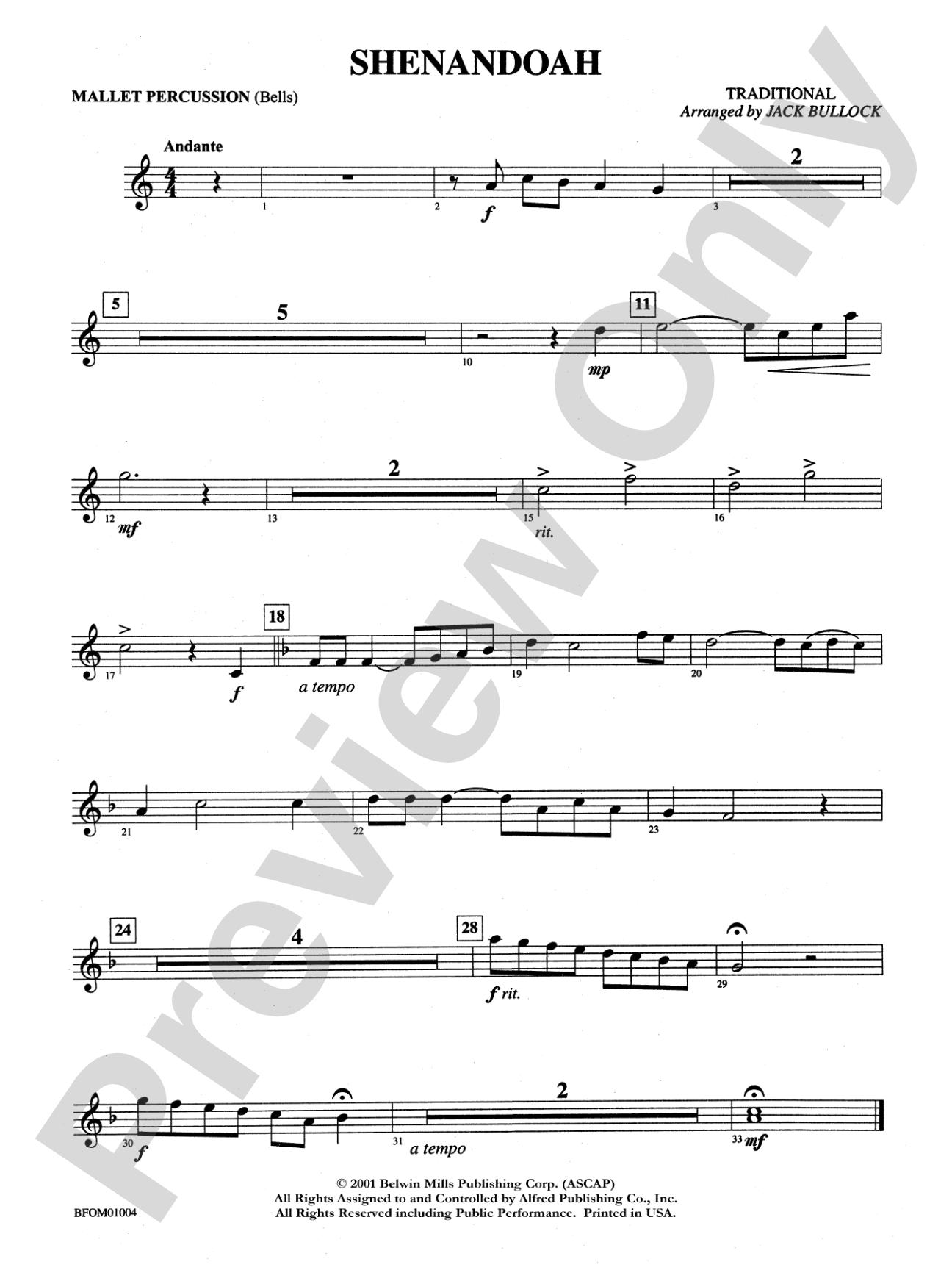

Shenandoah: Mallets
Traditional / arr. Jack Bullock
Grade: 2.5
Item: 00-PC-0002225_M1
$3.00
Pickup currently not available
Description
A lush new orchestration of the traditional American folk melody. Exquisite harmonies enhance the expressive nature of the arrangement. Suitable for strings alone or with supplementary winds, this programmatic selection will cultivate the concepts of both tone and balance. (2:21)


Don't just read it, hear it, play along with it, and watch your students grow with it. In MakeMusic Cloud, Shenandoah: Mallets comes alive with professional accompaniment, adjustable tempo, and built-in practice tools that turn solo practice into real progress.
Open in the Player
Jump straight in and assign it today.
Start Your Free Trial
Open this title and explore the full library in minutes.
Sample Audio
1
Audio File
--:--
0:00
0:00
Sample Video
Additional Details
Series:
Belwin Intermediate String/Full Orchestra
Publisher:
Alfred Music
Page Count:
132
SKU:
00-PC-0002225_M1
More about this title
About the Arranger: Jack Bullock

Jack Bullock brings three decades of hands-on experience across performance, composition, and music education. A trumpet player who performed with the Miami Philharmonic Orchestra and Miami Opera Company, he has also worked regionally with show bands and nationally with traveling ensembles. His academic credentials include undergraduate, graduate, and doctoral degrees in Music Education, and his twenty years teaching instrumental music includes seven years as assistant band director at Ithaca College's School of Music.
With over 600 published works spanning concert band, orchestra, jazz ensemble, and marching band, Bullock has established himself as a prolific arranger and composer. He co-authored the Belwin 21st Century Band Method and served as contributing arranger for Alfred Music's Music Expressions curriculum. A member of ASCAP since 1980, he has conducted clinics and workshops across the United States, Canada, and England.
Why we love this
Bullock's orchestration transforms this familiar melody into something immediately rewarding while remaining accessible at the intermediate level. The arrangement's flexibility to work with strings alone or with winds makes it valuable programming without requiring a full pit, and the focus on tone production and balance addresses genuine pedagogical needs rather than simply showcasing virtuosity. For contest and festival seasons, this piece delivers musicality and ensemble development in just over two minutes.
What to expect
The orchestration wraps Shenandoah in rich, contemplative harmonies that honor the folk melody's inherent dignity. You'll feel the piece unfold with restraint and warmth, emphasizing sustained tones and carefully voiced supporting parts rather than the flashy arrangement approach. It's the kind of music that rewards listening as much as it rewards playing.
Who it's for
This arrangement suits intermediate orchestras and upper-level school ensembles looking for substantial musical content at Grade 2.5. It works equally well for directors building tone and balance skills or preparing concert and festival repertoire that demands expressive maturity without technical excess.
How to get the most out of it
- Approach the opening statement as if introducing a question. The melody needs space and breath, not momentum; shape it through long-line phrasing rather than measure-by-measure execution.
- Balance the inner voices carefully during harmonic passages. Because the arrangement relies on lush harmonies for its character, secondary voices can easily overshadow the melody if strings aren't careful about dynamic layering.
- Let the recorded accompaniment guide pulse, but train your ensemble to listen for it rather than depend on it. Use rehearsals without the track to build genuine rhythmic independence.
- Pay attention to transitions between sections. Even brief shifts in texture or orchestration need preparation so they land with intention instead of sounding accidental.
How to use it
Program this early in the concert season when building tone and balance are active teaching priorities. It pairs naturally with other American folk settings or sits effectively as a solo concert selection at festivals. The runtime and contest designation make it ideal for students first encountering programmatic performance without lengthy rehearsal demands.
Skills your students will build
- Sustaining long melodic lines with consistent tone quality
- Balancing inner voices within lush harmonic textures
- Listening to and adjusting within a supported accompaniment
- Shaping expressive phrasing across four-to-eight-bar units
- Understanding arrangement and orchestration as compositional tools