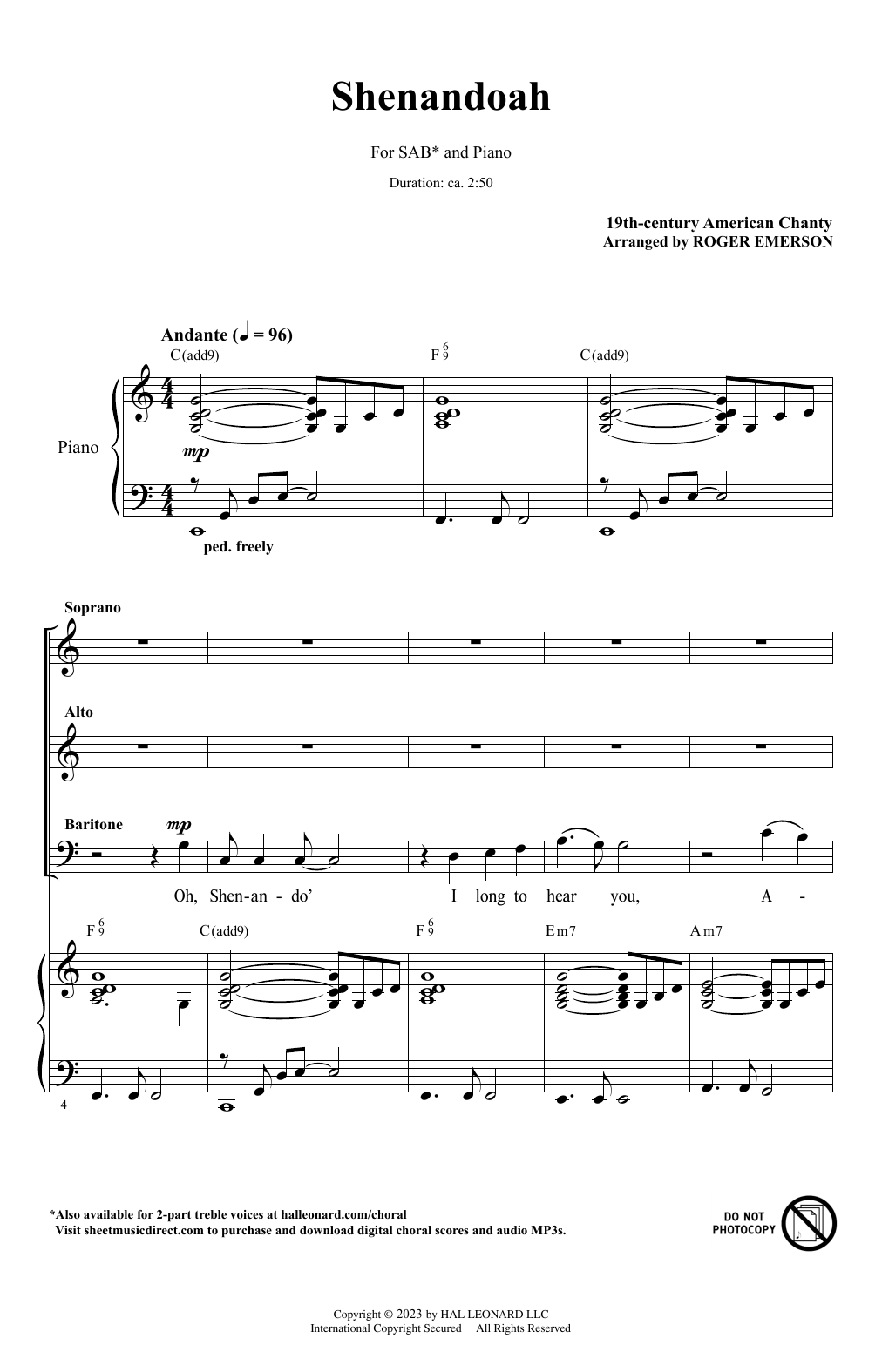
Shenandoah (arr. Roger Emerson) Sheet Music Preview

Shenandoah (arr. Roger Emerson): SAB Choral Octavo

Arranged by Roger Emerson

Item: 35-DS01204210

Digital Download
$2.75
Description

Shenandoah (arr. Roger Emerson): SAB Choral Octavo isn't in MakeMusic Cloud just yet...but it could be. Let us know you'd like to see it, and you'll help shape what comes next. In the meantime, start a free trial and dive into thousands of interactive titles your students can play along with today.

Sample Audio
No sample audio found.
Sample Video
Additional Details
Publisher: Hal Leonard
Page Count: 9
SKU: 35-DS01204210

More about this title

About the Arranger: Roger Emerson

Roger Emerson has built a career creating accessible choral arrangements that respect the integrity of traditional material while opening it to singers of varying experience levels. His work across SAB, SATB, and unison voicings has made him a trusted resource for directors seeking repertoire that sounds sophisticated without demanding virtuosic technique.

Why we love this

Emerson's treatment of this American spiritual preserves its contemplative depth while making it singable for mixed ensembles without a tenor section. The nine-page score gives you enough musical substance to create a meaningful moment in concert without the rehearsal overhead of more demanding arrangements.

What to expect

There's a quiet longing here, the kind of straightforward emotion that folk songs express best. The piece unfolds with patience, letting the text and melody do the work rather than relying on harmonic complexity.

Who it's for

This arrangement serves choirs at the middle school through early high school level, as well as community and adult ensembles looking for dignified folk material that doesn't require extensive prior arranging knowledge to prepare. It's ideal for programs building repertoire quickly without sacrificing musical quality.

How to get the most out of it

  • Shape the phrases by thinking through the text, especially the river imagery in the melody. Avoid a metronomic approach that deadens the song's natural breathing points.
  • Balance the parts so the soprano line remains audible without forcing. The arrangement likely sits the melody high, making it easy for altos and baritones to disappear if they pull back.
  • Explore the dynamic range available within the arrangement. A folk song doesn't demand constant pp, and small crescendos and diminuendos can bring genuine expression to repetitive melodic material.

How to use it

This works beautifully on a concert exploring American roots music, particularly if you're pairing it with spirituals or work songs from the same tradition. It also serves as an excellent palate cleanser between more dramatic pieces, offering audiences a moment of reflection without feeling like filler.

Skills your students will build

  • Singing with legit breath support across sustained phrases
  • Balancing three-part mixed voicing without doubling
  • Interpreting text-driven phrasing in traditional material
  • Blending register transitions between different vocal ranges

You May Also Like