
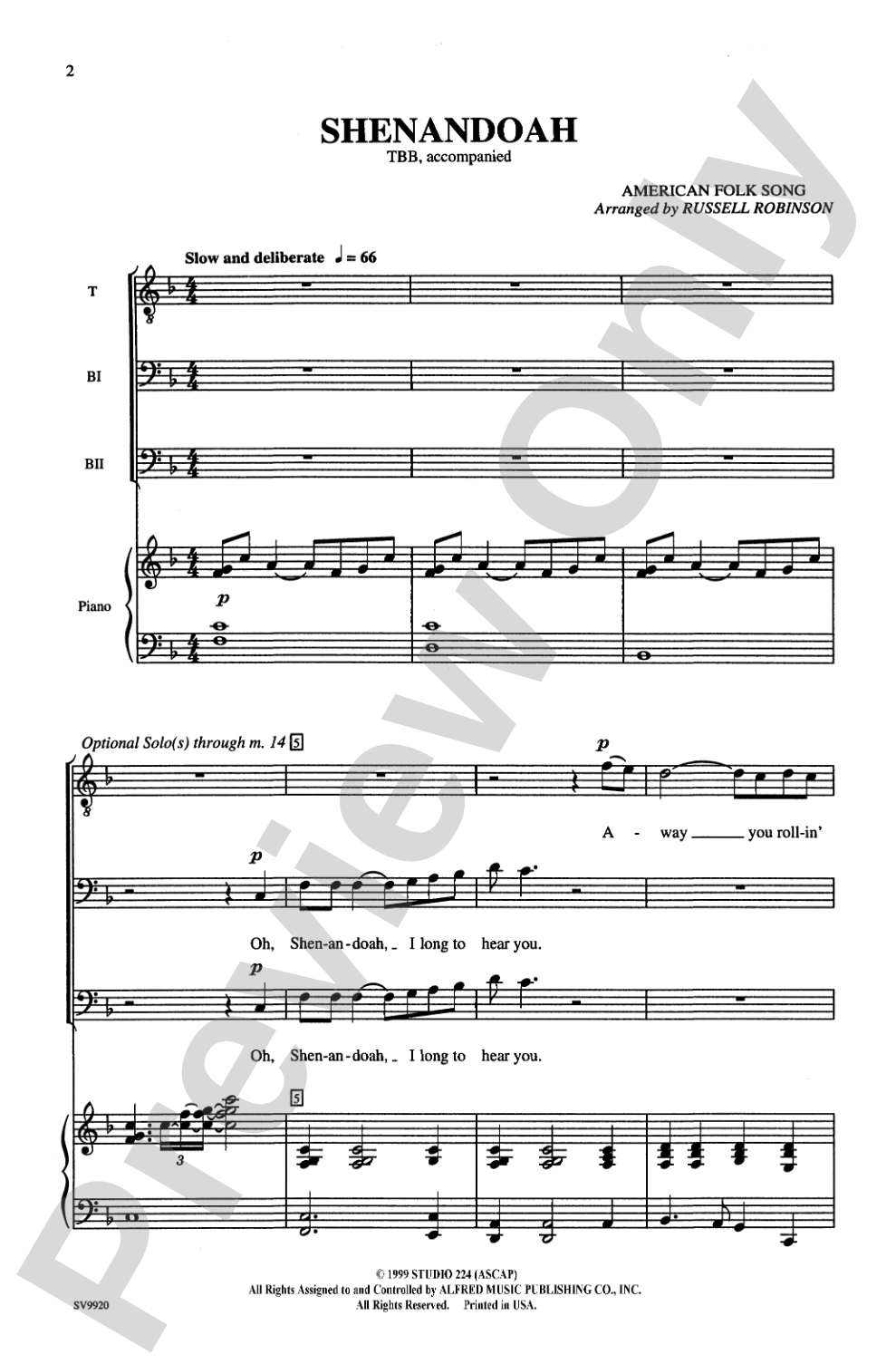
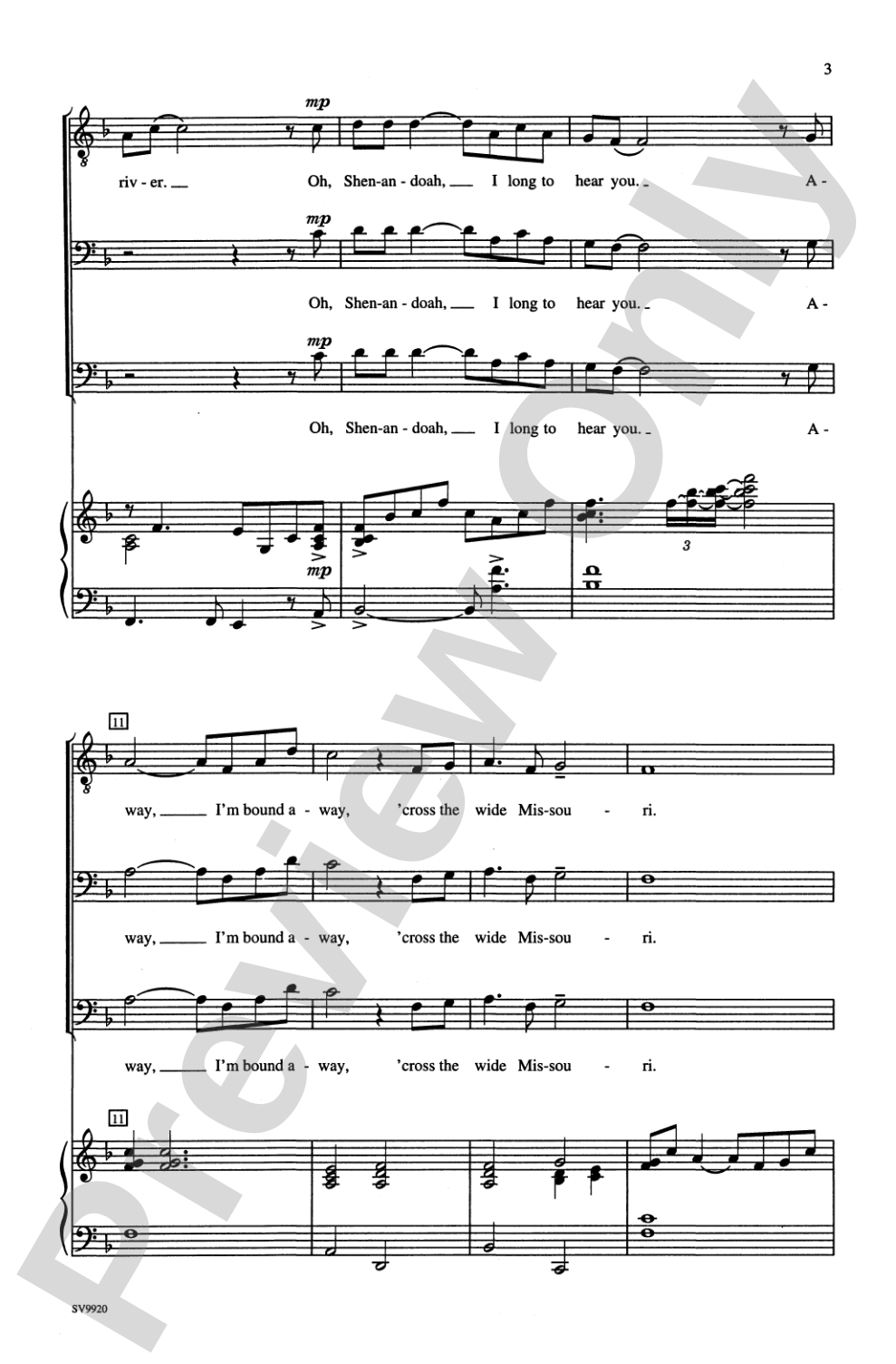

Shenandoah: TBB Choral Octavo
American Folk Song / arr. Russell Robinson
Item: 00-PO-0005305
$2.25
Minimum order quantity: 20 copies
Pickup currently not available
Description
This beautiful setting of the great American folk classic was originally released for men's choirs in 1999. Now it's available in both SATB and Three-Part Mixed editions. The gorgeous choral writing makes this one you should seriously consider adding to your library.


Shenandoah: TBB Choral Octavo isn't in MakeMusic Cloud just yet...but it could be. Let us know you'd like to see it, and you'll help shape what comes next. In the meantime, start a free trial and dive into thousands of interactive titles your students can play along with today.
Request This Title
Tell us you want it.
Start Your Free Trial
Explore everything that's ready to play right now.
Sample Audio
No sample audio found.
Sample Video
No sample videos found.
Additional Details
Series:
Alfred Archive Edition: Studio PR Catalog
Publisher:
Alfred Music
Page Count:
8
SKU:
00-PO-0005305
More about this title
About the Arranger: Russell Robinson

Russell Robinson's career spans five decades of conducting, composing, and arranging across every continent. He served as Emeritus Professor of Music Education at the University of Florida and held leadership roles including Associate Dean of the College of the Arts, President of the Florida Music Educators Association, and National Collegiate Chair and Choral Adviser for NAfME. His work has taken him to Carnegie Hall, Lincoln Center, the Kennedy Center, and the White House.
With over 500 publications to his name, Robinson has established himself as a prolific voice in choral music. His output spans choral compositions, arrangements, pedagogical articles, instructional videos, and books. The 2016 inductee into the FMEA Hall of Fame, Robinson continues to shape choral music education through his published work and his website, russellrobinson.com.
Why we love this
Robinson's arrangement captures the folk melody's inherent beauty while giving lower voices genuinely rewarding material. The 1999 original for men's voices has proven its durability, and this TBB edition opens the same elegant writing to more singers. It's the kind of setting that sounds effortless until your singers try to nail the voicing and realize Robinson has built depth and warmth into every measure.
What to expect
Shenandoah arrives as a meditation on longing and distance. Robinson's setting honors the folk melody's quiet yearning while surrounding it with warm, grounded harmony that feels both intimate and expansive. The writing invites singers to sink into full, resonant tones rather than racing through the familiar tune.
Who it's for
Directors of men's choirs, boy choirs, and unchanged or lower-voiced youth ensembles looking for literature with genuine musicality and emotional depth. This arrangement suits singers who can sustain a line and follow harmonic movement with confidence.
How to get the most out of it
- Let the melody breathe in the top voice without rushing; the simplicity of Shenandoah demands clean, unhurried phrasing from your tenors.
- Balance is everything here. Because the lower voices carry supporting harmony rather than a counter-melody, they need enough presence to anchor the sound without overshadowing the folk tune.
- Vowel consistency across the three parts will reveal the beauty of Robinson's voicing; unified vowels make the chords ring rather than fracture.
- Mark your phrase endings clearly in rehearsal so singers understand where the melody breathes and can shape their harmonic support accordingly.
How to use it
Pair this with other American folk settings or spirituals to build a concert of American choral heritage. Its gentle, reflective quality makes it ideal for a closing group or as a moment of repose within a more energetic program. This piece also works beautifully in community sings or heritage-focused festivals.
Skills your students will build
- Sustaining legit tones across longer phrases without strain or pitch sag
- Following harmonic movement in three-part voicing where the melody is not in all parts
- Balancing individual voice parts in a closely voiced arrangement
- Blending vowels across parts to create unified chord sonority