

Shenandoah: SAB Choral Octavo
Arr. Jay Althouse
Item: 00-PO-0002855
$2.25
Minimum order quantity: 20 copies
Pickup currently not available
Description
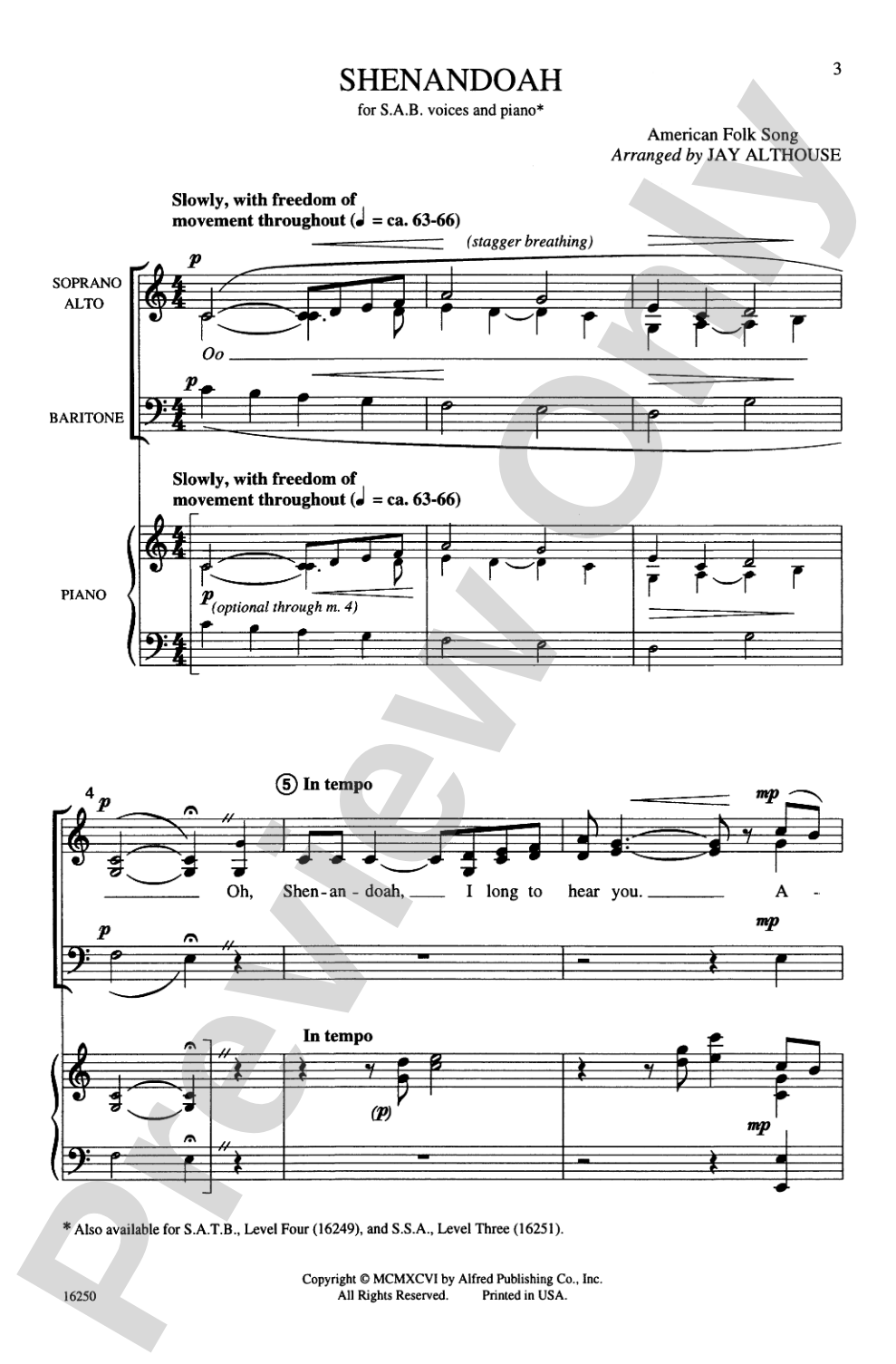
This is classic American choral writing. Opens with a legato "oo" passage which may be performed a cappella. Comfortable ranges. A timeless addition to your choral library.


Shenandoah: SAB Choral Octavo isn't in MakeMusic Cloud just yet...but it could be. Let us know you'd like to see it, and you'll help shape what comes next. In the meantime, start a free trial and dive into thousands of interactive titles your students can play along with today.
Request This Title
Tell us you want it.
Start Your Free Trial
Explore everything that's ready to play right now.
Sample Audio
1
Audio File
--:--
0:00
0:00
Sample Video
No sample videos found.
Additional Details
Series:
Alfred Archive Edition: Alfred Choral Designs
Publisher:
Alfred Music
Page Count:
8
SKU:
00-PO-0002855
More about this title
About the Arranger: Jay Althouse

Jay Althouse holds degrees in Music Education and Music from Indiana University of Pennsylvania, where he was later honored with the Distinguished Alumni award. His career spans both publishing and composition; he spent eight years in rights and licensing administration at a major educational music publisher and served on the Executive Board of the Music Publishers Association of America. As a composer, Althouse has more than 800 choral works in print across all difficulty levels, with music performed widely throughout English-speaking countries.
Althouse is a writer member of ASCAP and a consistent recipient of the ASCAP Special Award for his compositional output. Beyond choral writing, he has co-created children's musicals with his wife Sally K. Albrecht, compiled vocal solo collections, and written instructional resources for music classrooms including The Complete Choral Warm-up Book and Accent on Composers. He served on the board of the North Carolina Master Chorale and currently sits on the National Advisory Board of the Folk Art Society of America.
Why we love this
Althouse's arrangement respects the folk tune's inherent beauty while making it genuinely singable for mixed choirs at an accessible level. The opening legato 'oo' passage creates an immediate vocal warmth that can stand alone acoustically, giving you options for how to frame this familiar melody. It belongs in every choral library not because it's safe, but because it proves that American folk music, when arranged with care, never goes out of style.
What to expect
There is a quiet dignity in this arrangement. The opening spreads out over an 'oo' vowel as if voices are finding their way through gentle water. When text appears, the familiar melody becomes grounded in American identity without sentimentality or arrangement flourish getting in the way.
Who it's for
This arrangement works for high school, community college, and adult community choirs seeking a straightforward, rewarding addition to their repertoire. Its comfortable ranges and accessible voice writing make it ideal for groups that may include singers with limited reading experience but solid harmonic instincts.
How to get the most out of it
- Shape the opening 'oo' passage with a slight swell in the middle of longer phrases, even if singing a cappella; this prevents the sound from becoming static.
- Keep the soprano line singing the melody prominent, but ensure the alto and baritone parts maintain their harmonic integrity so the texture feels full rather than accompanied.
- Attend to diction during any text sections; folk arrangements thrive when words land clearly without sacrificing the legato singing that defines this piece.
- Balance the a cappella portions by having singers find the pitch confidently before the phrase begins, then sustain with a unified vowel sound.
How to use it
Program this as the emotional anchor in a set of American folk or folk-adjacent arrangements, or use it as a calming contrast to more energetic pieces in the same concert. Its a cappella opening makes it particularly effective as a concert opener or closer, and its eight pages fit naturally into any season's repertoire planning.
Skills your students will build
- Singing legato lines with consistent vowel shape and breath support
- Balancing melody with harmonic voices in three-part texture
- Sustaining pitch and tone in a cappella singing
- Interpreting folk melody with musical intent rather than mechanical delivery