
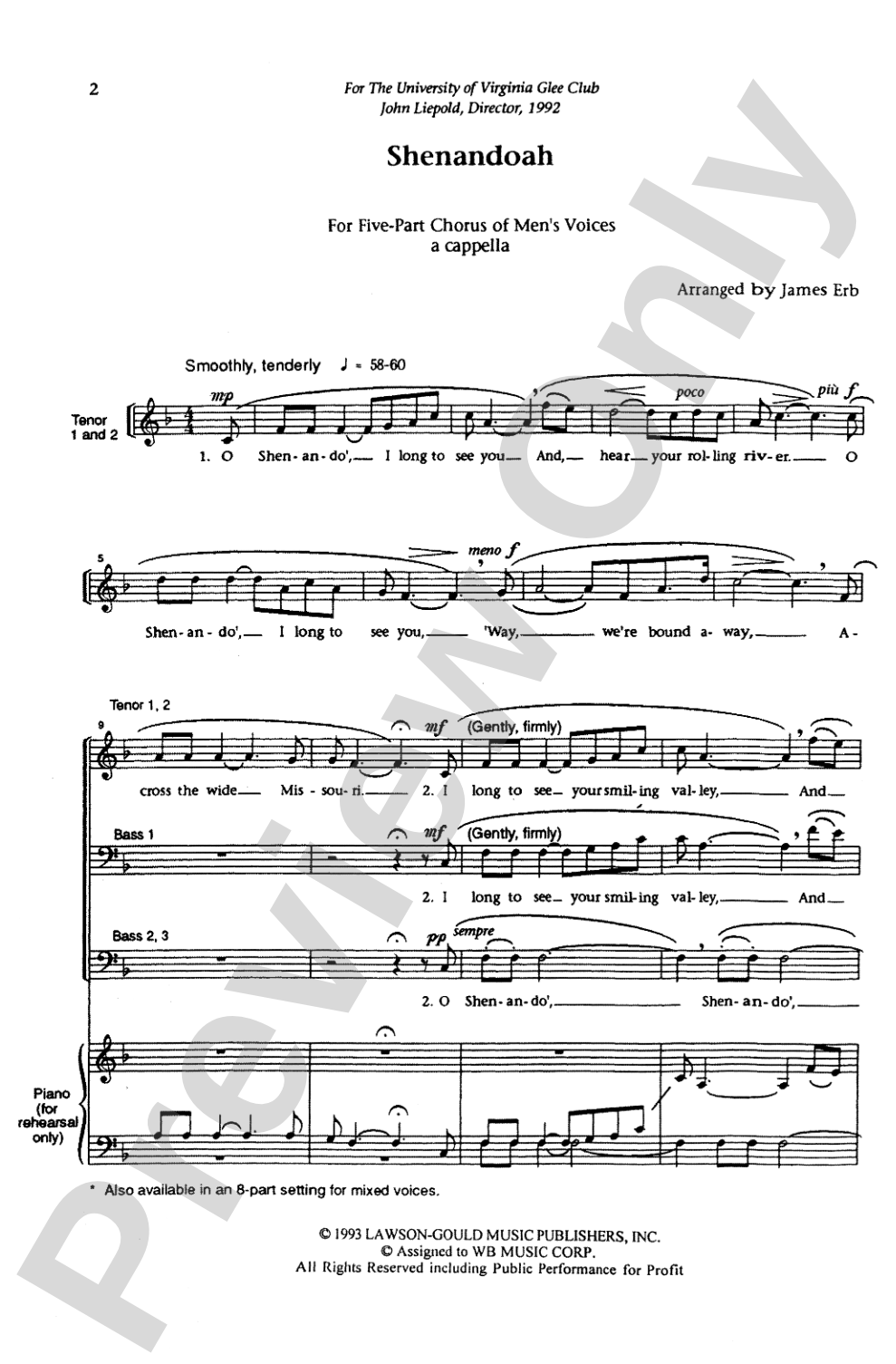
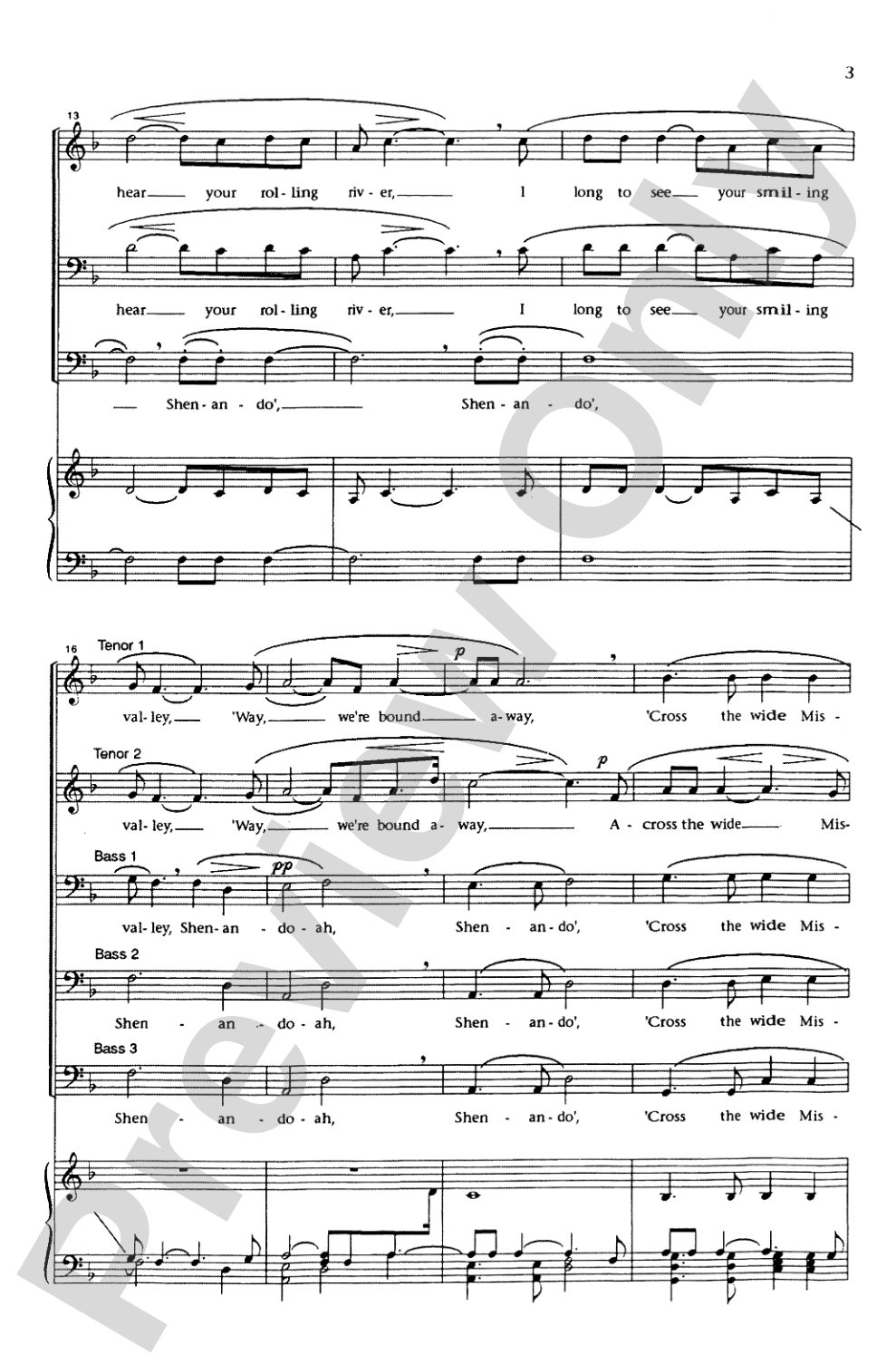
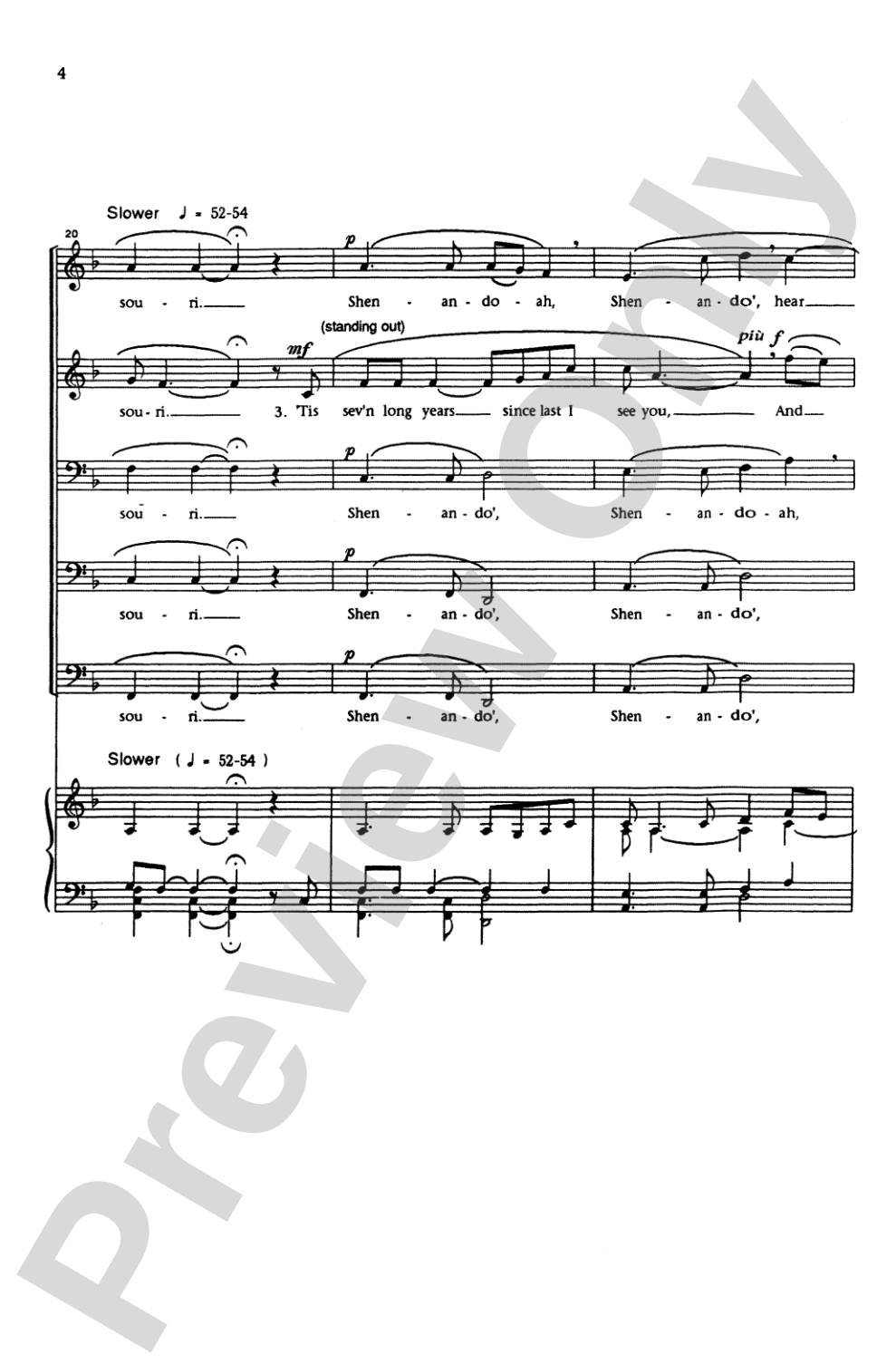

Shenandoah: TTBBB, a cappella Choral Octavo
American Folk Song / arr. James Erb
Item: 00-PO-0002679

$2.25
Minimum order quantity: 20 copies
Pickup currently not available
Description
James Erb's classic arrangement of the American folk song "Shenandoah" has taken its rightful place in contemporary choral literature. Alfred Music wishes to express their gratitude for the late composer's many contributions to choral music. Recording provided by Cincinnati's Vocal Arts Ensemble, directed by Craig Hella Johnson.


Don't just read it, hear it, play along with it, and watch your students grow with it. In MakeMusic Cloud, Shenandoah: TTBBB, a cappella Choral Octavo comes alive with professional accompaniment, adjustable tempo, and built-in practice tools that turn solo practice into real progress.
Open in the Player
Jump straight in and assign it today.
Start Your Free Trial
Open this title and explore the full library in minutes.
Sample Audio
1
Audio File
--:--
0:00
0:00
Sample Video
No sample videos found.
Additional Details
Series:
Alfred Archive Edition: Lawson-Gould Music Publishers
Publisher:
Alfred Music
Page Count:
12
SKU:
00-PO-0002679
More about this title
About the Arranger: James Erb
James Erb was a respected choral composer and arranger whose work became central to the Alfred/Lawson-Gould catalog. His arrangements of American folk material brought scholarly attention to vernacular traditions while remaining fully singable in school and community choir settings. Erb's gift was distilling complex harmonic language into parts that served the music rather than overshadowing it.
Why we love this
This arrangement captures the restless yearning of the original ballad without forcing false sophistication onto it. The TTBBB voicing creates natural weight in the lower voices, letting them anchor the melody while the tenors carry the essential narrative line. It's the kind of piece that sounds immediately singable but deepens with each rehearsal, revealing harmonic turns that feel inevitable rather than imposed.
What to expect
There's a quiet, almost austere beauty here. The harmonies move with purpose but never rush; you hear the river in the unfolding chords and feel the distance and longing that animate the lyric. The piece breathes like a landscape unfolding at dusk.
Who it's for
Men's and upper men's choirs at the high school, collegiate, and adult community level will find this arrangement sits naturally in their tessitura and rehearsal time budget. Directors seeking repertoire that authentically represents American song without condescension will recognize this as a standard-bearer in the genre.
How to get the most out of it
- Build the narrative arc across the entire piece rather than treating verse sections identically. Small dynamic shifts and slight tempo flexibility will honor the storytelling at the heart of this folk material.
- Balance the tenor melody against the lower voice parts carefully in rehearsal; the TTBBB voicing demands that inner voices resist the pull to oversing.
- Attend to vowel migration and resonance across the phrase arcs. The a cappella texture leaves no room for accompaniment to mask intonation drift.
How to use it
Program this as an anchor for a concert exploring American roots music, or place it alongside contemporary works to show the continuum between vernacular and composed traditions. Its modest length and a cappella format make it an ideal opening or closing statement, and it pairs naturally with spirituals, shape-note hymns, or other folk settings.
Skills your students will build
- Singing sustained a cappella intonation without instrumental support
- Balancing melody against harmonic underpinnings in close-voiced arrangements
- Shaping phrase arcs in folk material with minimal editorial markings
- Part independence in TTBBB voicing with limited doubling