
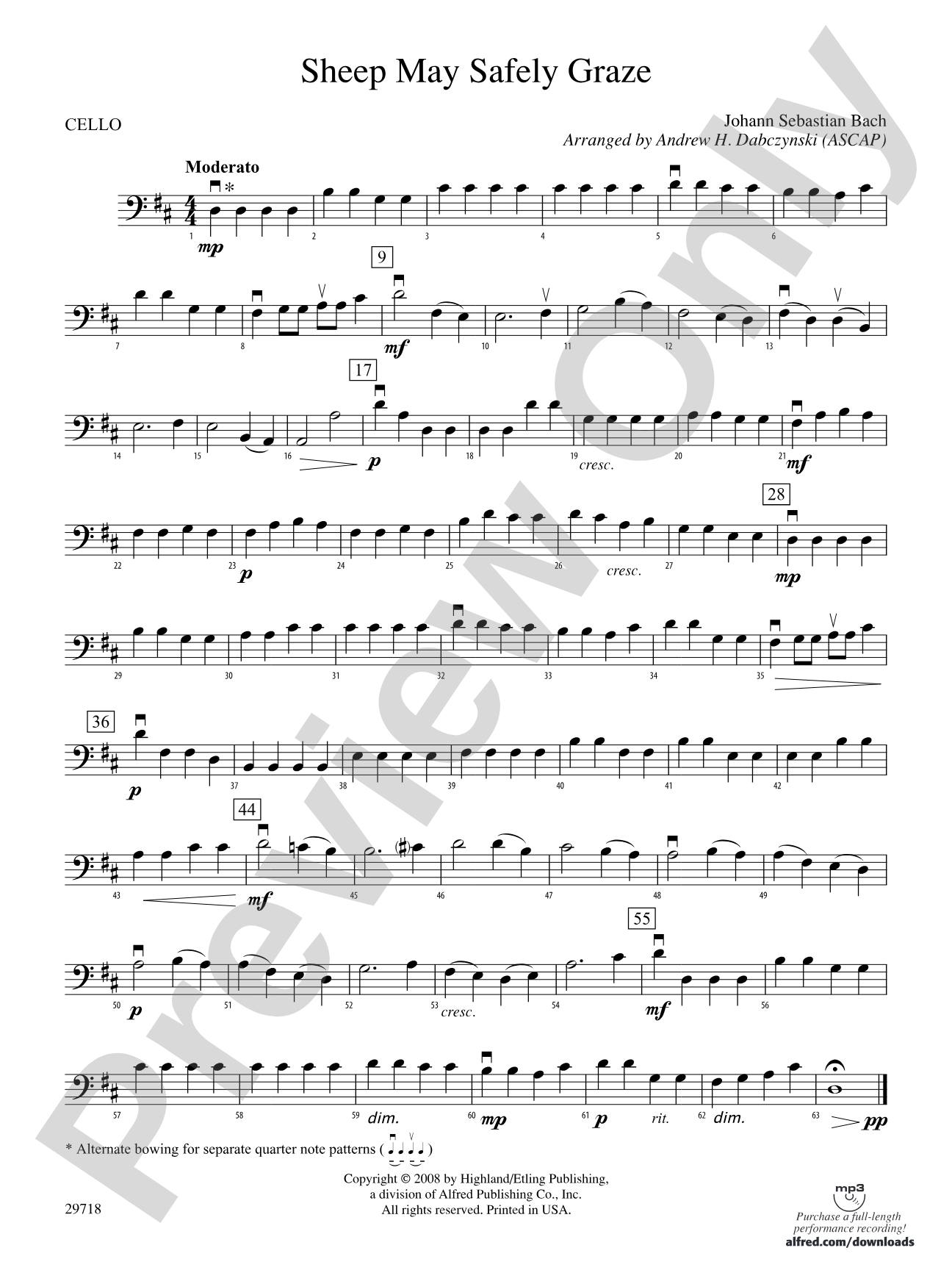

Sheep May Safely Graze: Cello
By Johann Sebastian Bach / arr. Andrew H. Dabczynski
Grade: 1.5
Item: 00-PC-0001571_VC1
$5.99
Pickup currently not available
Description
A new and welcome treatment of one of Bach's most memorable works. Sensitively arranged for young orchestra, the gentle essence of Bach's original aria is maintained while all the sections of the orchestra have an opportunity to play the rich melodies and counterpoint. Concert audiences and students alike will be touched by the lyricism and musicality of this piece, yet it is remarkably uncomplicated to rehearse and perform. Here is an arrangement that almost plays itself, all with a peaceful spirit that your beginning students will surely remember long after the concert is over. (2:10)
Correlates with String Explorer Book One, Unit 9.


Correlates with String Explorer Book One, Unit 9.
Don't just read it, hear it, play along with it, and watch your students grow with it. In MakeMusic Cloud, Sheep May Safely Graze: Cello comes alive with professional accompaniment, adjustable tempo, and built-in practice tools that turn solo practice into real progress.
Open in the Player
Jump straight in and assign it today.
Start Your Free Trial
Open this title and explore the full library in minutes.
Sample Audio
1
Audio File
--:--
0:00
0:00
Sample Video
No sample videos found.
Additional Details
Series:
Highland/Etling String Explorer
Publisher:
Alfred Music
Page Count:
72
SKU:
00-PC-0001571_VC1
More about this title
About the Composer: Johann Sebastian Bach
Johann Sebastian Bach (1685–1750) stands as one of music's most influential architects of counterpoint and harmonic language. His compositions span sacred and secular genres, from cantatas and passions to keyboard works and instrumental suites, all marked by mathematical precision, emotional depth, and inexhaustible melodic invention. His music has shaped the foundation of Western music education for nearly three centuries.
Bach's ability to weave multiple independent lines into unified wholes makes his work particularly valuable for young musicians. Even in simplified arrangements, the clarity of his compositional voice teaches students how musical architecture works. "Sheep May Safely Graze" exemplifies this gift: a humble aria whose warmth and elegance remain intact regardless of instrumentation.
Why we love this
This arrangement trusts young players with genuine Bach without reducing his musical substance. Dabczynski distributes the melodic and harmonic material across the full string section, so every student hears themselves carrying essential voices rather than playing filler parts. The result feels collaborative and purposeful, qualities that build ensemble confidence and ownership.
What to expect
A moment of genuine repose and grace. The melody unfolds with an unhurried, hymn-like quality, supported by gentle harmonic movement that feels inevitable rather than complex. Students will experience the peace the title promises, not as simplistic sentiment but as the result of Bach's compositional clarity and Dabczynski's transparent scoring.
Who it's for
String orchestras at the beginning level, particularly groups using the String Explorer curriculum, will find this piece accessible yet musically substantial. Directors seeking repertoire that rewards careful listening and builds awareness of counterpoint without overwhelming young players will return to this arrangement year after year.
How to get the most out of it
- Balance the melody across sections rather than spotlighting a single first violin line. When violas or cellos carry the theme, ensure they sing with the same warmth and projection as the violins do in other passages.
- Shape phrases toward natural breathing points and cadences. The gentle character doesn't mean static; allow the music to breathe and settle at phrase endings.
- Listen for the countermelodies that support the main line. Once students locate these inner voices in rehearsal, the texture becomes transparent and the harmonic movement audible.
- Use the 2:10 duration as a rehearsal anchor. If your run feels rushed or draggy, check whether the fundamental pulse is steady rather than pushing tempo adjustments.
How to use it
Program this as a concert opener to establish an audience's attention and goodwill, or as a contrasting slow movement between livelier selections. It also serves as an excellent festival piece at the Grade 1.5 level, where its musical substance and performance reliability stand out. Consider pairing it with other Baroque or early music arrangements to create a thematic concert segment.
Skills your students will build
- Playing sustained melodic lines with consistent tone and phrasing
- Recognizing and executing countermelody and harmonic voices within a texture
- Listening across the ensemble to maintain tuning and balance in multi-part writing
- Interpreting Baroque musical style and ornamentation conventions