Sheep May Safely Graze: 2nd Violin Sheet Music Preview

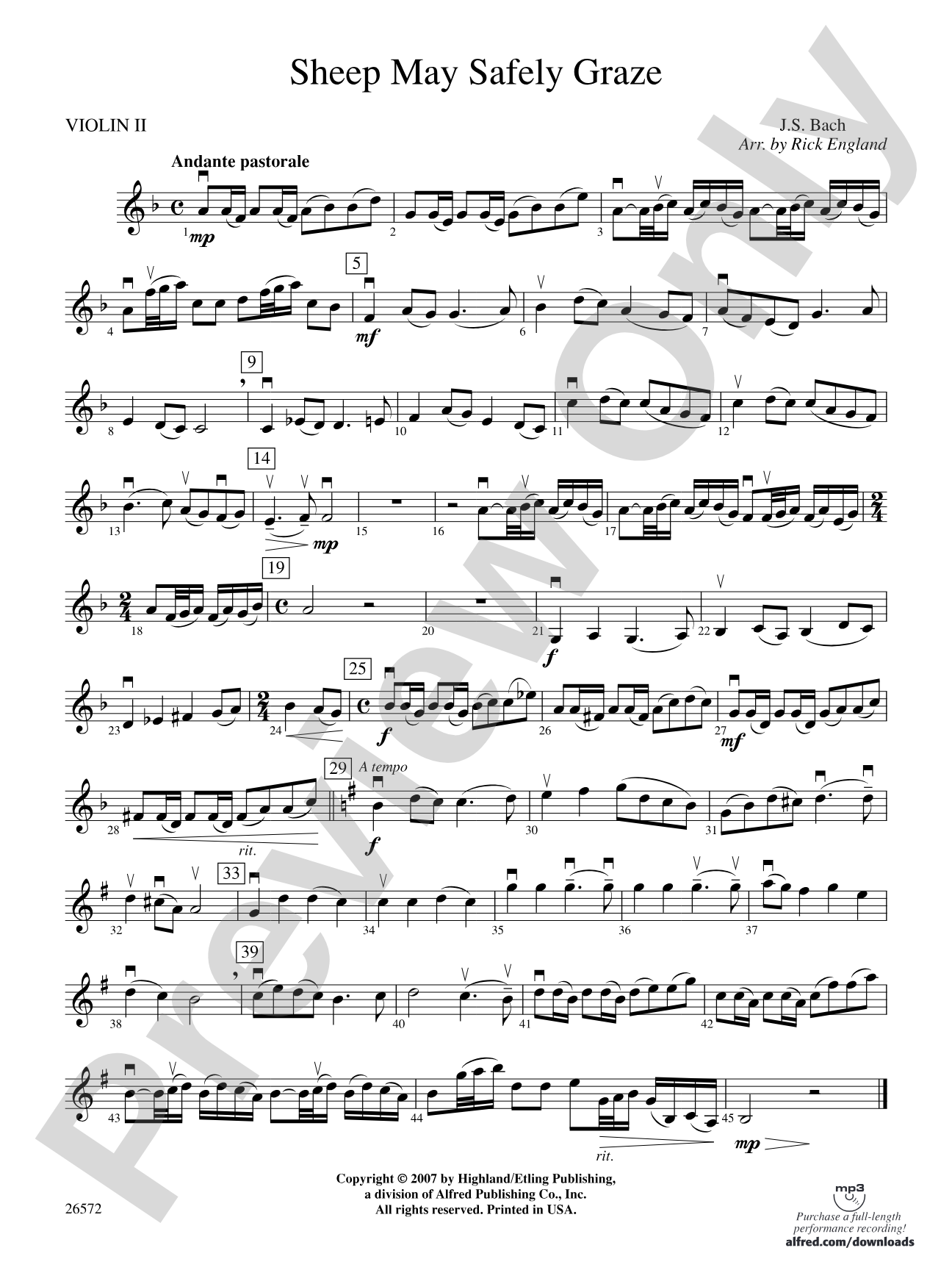
Sheep May Safely Graze: 2nd Violin

Traditional / arr. Rick England

Grade: 3

Item: 00-PC-0001088_VN2

Digital Download
$5.99
Description
Composed by Johann Sebastian Bach in 1713, the secular cantata Was mir behagt, is nur die muntre Jagd BWV 208 is the most famous of all Bach's arias. Arranged by Rick England, this string orchestra arrangement includes all the familiar elements assembled to showcase each instrument in a prominent role. Designed to be accessible in orchestra-friendly keys and scored for success at any performance. This title is available in MakeMusic Cloud.

Don't just read it, hear it, play along with it, and watch your students grow with it. In MakeMusic Cloud, Sheep May Safely Graze: 2nd Violin comes alive with professional accompaniment, adjustable tempo, and built-in practice tools that turn solo practice into real progress.

Sample Audio
0:00
0:00
Sample Video
Additional Details
Series: Highland/Etling String Orchestra
Publisher: Alfred Music
Page Count: 31
SKU: 00-PC-0001088_VN2

More about this title

About the Arranger: Rick England

Rick England has built a reputation as an arranger who understands what makes classical masterworks sing for young ensembles. His work with the Highland/Etling String Orchestra series demonstrates a keen ear for balancing accessibility with musical integrity, creating arrangements that respect the original while opening doors for students at intermediate levels.

Why we love this

England's arrangement strips away none of Bach's melodic brilliance while giving every section of your orchestra something genuinely musical to play. The scoring distributes solo moments generously across first violins, seconds, violas, cellos, and basses, so your ensemble feels like soloists rather than accompanists. At Grade 3, it sits at that sweet spot where the piece sounds mature and concert-ready without demanding virtuosity.

What to expect

Serene and graceful, with an underlying sense of purpose. The familiar aria unfolds with a pastoral quality that feels both stately and intimate, allowing the string sound itself to become the primary vehicle for Bach's elegant counterpoint.

Who it's for

String orchestras working at Grade 3 who want to program substantial Baroque repertoire without overreaching technically. Directors preparing for concert or festival contexts will appreciate how the arrangement presents Bach's music with polish and confidence.

How to get the most out of it

  • Balance the counterpoint between the main melodic line and inner voices; Bach's architecture hinges on how clearly the parts speak to each other, so attend to articulation and weight in rehearsal rather than just tempo.
  • Keep the pulse steady and slightly buoyant rather than heavy. The character benefits from a sense of forward motion, which prevents it from sagging in the slower sections.
  • Highlight the transitions where solo passages hand off between sections. These moments are compositionally active and deserve clear communication in your conducting.
  • Use dynamic shaping to draw the ear where England has placed it. Unlike some arrangements that simplify dynamics, this one uses them strategically to support the harmonic flow.

How to use it

This works beautifully as a centerpiece on a concert mixing eras, providing an elegant bridge between lighter opening pieces and heavier contemporary works. Festival adjudicators respond well to mature interpretation of Bach at this level, so consider it a strong programmatic choice when you want to show interpretive depth alongside technical growth.

Skills your students will build

  • Playing inner voice independence while supporting a primary melodic line
  • Articulation clarity across sustained passages and moving lines
  • Responding to sectional solo moments with musical confidence and blend
  • Baroque phrasing and shaping within moderate tempo ranges
  • Ensemble balance when multiple lines carry equal musical weight

You May Also Like