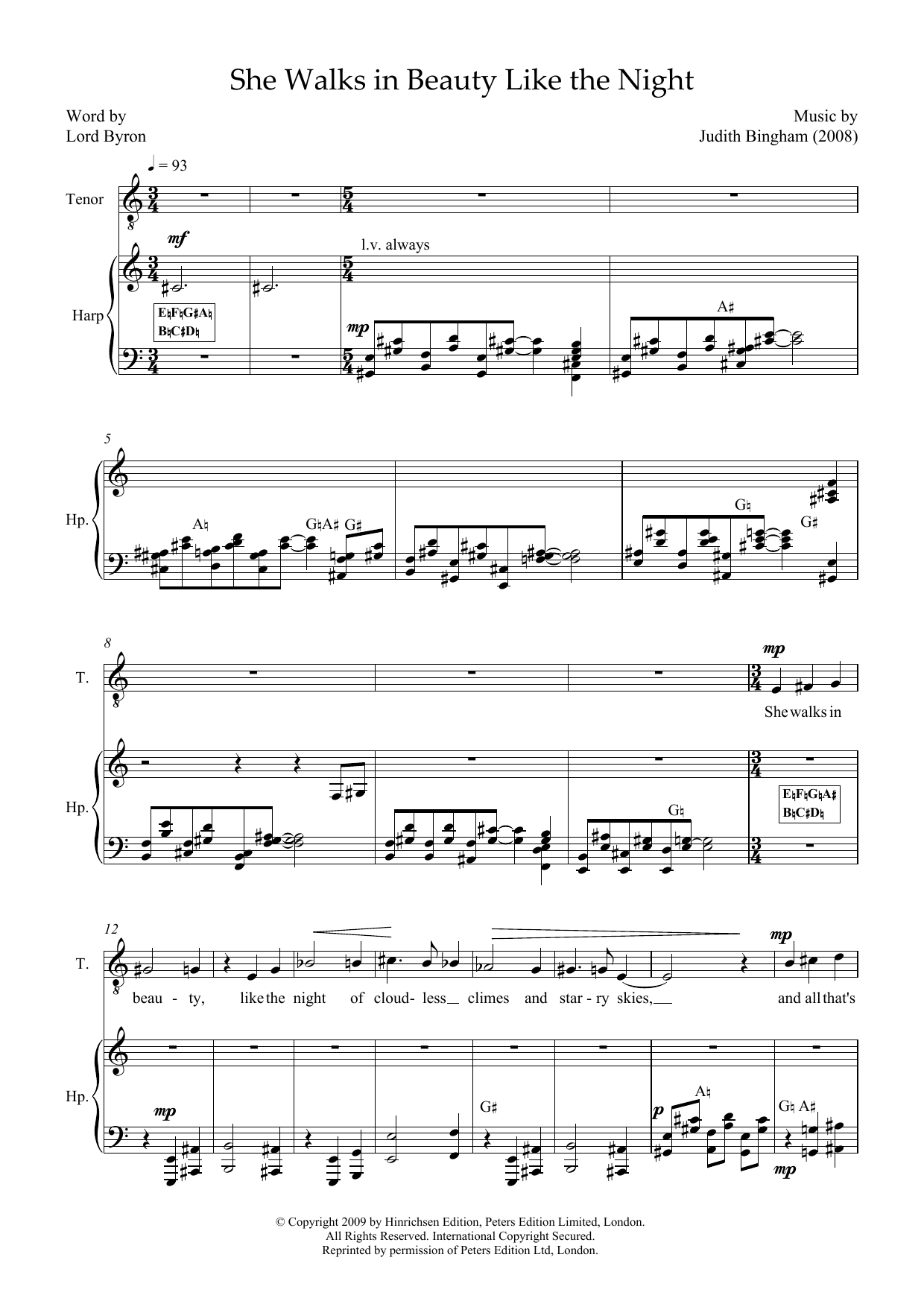
She walks in beauty like the night (for tenor and harp) Sheet Music Preview

She walks in beauty like the night (for tenor and harp): Piano Vocal

As performed by Judith Bingham

Item: 35-DS00365203

Digital Download
$5.99
Description

She walks in beauty like the night (for tenor and harp): Piano Vocal isn't in MakeMusic Cloud just yet...but it could be. Let us know you'd like to see it, and you'll help shape what comes next. In the meantime, start a free trial and dive into thousands of interactive titles your students can play along with today.

Sample Audio
No sample audio found.
Sample Video
Additional Details
Publisher: Hal Leonard
Page Count: 3
SKU: 35-DS00365203

More about this title

About the Artist: Judith Bingham

Judith Bingham is a British composer whose vocal works demonstrate a gift for setting poetry to music with both sophistication and accessibility. Her compositions span art songs, choral works, and chamber pieces, all marked by careful attention to text and lyrical writing that serves the voice.

Why we love this

Bingham's setting of Byron's famous lines captures the romantic restraint of the poem while giving the tenor voice genuine musical substance. The harp part provides elegant harmonic support without overshadowing the vocal line, making this a genuine three-way conversation between voice, piano, and text.

What to expect

The music evokes quietude and admiration, matching Byron's meditative gaze. Bingham's harmonic language is warm and accessible without sacrificing elegance, creating a sound world that feels both timeless and immediate.

Who it's for

This setting suits mature high school tenors and young adult singers who have solid musicianship and can handle the interpretive demands of Romantic art song. It works well for recital programs, senior showcase concerts, or chamber performance venues where intimate vocal writing is valued.

How to get the most out of it

  • Shape the phrase to follow the natural rhetoric of Byron's language; avoid metronomic phrasing that chops up the poetic lines.
  • Balance the tenor's line with the harp accompaniment so the word painting in the piano part enhances rather than competes with the vocal melody.
  • Allow space for the vocalist to breathe between phrases; this piece rewards singers who understand the emotional weight of each image.

How to use it

Include this in a curated recital pairing it with other settings of Romantic poetry, or feature it as a solo moment within a mixed chamber concert. It also serves beautifully as part of a program exploring literary connections across music history.

Skills your students will build

  • Interpreting Romantic-era poetry through vocal phrasing and text expression
  • Balancing a solo voice against ensemble accompaniment
  • Sustaining lyrical line across longer phrases without artificial breath breaks
  • Collaborating effectively with a pianist accompanying on harp-inspired writing

You May Also Like