
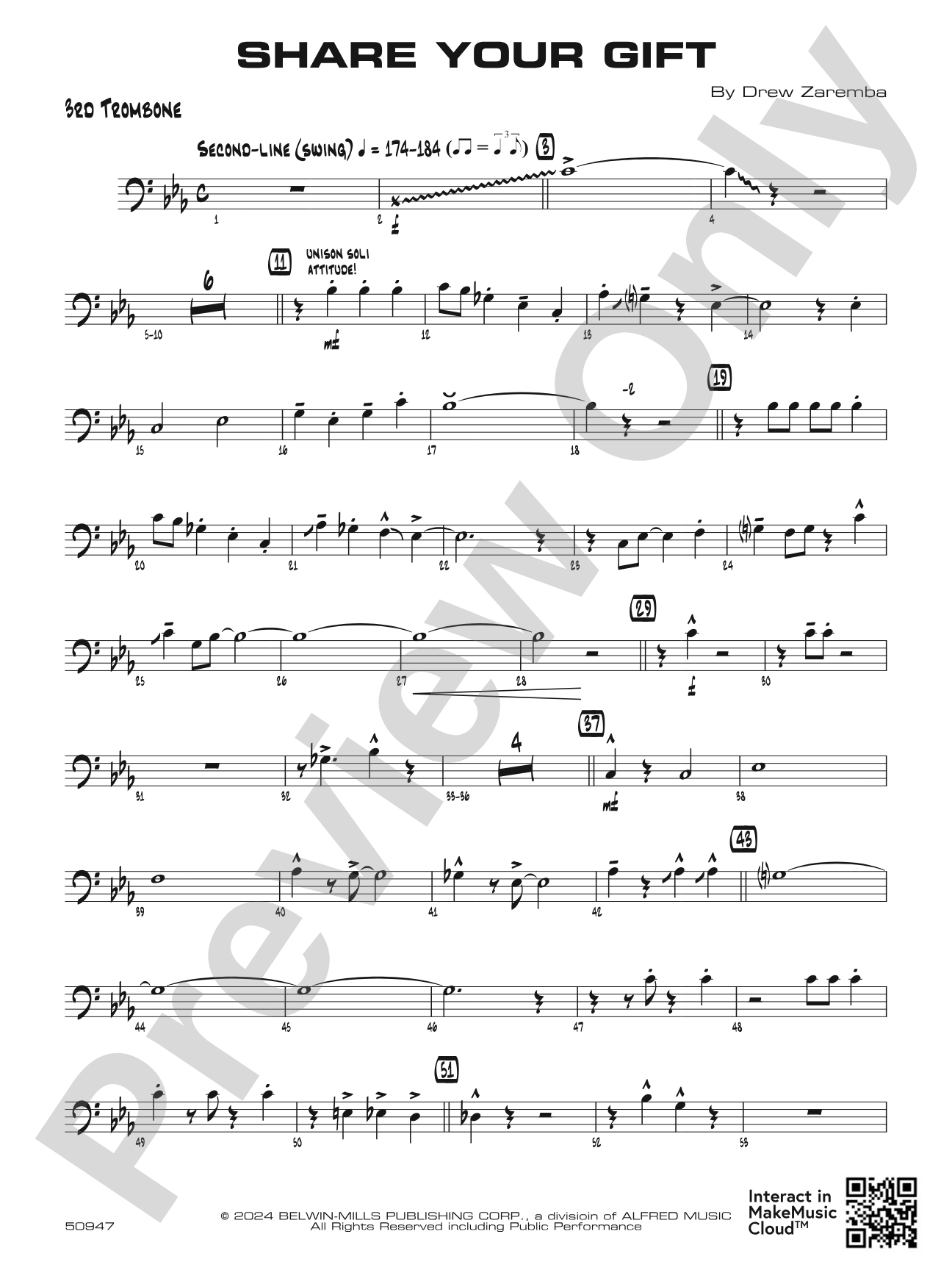

Share Your Gift: 3rd Trombone
By Drew Zaremba
Grade: 2.5
Item: 00-PC-0019356_TN3
$3.00
Pickup currently not available
Description
Oh yeah, check out this happy Second Line groove played around 174 BPM. Every section gets some action plus a huge ensemble sound for the shout chorus. Lead trumpet range is to written A-flat above the staff, solos are provided for tenor 1, trumpet 2, and trombone 1, plus the drummer will want to have a cowbell. There's excitement and positive energy throughout this chart! (5:35)


Don't just read it, hear it, play along with it, and watch your students grow with it. In MakeMusic Cloud, Share Your Gift: 3rd Trombone comes alive with professional accompaniment, adjustable tempo, and built-in practice tools that turn solo practice into real progress.
Open in the Player
Jump straight in and assign it today.
Start Your Free Trial
Open this title and explore the full library in minutes.
Sample Audio
1
Audio File
--:--
0:00
0:00
Sample Video
Additional Details
Series:
Jazz Band Series
Publisher:
Alfred Music
SKU:
00-PC-0019356_TN3
More about this title
About the Composer: Drew Zaremba
Drew Zaremba has built an international profile as a composer, arranger, and conductor with commissions from the BBC Orchestra, Metropole Orkest, Dallas Symphony Orchestra, and soloists including Wycliffe Gordon and Randy Brecker. His work spans classical and jazz idioms; he spent two months in Zhuhai, China, creating an original concert that merged Chinese opera with jazz composition. He has served on the faculty at the University of Northern Colorado since 2018, teaching jazz composition and arranging.
Zaremba's honors include the 2015 Sherman/Barsanti Inspiration Award ($10,000 first prize) from the University of North Texas for his orchestra, the Unity Orchestra, and the 2018 Sammy Nestico Award for original composition, which led to a commission with the U.S. Air Force Airmen of Note. His catalog has been recorded by the UNT One and Two O'Clock Lab Bands and published through Sierra Music and UNC Jazz Press.
Why we love this
Zaremba writes ensemble jazz that actually sounds like a real band playing together. Every section has meaningful material in the shout chorus, so no one sits idle; the soloists (tenor 1, trumpet 2, trombone 1) get genuine space to shine without overshadowing the orchestration. The Second Line groove at 174 BPM locks in fast enough to feel contemporary and fun but sits well within Grade 2.5 reach.
What to expect
This is straightforward joy. The Second Line groove carries the listener immediately into a celebratory, dance-floor energy that never feels forced. Soloists get room to breathe and express themselves, while the ensemble shout chorus crests with the kind of excitement and positive momentum that reminds you why jazz matters.
Who it's for
Jazz ensembles at the Grade 2.5 level looking for a contemporary, uplifting chart that works equally well in contest settings or concert programs. Directors who want every section and every player to contribute something meaningful will find the distributed solos and full ensemble moments rewarding to rehearse.
How to get the most out of it
- Lock the rhythm section (drums, bass, piano) into the Second Line pocket first. The cowbell articulation anchors the whole feel; once that's locked, the horns' lines will fall naturally into the groove.
- Balance the shout chorus so the ensemble sound builds without drowning out soloists during their features. Think "supportive backdrop" rather than "wall of sound."
- Highlight the lead trumpet's arc to A-flat above the staff in context. A-flat is high but written, not extreme; make sure your section is comfortable with the range before pushing the energy.
- Record a rehearsal with the rhythm section playing alone. Let soloists practice their features against just the groove without the full ensemble so they develop confidence in their own time.
How to use it
Program this early in a jazz concert to set an upbeat, welcoming tone, or save it for the closer if you want the audience leaving energized. It pairs well with blues-based or funk charts and works especially effectively as a bridge between a ballad and something more challenging. The five-and-a-half-minute runtime also fits neatly into festival schedules without overstaying.
Skills your students will build
- Reading and performing Second Line/funk rhythmic feels
- Soloing over a groove-based progression
- Balancing individual solos with ensemble background figures
- Ensemble cohesion in high-energy, rhythmically active contexts
- Drumset independence and cowbell articulation in jazz contexts