Shapes Are Nice Sheet Music Preview

Shapes Are Nice: Piano

By Dennis Alexander

Level: Elementary

Item: 00-PS-0016061

Digital Download
$3.99
Description
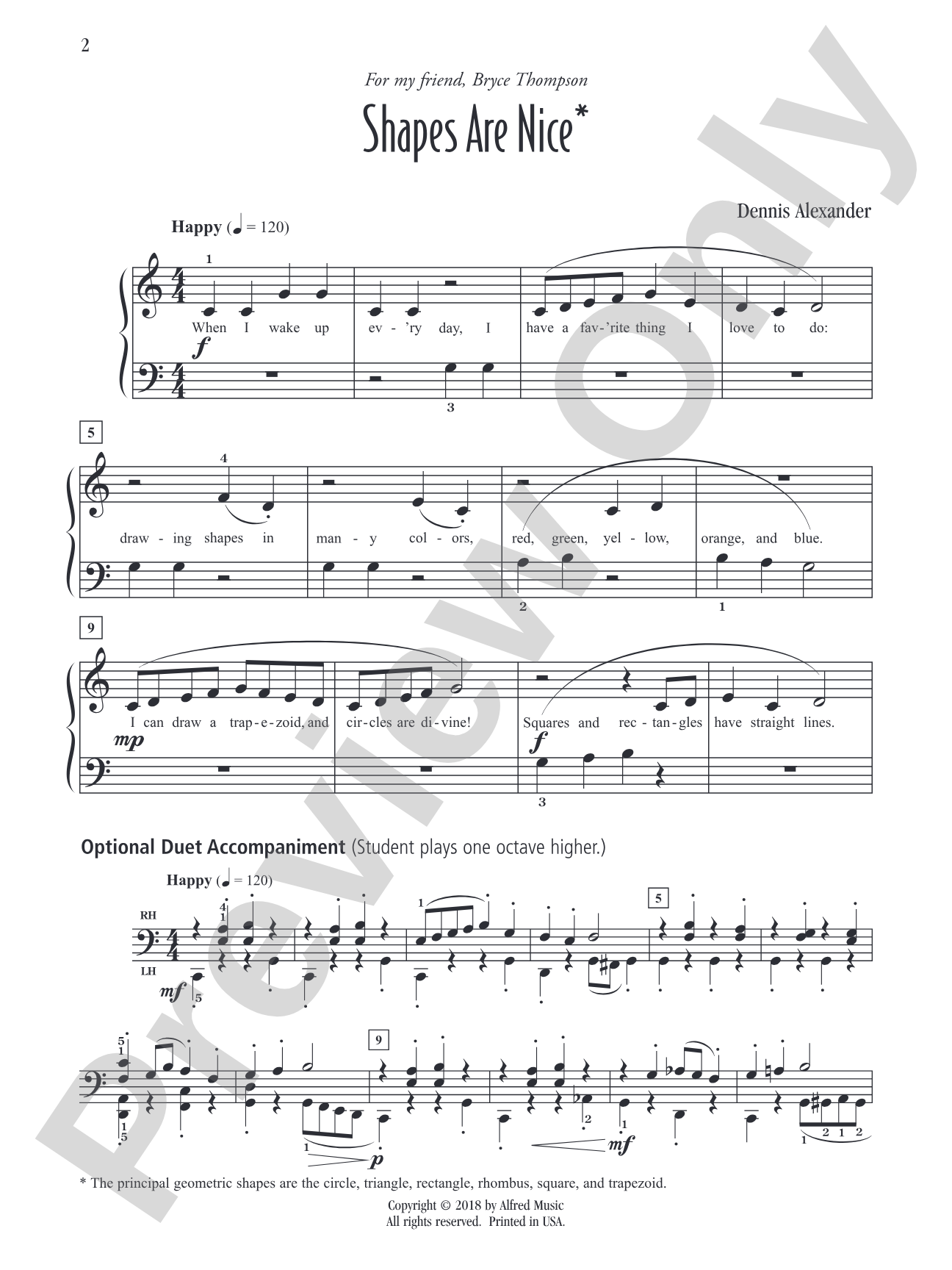
The melody of this elementary solo is divided between the hands with hands-together playing required only in the last two measures. Technical features include two-note slurs and crossing the left hand over the right hand. The words introduce students to the six principal geometric shapes: circle, triangle, rectangle, rhombus, square, and trapezoid.

Shapes Are Nice: Piano isn't in MakeMusic Cloud just yet...but it could be. Let us know you'd like to see it, and you'll help shape what comes next. In the meantime, start a free trial and dive into thousands of interactive titles your students can play along with today.

Sample Audio
No sample audio found.
Sample Video
Additional Details
Series: Signature Series
Publisher: Alfred Music
Page Count: 4
SKU: 00-PS-0016061

More about this title

About the Composer: Dennis Alexander

Dennis Alexander

Dennis Alexander has shaped elementary piano pedagogy for decades through his prolific output of accessible, musically engaging compositions. Since 1986, his work with Alfred Music Publishing has produced over 400 publications and recordings that demonstrate his deep understanding of how students learn at the keyboard. His career spans teaching positions at the University of Montana (where he led the piano department for 24 years), Cal State Fullerton, and Cal State Northridge, alongside an active performance schedule that includes Carnegie Recital Hall debuts and international tours across Asia and beyond.

Alexander brings his clinical expertise to music education conferences nationwide and has been commissioned repeatedly by state and national music teacher associations. His reputation rests on a simple principle: elementary students deserve music that is both pedagogically sound and genuinely enjoyable to play.

Why we love this

Alexander understands that students engaging with newly acquired hand-crossing technique need repertoire that makes the awkward feel natural. This piece weaves that technical demand seamlessly into a melody structured around concrete visual content, keeping young players focused on the music rather than on the mechanics of their hands.

What to expect

Bright and purposeful, with a melody that feels like it's being discovered one hand at a time. The piece carries a gentle pedagogical clarity that never condescends; instead, it gives students the satisfaction of playing something that sounds complete and intentional despite its elementary technical demands.

Who it's for

Elementary piano students who have developed basic facility with both hands separately and are ready to coordinate hand independence with more sophisticated melodic phrasing. The geometric-shapes text makes this especially appealing for younger students (roughly grades 1-3) who benefit from the pairing of music with concrete, age-appropriate content.

How to get the most out of it

  • Isolate the hand-crossing passage (measures 13-16) and practice it at a slow tempo with exaggerated arm movement to build spatial confidence before adding the melody line.
  • Have students identify which hand holds the melody at each phrase boundary so they internalize the hand-switching pattern during initial practice.
  • Shape the two-note slurs with a gentle lift at the end of each pair; avoid scooping or letting them lag behind the beat.
  • The hands-together ending should feel like a natural conclusion to the piece, not an abrupt join. Practice counting aloud through the last four measures to establish clear timing.

How to use it

Program this as part of a spring recital devoted to early elementary soloists, where it can anchor a set that showcases hand independence and coordination. It also works beautifully as a teaching showcase piece when demonstrating to parents how pianistic technique develops in stages.

Skills your students will build

  • Hand-crossing technique with the left hand moving over the right hand
  • Two-note slurs and shaping within a single hand
  • Coordinating melody lines that alternate between hands
  • Hands-together playing after extended separated passages
  • Connecting technical facility to expressive musical phrasing

You May Also Like