
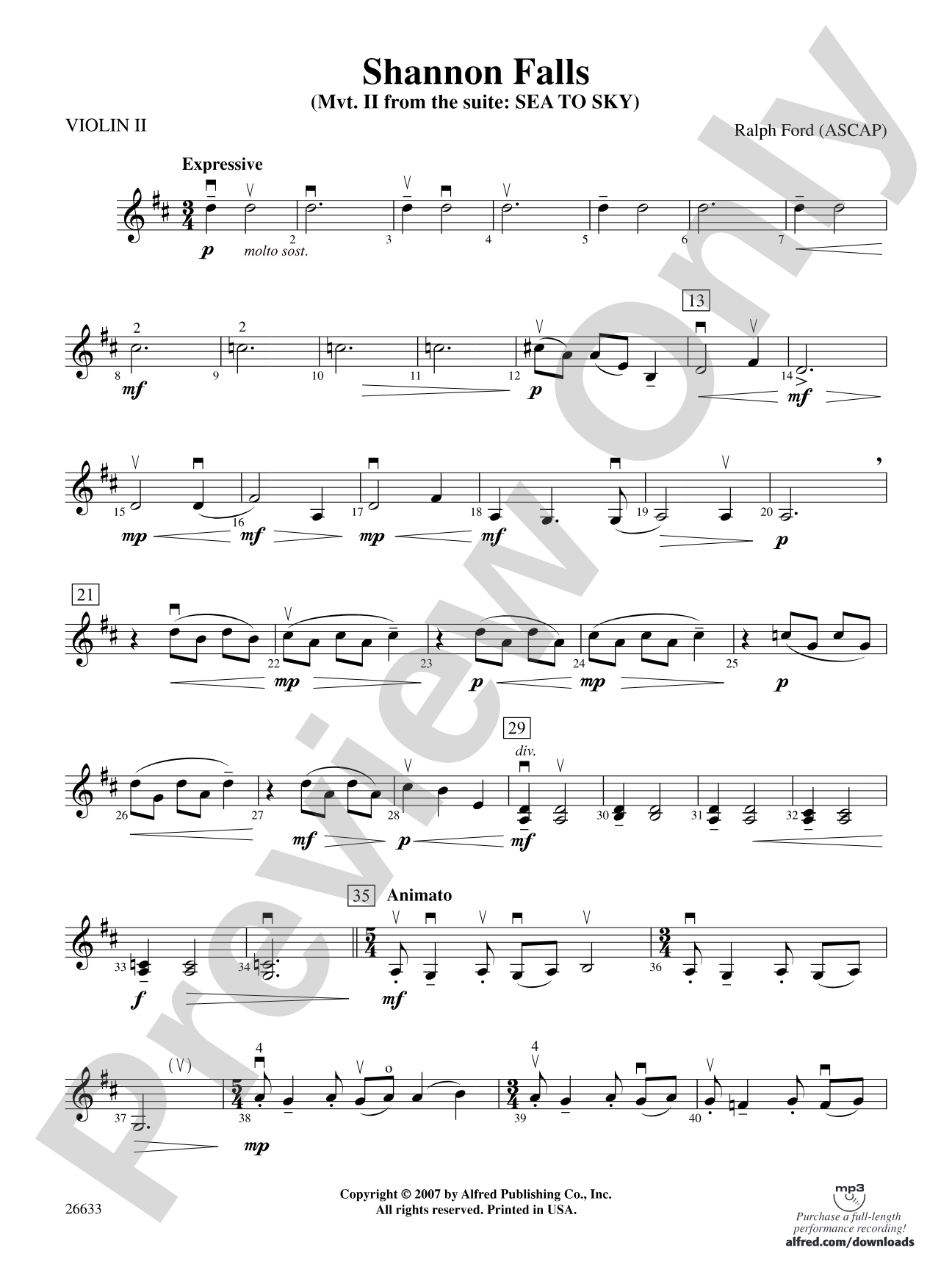

Shannon Falls: 2nd Violin
By Ralph Ford
Grade: 3
Item: 00-PC-0001136_VN2
$3.00
Pickup currently not available
Description
The awesome majesty and grandeur of the Canadian mountains near Vancouver are reflected in this piece for string or full orchestra. A wonderful opportunity for musical growth and expression! (3:20)


Don't just read it, hear it, play along with it, and watch your students grow with it. In MakeMusic Cloud, Shannon Falls: 2nd Violin comes alive with professional accompaniment, adjustable tempo, and built-in practice tools that turn solo practice into real progress.
Open in the Player
Jump straight in and assign it today.
Start Your Free Trial
Open this title and explore the full library in minutes.
Sample Audio
1
Audio File
--:--
0:00
0:00
Sample Video
Additional Details
Series:
Belwin Intermediate String/Full Orchestra
Publisher:
Alfred Music
Page Count:
94
SKU:
00-PC-0001136_VN2
More about this title
About the Composer: Ralph Ford

Ralph Ford brings three decades of university teaching, professional conducting, and compositional output to his work as an exclusive composer and arranger for Alfred Music. Since 1999, he has created over 250 titles across orchestra, concert band, jazz ensemble, and marching band repertoire, earning commissions from ensembles ranging from school orchestras to professional orchestras worldwide.
Ford's career spans composition, arranging, conducting, and media production. He began arranging professionally at fifteen and served as director of his university's jazz ensemble for fifteen years while maintaining faculty positions in orchestration, theory, and applied instruction. His work extends beyond the concert hall into broadcast, advertising, and television production, where he has composed news packages and original scores for national networks.
Why we love this
Ford's orchestration at Grade 3 feels genuinely idiomatic rather than simplifiedyet the writing never strains younger ensembles. The piece captures genuine landscape drama while remaining accessible enough for musicians still building their technical foundation, making it rewarding for both conductors and students.
What to expect
The piece unfolds like a mountain vista gradually revealing itself through morning mist. Broad harmonic gestures and sustained textures evoke the scale and permanence of landscape, while moments of rhythmic energy suggest the living drama within that grandeur. The 3:20 duration builds a complete arc from contemplation to majesty.
Who it's for
Grade 3 full orchestras preparing for festival or concert performance. Conductors seeking repertoire that demands genuine musicality and orchestral balance without excessive technical difficulty. This score works equally well for string orchestra or full orchestra configurations, making it flexible for varied instrumentation.
How to get the most out of it
- Balance the melodic lines across your string sections so the thematic material sings through even when ensemble texture thickens. Test balances in a full rehearsal rather than assuming dynamic markings will create the needed clarity.
- Let the opening establish space and calm. Resist pushing tempo too early; the mountains need room to breathe before the music builds.
- Mark phrase endings clearly for your students so everyone understands where the musical ideas land. Young orchestras often rush through transitions without understanding their function.
- Use the 3:20 runtime as a conductor's anchor. If your orchestra consistently runs longer, examine whether sections are dragging or if ensemble transitions need tightening.
How to use it
Pair this with lighter or more rhythmically driven concert works to showcase your orchestra's capacity for dynamic range and tonal control. It fits naturally on a festival program where judges expect to hear orchestral maturity, or anchor a spring concert around an environmental or Canadian theme. The modest difficulty level leaves room in rehearsal for students to focus on musicianship and blend rather than survival-level note reading.
Skills your students will build
- Sustaining long melodic phrases with shape and forward motion
- Balancing multiple simultaneous lines within string and full orchestral textures
- Interpreting dynamic architecture across a complete formal arc
- Responding to conducting for tempo and ensemble cohesion without constant metric subdivision
- Listening for orchestral blend and adjusting individual part intensity accordingly