
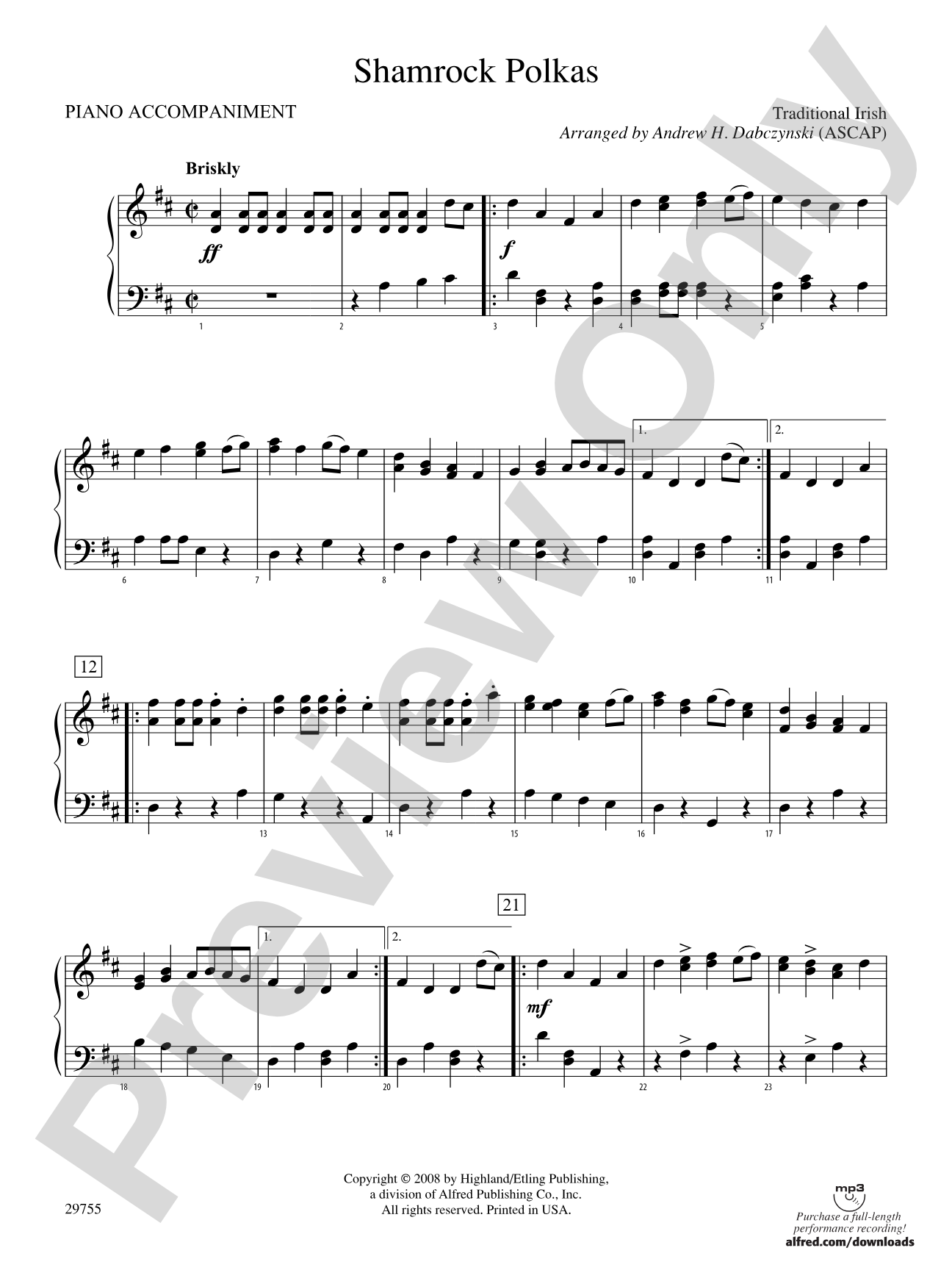

Shamrock Polkas: Piano Accompaniment
Traditional / arr. Andrew H. Dabczynski
Grade: 2.5
Item: 00-PC-0001601_K
$5.99
Pickup currently not available
Description
It seems like everyone enjoys a good polka! Shamrock Polkas is a medley of three traditional Irish dance tunes that will quickly become favorites of students and audience alike. The parts are creatively arranged so the rhythms are easy to read and the notes fall under the fingers, making this piece playable even by an intermediate level string orchestra. Yet the compelling polka melodies will also attract advanced students as they are challenged by optional improvisation opportunities and "up-tempo" possibilities. This bright arrangement---with melodies shared by all the instruments above a memorable bass line---will complement any concert program. It's sure to bring the audience to its feet---to applaud and to dance! (2:10)


Don't just read it, hear it, play along with it, and watch your students grow with it. In MakeMusic Cloud, Shamrock Polkas: Piano Accompaniment comes alive with professional accompaniment, adjustable tempo, and built-in practice tools that turn solo practice into real progress.
Open in the Player
Jump straight in and assign it today.
Start Your Free Trial
Open this title and explore the full library in minutes.
Sample Audio
1
Audio File
--:--
0:00
0:00
Sample Video
No sample videos found.
Additional Details
Series:
Highland/Etling String Alternatives
Publisher:
Alfred Music
Page Count:
132
SKU:
00-PC-0001601_K
More about this title
About the Arranger: Andrew H. Dabczynski

Andrew H. Dabczynski served as Emeritus Professor of Music Education at Brigham Young University, where he established the BYU "New Horizons Orchestra" as both a community ensemble for adult beginners and a training laboratory for string educators. His contributions to music pedagogy earned him BYU's Joseph E. White Fellowship for Teaching and Learning, recognition from Utah ASTA as "Higher Education Teacher of the Year" in 2005, and an award for "Outstanding Contributions to Music Education" in 2014.
Dabczynski brought decades of experience from leadership roles at the Eastman School of Music and in public school systems across New York and Michigan, combined with a performing career that included tenures with regional orchestras and the Colden String Quartet. His research interests in folk music and ethnomusicology, paired with his deep expertise in string pedagogy, shaped his work on the String Explorer method series and his many arrangements for student orchestras. He holds degrees from the Eastman School of Music, the University of Connecticut, and the University of Michigan.
Why we love this
Dabczynski writes for intermediate orchestras with a conductor's understanding of what actually works in a room. The parts sit comfortably under the fingers without sacrificing melodic appeal, and the shared scoring means every player gets a moment in the sun. The optional up-tempo challenge and improvisation opportunities give you room to grow the piece with your ensemble as the year progresses.
What to expect
Bright, buoyant, and irresistibly rhythmic. The three traditional Irish tunes tumble forward with the kind of infectious energy that invites audiences to lean forward in their seats. There's joy in the arrangement and room for personality without losing the driving pulse that makes a polka a polka.
Who it's for
Intermediate string orchestras (Grade 2.5) ready to tackle authentic folk melodies and ensemble texture without getting bogged down in technical demands. This works equally well for conductors building confidence in a developing program or offering a refreshing change of pace to an advancing group.
How to get the most out of it
- Lock the bass line first. The memorable harmonic foundation that supports all three melodies needs to sit steady before you layer in the fiddle tunes above it.
- Encourage rhythmic precision in the articulations. Polka energy lives in clean, synchronized bowstrokes, especially in the quicker passages.
- Consider the optional up-tempo version as a final rehearsal goal rather than a starting point. Build confidence and clarity at a comfortable tempo, then offer the faster option for those ready to run with it.
- If your ensemble tries the improvisation opportunities, give them a harmonic framework and a few rehearsals to explore before performance. This isn't sight-reading; it's collaborative risk-taking.
How to use it
This lands perfectly in spring concerts as a palate-cleanser between heavier repertoire, or as a closer that sends the audience home smiling. It also pairs naturally with other folk-inspired or light concert fare, and the 2:10 duration means you can build a strong second half without overloading your players.
Skills your students will build
- Reading and executing consistent rhythmic figures across multiple measures
- Balancing melody and accompaniment within the ensemble texture
- Playing through a polka's characteristic rhythmic drive without rushing
- Interpreting optional improvisation (for advanced players)
- Executing clean, articulated bowstrokes in faster passages