
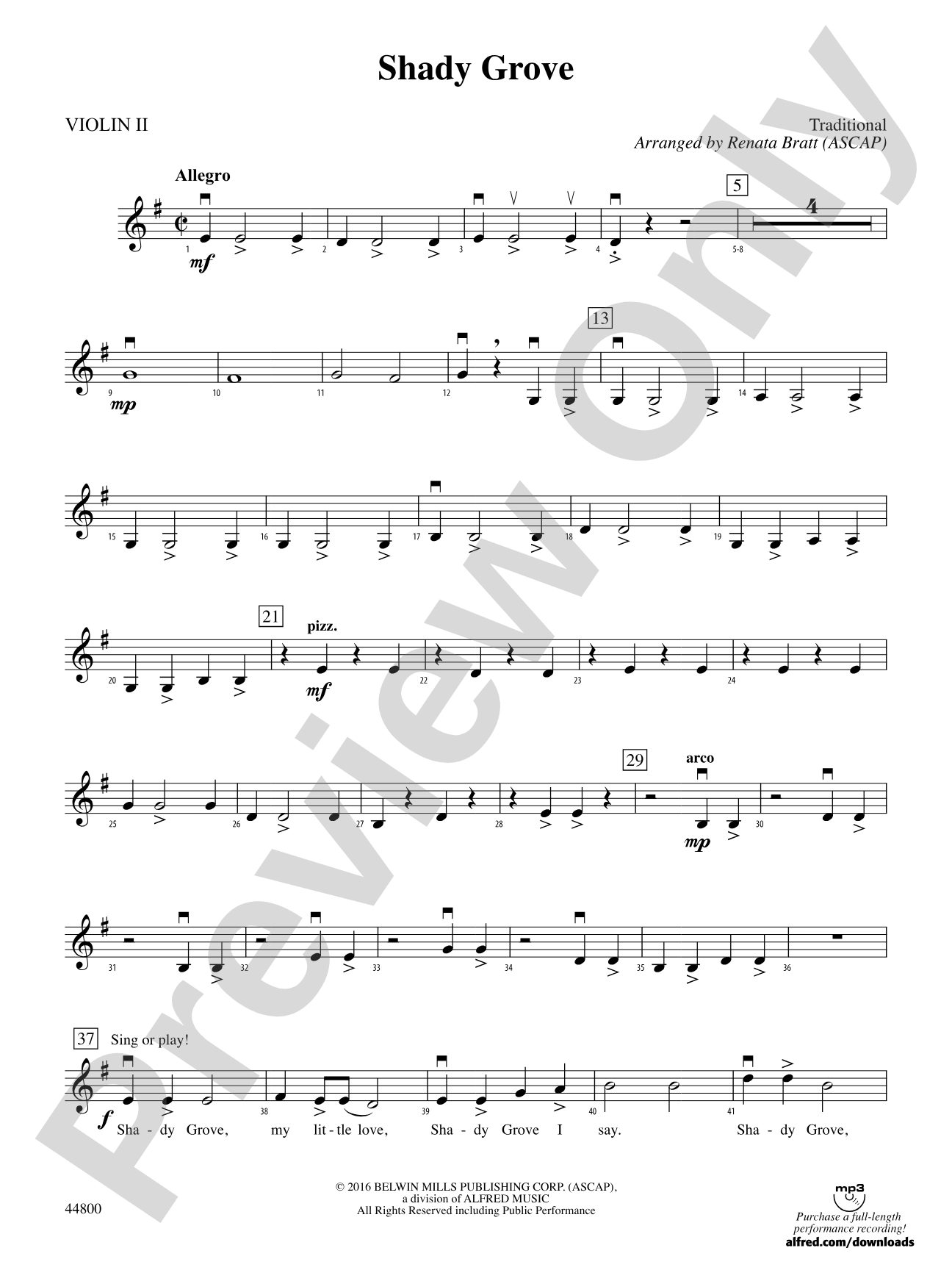

Shady Grove: 2nd Violin
Traditional / arr. Renata Bratt
Grade: 2
Item: 00-PC-0017317_VN2
$5.99
Pickup currently not available
Description
Ever ask your intermediate students to sing their parts? This one's for you! This American fiddling song is arranged by Renata Bratt so that every section gets a chance to sing the song as well as play the tune with idiomatic fiddle breaks based on the tune. Sounds great without the singing as well! The fast driving rhythmic power of offbeat accents in cut time is emphasized in this accessible D major arrangement. This tune calls for fast left hand fingers and some quick bow-crossings, though it stays in the first position. Great fun! (1:40)


Don't just read it, hear it, play along with it, and watch your students grow with it. In MakeMusic Cloud, Shady Grove: 2nd Violin comes alive with professional accompaniment, adjustable tempo, and built-in practice tools that turn solo practice into real progress.
Open in the Player
Jump straight in and assign it today.
Start Your Free Trial
Open this title and explore the full library in minutes.
Sample Audio
1
Audio File
--:--
0:00
0:00
Sample Video
Additional Details
Series:
Belwin Intermediate String Orchestra
Publisher:
Alfred Music
Page Count:
144
SKU:
00-PC-0017317_VN2
More about this title
About the Arranger: Renata Bratt

Renata Bratt is a cellist, clinician, and educator who has shaped contemporary string pedagogy through her work bridging classical, jazz, and fiddling traditions. Based in California, she has taught cello at multiple schools and youth orchestras while also directing clinics at major string conferences including the Mark O'Connor String Conference, Alasdair Fraser's Sierra Fiddle Camp, and national ASTA and Suzuki institutes. Her performance credits span classical collaborators like Liz Carroll and John Doyle to sessions with artists including Lyle Lovett and David Sanborn.
Bratt served as past president of both the Suzuki Music Association of California and the International Association for Jazz Education String Caucus, and sits on the American String Teachers Association Alternative String Styles Advisory Committee. She holds a Ph.D. in Music from UC San Diego and has authored instructional publications including The Modern Cello Method and The Fiddling Cellist for Mel Bay Publications, establishing herself as a voice for expanding the repertoire and pedagogical approaches available to string students.
Why we love this
Bratt understands what makes fiddling engaging for young players, and this arrangement channels that energy into a piece your orchestra will actually want to rehearse. The singing sections break up the typical string orchestra routine and give every player a moment in the spotlight, while the fiddle breaks and offbeat rhythmic drive in cut time teach genuine style without requiring advanced technique.
What to expect
Driving and rhythmically alive, with the energy of a barn dance filtered through careful orchestration. The offbeat accents create forward momentum while the D major brightness keeps everything accessible and joyful, even when the fiddle breaks demand quick fingers and precise bow control.
Who it's for
Intermediate string orchestras (Grade 2) ready to explore American fiddle traditions while building technical confidence in rhythm, intonation, and shifting between singing and playing responsibilities. This works perfectly for programs seeking accessible folk arrangements that still deliver authentic style and musical challenge.
How to get the most out of it
- Emphasize the offbeat accents in cut time; these drive the entire arrangement and should feel almost percussive without losing the lyrical quality of the tune.
- Balance the singing sections carefully so the melody stays clear and the orchestral parts don't overshadow the vocals, even when players are covering both responsibilities.
- Prepare left hand finger work with scale passage exercises beforehand; the fast runs demand accuracy at tempo, so build speed gradually in rehearsal.
- Use the D major tonality to your advantage by tuning carefully and letting the bright harmonic environment resonate through the full ensemble.
How to use it
Program this alongside other American folk selections for a concert exploring string traditions, or use it mid-season when your ensemble has developed enough technical security to balance singing and playing simultaneously. The 1:40 duration makes it ideal filler for mixed-genre concerts or a strong opening number that immediately engages your audience with its rhythmic vitality.
Skills your students will build
- Offbeat accent articulation in cut time
- Rapid left hand finger work while maintaining intonation
- Quick bow crossings in first position
- Balancing vocal and instrumental responsibilities
- D major tonality and ensemble tuning
- Stylistic interpretation of American fiddling