
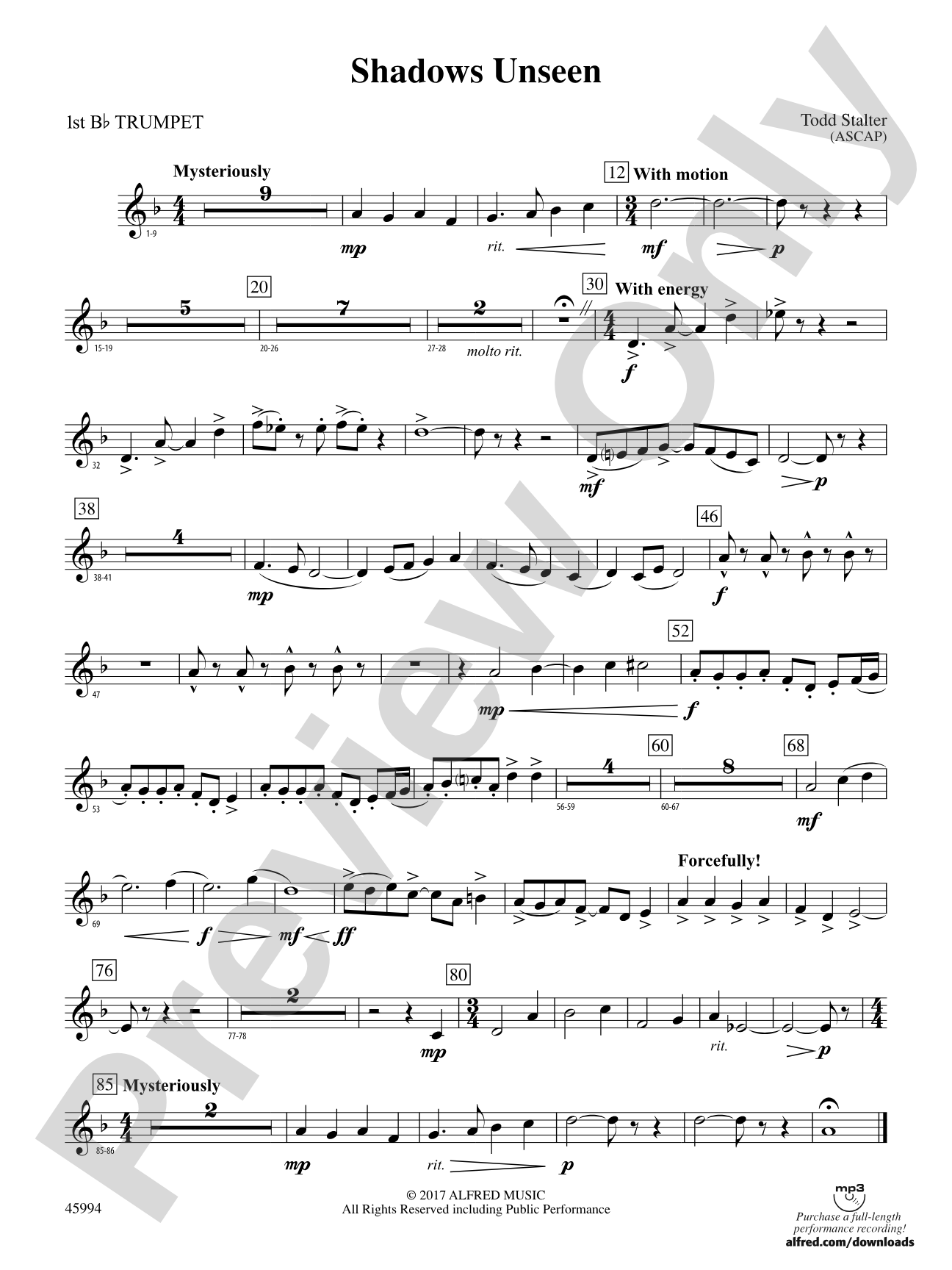

Shadows Unseen: 1st B-flat Trumpet
By Todd Stalter
Grade: 2.5 (Medium Easy)
Item: 00-PC-0017720_T1
$3.00
Pickup currently not available
Description
Composed using modified student-submitted melodic examples and ideas, this is a uniquely collaborative work evoking the darkness of the "shadows" we sometimes keep to ourselves. The piece ends optimistically, reminding us that shadows are small compared to the light around them. (3:45)


Don't just read it, hear it, play along with it, and watch your students grow with it. In MakeMusic Cloud, Shadows Unseen: 1st B-flat Trumpet comes alive with professional accompaniment, adjustable tempo, and built-in practice tools that turn solo practice into real progress.
Open in the Player
Jump straight in and assign it today.
Start Your Free Trial
Open this title and explore the full library in minutes.
Sample Audio
1
Audio File
--:--
0:00
0:00
Sample Video
Additional Details
Series:
Young Symphonic
Publisher:
Alfred Music
Page Count:
150
SKU:
00-PC-0017720_T1
More about this title
About the Composer: Todd Stalter

Todd Stalter brings four decades of band directing experience to his compositions. As director of bands at Eureka High School in Illinois, he built a program of exceptional achievement: his marching band earned 16 Class 1A state championships, his concert band consistently received Superior ratings at IHSA contests, and his ensembles performed at Orchestra Hall in Chicago and Walt Disney World. He has been recognized with induction into the Illinois State Marching Band Championships Hall of Fame.
Beyond the high school setting, Stalter has guest-conducted All-State Bands in Georgia and Delaware, served as an adjudicator and clinician across multiple states, and presented at conferences including the Illinois Music Educators Conference and the Delaware Music Educators Association. He holds degrees from Illinois State University in music education and trumpet performance, where he studied conducting with Dr. Stephen K. Steele. His concert band and string orchestra works are performed by ensembles worldwide and appear regularly on state festival and contest programs.
Why we love this
Stalter's decision to weave actual student melodic ideas into this work creates genuine investment from your ensemble. The Grade 2.5 difficulty balances accessibility with real compositional substance, building ensemble reading skills without oversimplifying the musical message. The arc from introspection to affirmation gives your band a piece with emotional weight that resonates in concert and contest settings alike.
What to expect
The piece opens with a contemplative, shadowed quality that feels introspective and grounded. As the work progresses, light gradually enters the texture, and the ending blooms with optimism that feels honest rather than saccharine. The 3:45 duration allows this emotional arc to breathe naturally without losing focus.
Who it's for
This score and parts work for Grade 2.5 concert bands that are ready to tackle thematic development and tonal balance. Directors seeking meaningful programming for contest or concert settings will find a piece that challenges ensemble cohesion without requiring advanced technical skill. Student musicians benefit from performing a work that was literally built in part from their own compositional voices.
How to get the most out of it
- Balance the student-derived melodic material to ensure it sings clearly without overwhelming the harmonic foundation; this emphasizes the collaborative spirit of the work.
- Shape the darker opening section with careful dynamic control and legit phrasing to establish the reflective mood before the shift toward resolution.
- Pay attention to voice independence in the mid-register (alto saxophones, violas, second clarinets) where supporting lines carry significant expressive weight.
- Use the final minutes to build genuine crescendo and brightness without rushing; the optimistic conclusion should feel earned, not abrupt.
How to use it
Program this on a full concert or festival competition set as a compelling closer or centerpiece that bookends a program with emotional resonance. The Grade 2.5 level makes it accessible enough to pair with lighter opening works while maintaining credibility as a serious artistic statement. Its collaborative origins and uplifting resolution make it particularly effective for concerts emphasizing community, growth, or ensemble identity.
Skills your students will build
- Dynamic contrast and controlled crescendo building
- Ensemble balance within thematic material across multiple voices
- Sustaining legit phrasing across longer melodic lines
- Hearing and performing sectional counterpoint at moderate complexity
- Responding to tonal and emotional shifts mid-phrase and across sections