
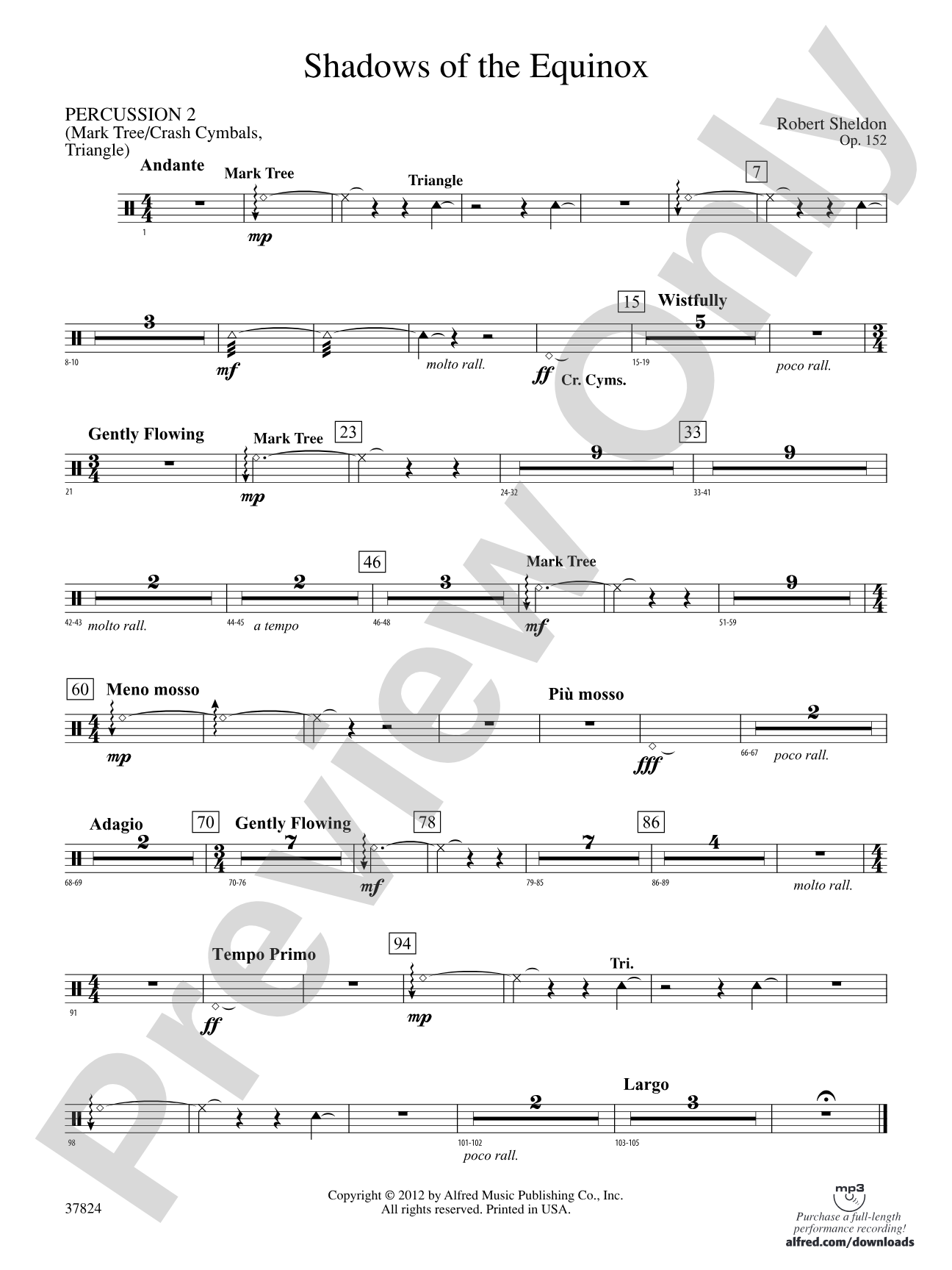

Shadows of the Equinox: 2nd Percussion
By Robert Sheldon
Grade: 3 (Medium)
Item: 00-PC-0015354_PC2
$3.00
Pickup currently not available
Description
As summer ends, the chill of the autumn air awakens feelings within us. The shadows are longer in late afternoon and darkness comes early. The trees are losing their leaves and their gnarled trunks and branches take on sinister profiles against the looming twilight. We shudder at the cold wind. Our pulse quickens and we suddenly want to return to the safety and warmth of home. Night falls and we are once again at peace. We say a final farewell to the carefree days of summer and accept the relentless march of the seasons. Winter will soon be here. (5:05)
"Shadows of the Equinox" is a dramatic and lyrical piece inspired by a late Midwest autumn. It was commissioned by the 2010 Festival of Bands, Vincennes, Indiana, including the bands from Barr-Reeve, Loogootee, Mitchell, North Daviess, North Knox, and South Knox High Schools. This title is available in MakeMusic Cloud.


"Shadows of the Equinox" is a dramatic and lyrical piece inspired by a late Midwest autumn. It was commissioned by the 2010 Festival of Bands, Vincennes, Indiana, including the bands from Barr-Reeve, Loogootee, Mitchell, North Daviess, North Knox, and South Knox High Schools. This title is available in MakeMusic Cloud.
Don't just read it, hear it, play along with it, and watch your students grow with it. In MakeMusic Cloud, Shadows of the Equinox: 2nd Percussion comes alive with professional accompaniment, adjustable tempo, and built-in practice tools that turn solo practice into real progress.
Open in the Player
Jump straight in and assign it today.
Start Your Free Trial
Open this title and explore the full library in minutes.
Sample Audio
1
Audio File
--:--
0:00
0:00
Sample Video
No sample videos found.
Additional Details
Series:
Alfred Concert Band
Publisher:
Alfred Music
Page Count:
144
SKU:
00-PC-0015354_PC2
More about this title
About the Composer: Robert Sheldon

Robert Sheldon's concert band compositions appear on contest and festival programs internationally, and his works are performed by ensembles ranging from high school bands to professional groups. Beyond his prolific output as a composer, Sheldon co-authored Sound Innovations for Concert Band, establishing himself as a significant voice in wind band pedagogy and literature. Recognition from the American School Band Director's Association, Phi Beta Mu, and ASCAP underscores the regard in which his music is held across the profession.
Sheldon's conducting experience extends across honor bands, all-state festivals, and university clinics throughout North America and abroad, including residencies in Japan, Canada, Italy, Germany, Australia, and China. His works have been performed in Carnegie Hall, Boston Symphony Hall, Orchestra Hall in Chicago, the Sydney Opera House, and the Kennedy Center. In 2020, VanderCook College of Music awarded him an honorary doctorate in recognition of his contributions to wind band music.
Why we love this
Sheldon brings the vocabulary of film scoring to concert band writing, and this piece demonstrates why. The program note isn't decorative flavor; it's the architecture of the work itself, unfolding in distinct emotional phases that your students will feel before they consciously hear them. Grade 3 bands can execute the musical drama because Sheldon writes for the ensemble you have, not the one you wish you had.
What to expect
The music captures the specific unease of late autumn: those first moments when summer's grip releases and you feel the season shift. It moves from atmospheric dread through genuine alarm before finally settling into acceptance and quiet repose. The orchestration breathes with the imagery, whether it's painting gnarled branches against twilight or returning to the safety of home.
Who it's for
Grade 3 concert bands with solid fundamentals in intonation and balance can take on this piece successfully. Directors seeking repertoire with genuine programmatic substance for festival or concert programming will find a work that engages both musicians and audiences without requiring advanced technical facility.
How to get the most out of it
- Build the opening atmosphere through section balance rather than volume. The low reeds and horns establish the harmonic foundation that makes the melodic statements land; uneven inner voice support will collapse the whole effect.
- Shape the dramatic peak by thinking of it as a conductor's moment first. Your clear commitment to the arc of that climax will transfer to the band's phrasing and intensity far more than any written accent marking.
- Let the final resolution breathe. The return to calm after the tumultuous middle section needs space; resist the urge to rush the ending's peaceful acceptance of the seasonal cycle.
- Mark your parts with the program narrative in mind, and share it with your ensemble. Knowing which measure corresponds to 'darkness comes early' or 'we suddenly want to return home' anchors interpretive choices in something beyond the printed score.
How to use it
Program this as the centerpiece of a thematic concert exploring seasonal transitions or the passage of time, perhaps bracketed by lighter works that celebrate autumn's visual beauty. Its five-minute duration and dramatic arc also make it a strong festival entry that demonstrates your band's musicality without overextending rehearsal capacity. The piece works particularly well in early fall programming, when the imagery resonates immediately with your audience.
Skills your students will build
- Sustaining lyrical phrasing across longer melodic lines
- Maintaining balance between primary melodic material and harmonic support
- Responding to programmatic cues through dynamic and textural control
- Executing sustained crescendos and diminuendos with ensemble precision
- Interpreting compositional intent from program notes and conductor gestures