
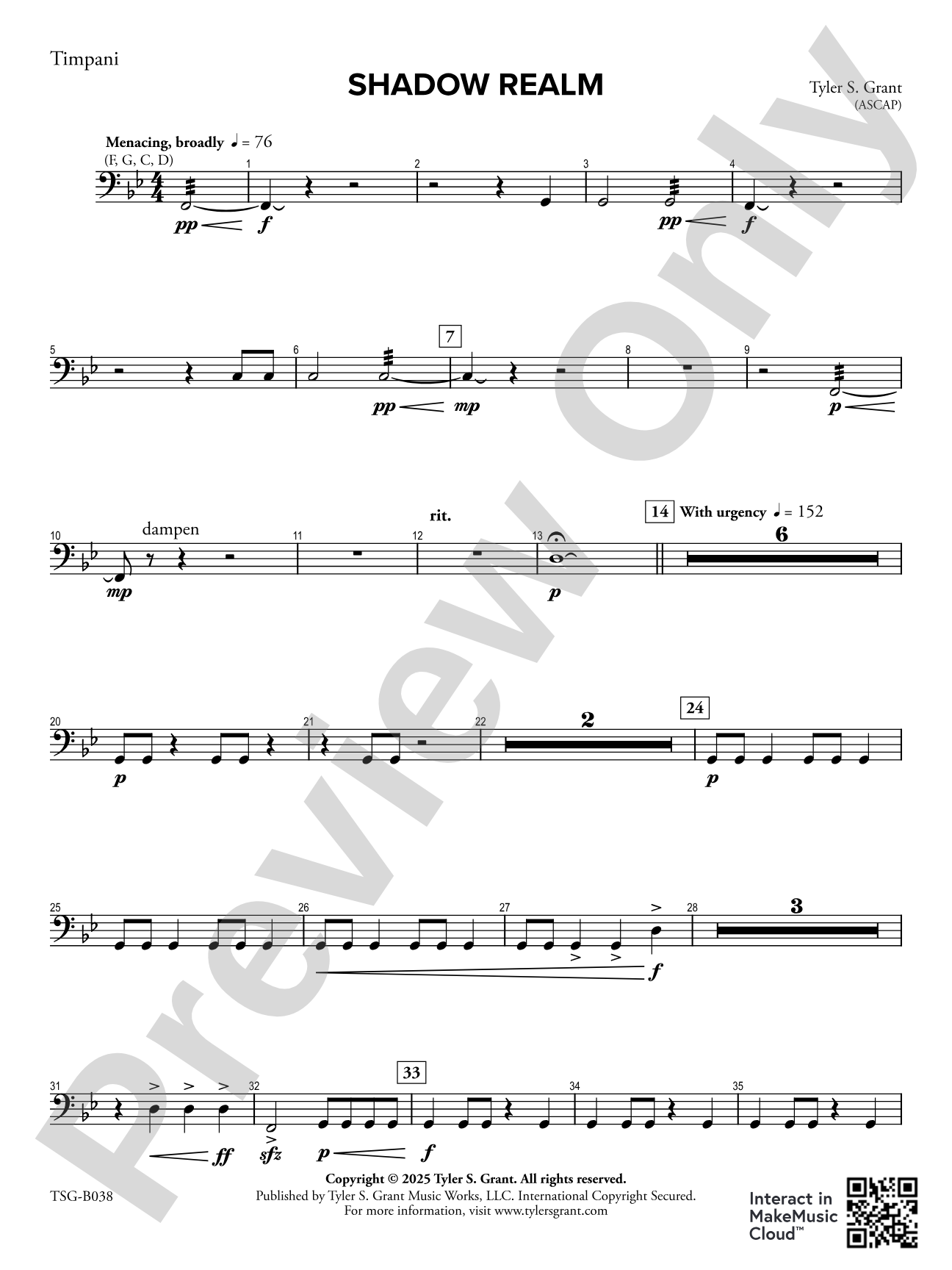

Shadow Realm: Timpani
Tyler S. Grant
Grade: 1.5
Item: 98-PC-TGB038_TMP
$4.50
Pickup currently not available
Description
Step into a world filled with shadows and mystery! Eerie melodies and distant textures in Shadow Realm by Tyler S. Grant create a soundscape unique to pieces at this level. Engaging percussion writing, paired with shifting tonal centers, gives everyone a glimpse of this dark, shadowy underworld. Equally appropriate for your fall concert and for contest/festival. Thrilling! (2:15)


Shadow Realm: Timpani isn't in MakeMusic Cloud just yet...but it could be. Let us know you'd like to see it, and you'll help shape what comes next. In the meantime, start a free trial and dive into thousands of interactive titles your students can play along with today.
Request This Title
Tell us you want it.
Start Your Free Trial
Explore everything that's ready to play right now.
Sample Audio
1
Audio File
--:--
0:00
0:00
Sample Video
Additional Details
Publisher:
Tyler S. Grant Music Works, LLC.
SKU:
98-PC-TGB038_TMP
More about this title
About the Composer: Tyler S. Grant

Tyler S. Grant stands out among contemporary band composers for his consistent output of accessible, performance-ready works that appeal equally to students and adjudicators. His compositions appear regularly on honor ensemble programs across North America and have earned recognition including a 2014 Dallas Wind Symphony Fanfare Competition win. Grant maintains an active schedule accepting commissions and producing new scores annually while also conducting clinics and conducting appearances at major venues like The Midwest Clinic, Carnegie Hall, and numerous state-level honor bands.
A University of Alabama graduate with a degree in instrumental music education, Grant studied conducting under Professor Randall Coleman and credits composer Brian Balmages as a formative influence on his artistic development. Beyond composing and arranging, he has contributed to Alfred Music's Sound Innovations series and shared insights through podcasts and publications including School Band & Orchestra Magazine. His work appears on Editor's and Publisher's Choice lists internationally, reflecting his reputation for writing that serves both student musicians and ensemble directors.
Why we love this
Grant nails the balance between atmospheric writing and ensemble engagement at Grade 1.5. The percussion parts actually breathe musically rather than merely filling space, and the shifting tonal centers give even developing players the sensation of navigating real harmonic terrain. It's accessible enough for early fall season work yet sophisticated enough to hold interest at festival adjudication.
What to expect
Shadow Realm creates an immersive descent into dimly lit sonic territory. Distant, shimmering textures shift beneath you like ground that won't hold still, while sharp attacks pierce through the haze just often enough to keep listeners unsettled. The world never fully emerges into light; instead it suggests mood through color and absence as much as through melody.
Who it's for
Grade 1.5 concert bands looking for fall festival material that goes beyond standard opening-week fare. Directors seeking writing that challenges developing musicians without requiring virtuosic technique, and programs building toward both competitive festival seasons and thematic concert programming.
How to get the most out of it
- Build the mystery gradually during the eerie passages by keeping initial attacks soft and letting silence matter as much as sound.
- Emphasize the percussion writing as melodic commentary rather than accompaniment; these lines carry narrative weight alongside the winds.
- Balance the tonal center shifts by asking players to identify the harmonic anchor in each section before rehearsing, so the ensemble understands where to lean.
- Take advantage of the 2:15 length by resisting the urge to slow it down; momentum sustains the atmospheric tension better than excessive space between phrases.
How to use it
Open a fall concert with atmospheric tension that captures autumn's darker side, or use it as a palette cleanser between larger structural works. The dual appropriateness for both contest and concert means you can rehearse toward festival season without sacrificing concert programming logic. At 2:15, it pairs naturally with contrasting selections for a well-balanced set.
Skills your students will build
- Reading shifting tonal centers and tracking harmonic movement without traditional root positions
- Balancing dynamic control in sustained, quiet passages to maintain ensemble cohesion
- Interpreting atmospheric texture as compositional intent rather than padding
- Responding to percussion cues as structural signposts within a non-traditional formal design
- Developing ensemble listening skills in pieces without consistent metric pulse anchors