Shadow of the Condor: Piccolo Sheet Music Preview

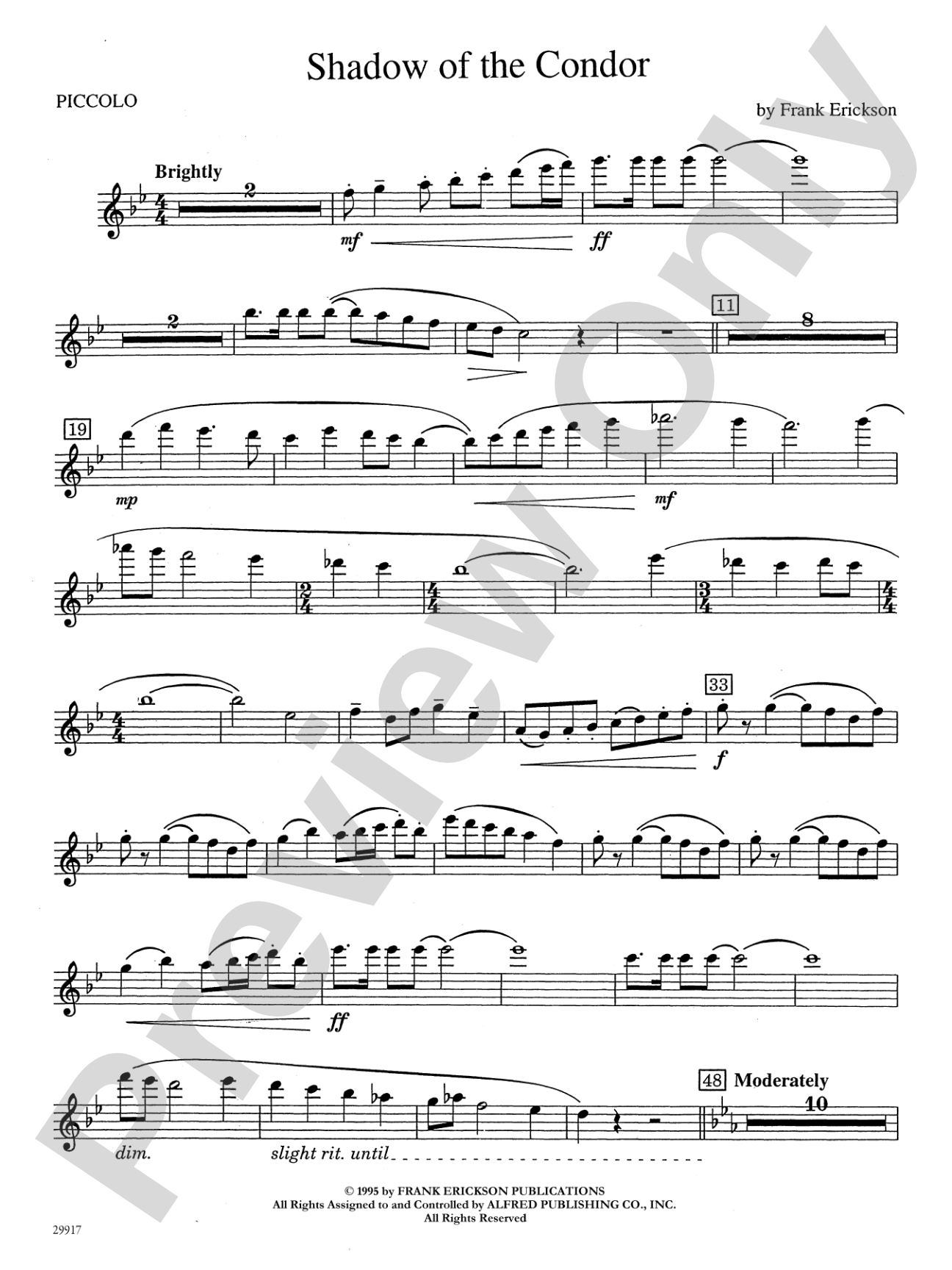
Shadow of the Condor: Piccolo

By Frank Erickson

Grade: 3 (Medium Easy)

Item: 00-PC-0001640_P1

Digital Download
$3.00
Description
Although music can be sufficient unto itself, it also may conjure images and ideas of many kinds to the audience (as well as the composer). It is not difficult to imagine the restlessness, the flight, the search for prey, the attack and the condor at rest during the many changes in mood of this composition. Few condors are alive today but this very fact justifies an admiration for its fight for survival in a hostile world.

Don't just read it, hear it, play along with it, and watch your students grow with it. In MakeMusic Cloud, Shadow of the Condor: Piccolo comes alive with professional accompaniment, adjustable tempo, and built-in practice tools that turn solo practice into real progress.

Sample Audio
No sample audio found.
Sample Video
Additional Details
Series: Frank Erickson Publications
Publisher: Alfred Music
Page Count: 274
SKU: 00-PC-0001640_P1

More about this title

About the Composer: Frank Erickson

Frank Erickson (1923-1996) composed and arranged extensively for concert and marching bands, earning recognition as one of the most performed American band composers of his era. His output included over 200 works for band, ranging from educational pieces to substantial concert works, and he maintained a deep commitment to writing music that was both musically rewarding and accessible to student ensembles.

Erickson's compositional voice emphasized clear orchestration, memorable themes, and structural integrity. His works for band remain staples in school and community band libraries, valued for their musicality and their ability to challenge students without overwhelming them technically.

Why we love this

Shadow of the Condor demonstrates Erickson's gift for program music that paints vivid scenes without sacrificing musical substance. Directors appreciate how the piece's dramatic arc and shifting moods keep student musicians engaged while building genuine interpretive skills, and the Grade 3 level allows mid-level bands to execute the full vision convincingly.

What to expect

Shadow of the Condor sweeps listeners through the condor's world: restless searching and hovering, sudden attacks, triumphant gliding, and finally peaceful rest. The orchestration captures both the raw power of a predator in motion and the haunting vulnerability of an endangered creature.

Who it's for

Band directors working with intermediate ensembles who want to program something narratively engaging and musically substantial. Students benefit from the interpretive opportunities and the chance to respond musically to extra-musical imagery without needing advanced technical skills.

How to get the most out of it

  • Shape the phrase contours deliberately during the restless sections; students often rush these passages, so precise conductor communication about breath points and line direction makes the difference between nervous energy and purposeful forward motion.
  • Balance the soloistic passages with careful voicing rehearsals. The predatory moments rely on clean articulation and transparency, particularly in the woodwind and brass lines that depict the hunt.
  • Establish the quiet, resting moments with as much care as the action sequences. The calm passages gain power through contrast, so invest rehearsal time in control at soft dynamics.
  • Use the full range of the ensemble's dynamics to mirror the condor's journey. The piece gains theatrical impact when students understand how their dynamic choices shape the narrative arc.

How to use it

Program this as a centerpiece for a concert exploring nature themes, or use it as a statement piece that demonstrates your band's maturity to audiences unfamiliar with Grade 3 ensemble music. It works equally well as a fall concert feature or spring concert closer, depending on your program's overall arc.

Skills your students will build

  • Reading and responding to program music and narrative content
  • Executing contrasting moods and dynamic shapes within a single work
  • Balancing clarity and blend across sustained harmonic passages
  • Interpreting conductor gestures that communicate dramatic intention beyond tempo
  • Coordinating articulation and phrasing across multiple instrument families

You May Also Like