
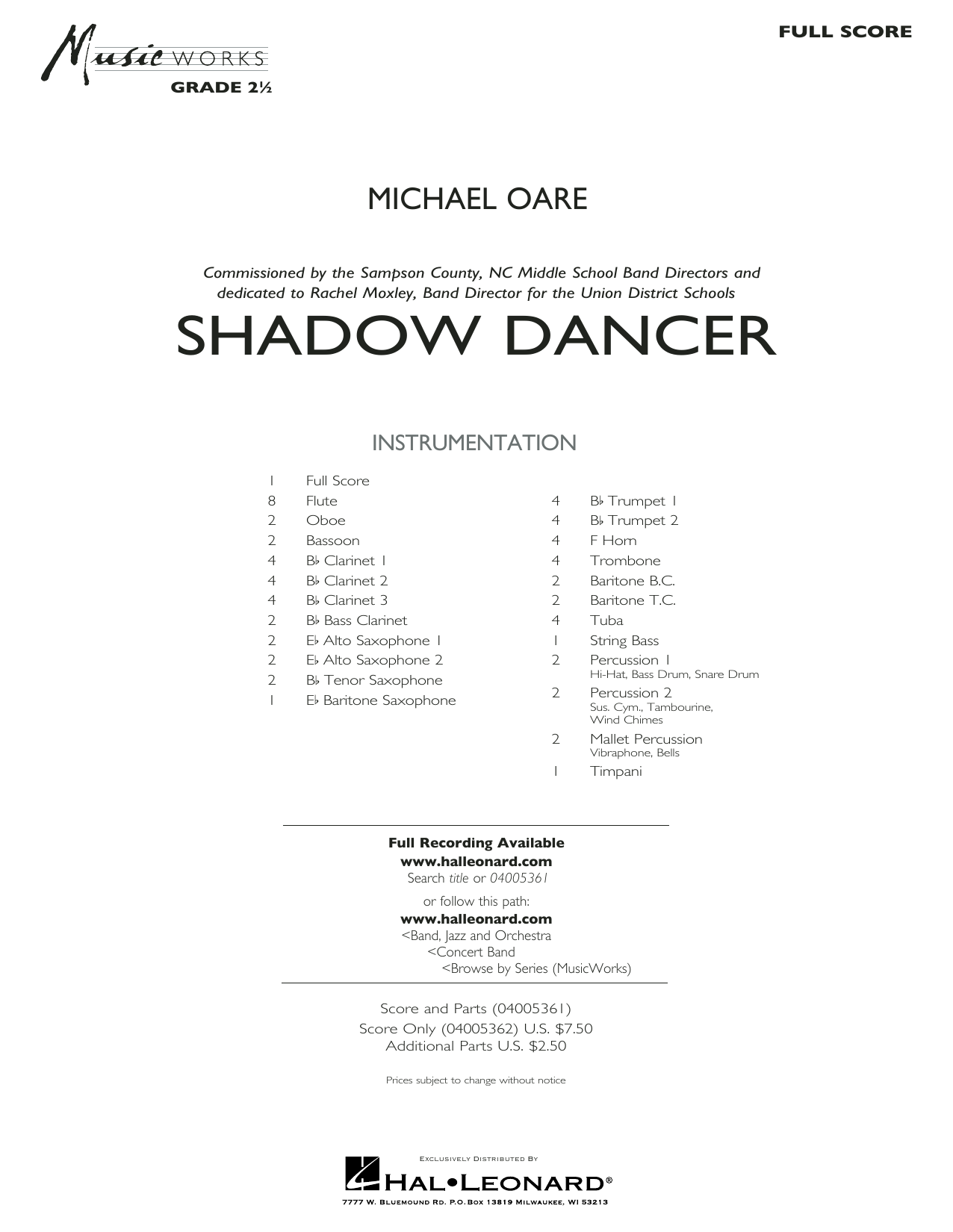

Shadow Dancer: Concert Band Conductor Score & Parts
By Michael Oare
Grade: 2
Item: 35-PK00411771
$55.00
Pickup currently not available
Buy Extra Parts (Digital PDF Download)
| Product | Price | Quantity |
|---|---|---|
| Shadow Dancer - Full Score | $10.00 | |
| Shadow Dancer - Flute | $6.00 | |
| Shadow Dancer - Oboe | $6.00 | |
| Shadow Dancer - Bassoon | $6.00 | |
| Shadow Dancer - Bb Clarinet 1 | $6.00 | |
| Shadow Dancer - Bb Clarinet 2 | $6.00 | |
| Shadow Dancer - Bb Bass Clarinet | $6.00 | |
| Shadow Dancer - Eb Alto Saxophone 1 | $6.00 | |
| Shadow Dancer - Eb Alto Saxophone 2 | $6.00 | |
| Shadow Dancer - Bb Tenor Saxophone | $6.00 | |
| Shadow Dancer - Eb Baritone Saxophone | $6.00 | |
| Shadow Dancer - Bb Trumpet 1 | $6.00 | |
| Shadow Dancer - Bb Trumpet 2 | $6.00 | |
| Shadow Dancer - F Horn | $6.00 | |
| Shadow Dancer - Trombone | $6.00 | |
| Shadow Dancer - Baritone B.C. | $6.00 | |
| Shadow Dancer - Baritone T.C. | $6.00 | |
| Shadow Dancer - Tuba | $6.00 | |
| Shadow Dancer - String Bass | $6.00 | |
| Shadow Dancer - Percussion 1 | $6.00 | |
| Shadow Dancer - Percussion 2 | $6.00 | |
| Shadow Dancer - Mallet Percussion | $6.00 | |
| Shadow Dancer - Timpani | $6.00 |
Parts Added to Cart!
Description
Composed using a single, yet driving tempo, "Shadow Dancer" incorporates a repeating syncopated rhythmic figure as its foundation. Every section is provided a melodic opportunity as the various instrument groups are introduced. By combining a couple of unexpected interjections with the repetitive and infectious rhythm pattern, this is a dynamic and enjoyable piece for both audience members and performers. Dur: 2:10


Shadow Dancer: Concert Band Conductor Score & Parts isn't in MakeMusic Cloud just yet...but it could be. Let us know you'd like to see it, and you'll help shape what comes next. In the meantime, start a free trial and dive into thousands of interactive titles your students can play along with today.
Request This Title
Tell us you want it.
Start Your Free Trial
Explore everything that's ready to play right now.
Sample Audio
No sample audio found.
Sample Video
No sample videos found.
Additional Details
Publisher:
Hal Leonard
SKU:
35-PK00411771
More about this title
About the Composer: Michael Oare

Michael Oare trained in composition and music education at Old Dominion University and spent 33 years building an exceptional band program at Great Bridge Middle School in Chesapeake, Virginia. His students achieved superior ratings consistently, including 30 consecutive years of straight superiors on grade 3 and 4 literature. Beyond his classroom work, Oare has established himself as a composer whose pieces appear in GIA Publications' Teaching Music Through Performance series, an arranger, conductor, and active member of ASCAP.
His work with the Bay Youth Orchestras of Virginia and ongoing performances with the Virginia Wind Symphony reflect a career devoted to elevating standards across multiple educational and performance contexts. Oare has earned recognition as Chesapeake Public Schools' Middle School Teacher of the Year, received two Citations of Excellence from the National Band Association, and maintains active involvement in state and national music education organizations.
Why we love this
Oare understands exactly what young bands need: a piece that locks students into a groove without requiring elaborate technique. The syncopated rhythmic engine powers the entire work, giving every section a moment to shine while the infectious pulse keeps players and listeners engaged. What separates this from other pop-styled band pieces is the structural clarity—every entrance feels purposeful, and those unexpected moments land because the foundational rhythm is so secure.
What to expect
Propulsive and modern. The syncopated rhythm creates forward momentum that carries through the entire two minutes, never losing energy despite the repetition. Moments of surprise punctuate the driving groove, keeping both players and audiences alert.
Who it's for
Grade 2 bands ready to tackle rhythmic coordination without drowning in sixteenth-note passages. This works especially well for ensembles with solid section leaders but still developing ensemble cohesion, since the repeating figure gives students plenty of anchoring material to lock onto.
How to get the most out of it
- Lock the tempo from measure one. The syncopated figure only works if the pulse is unwavering; use a metronome in sectionals to establish confidence in the rhythm section before putting the ensemble together.
- Highlight the melodic opportunities in each section entrance by isolating those moments in rehearsal. Let clarinets own their line, then trombones, then saxophones. Contrast makes the repetition feel fresh.
- Shape the unexpected interjections with clear dynamic intention. These are your punctuation marks. Practice them as ensemble moments where everyone resets together, not moments where some players drop out.
How to use it
Program this early in a concert to establish energy and set a contemporary tone. It pairs well alongside more traditional grade 2 literature and works as an ideal opener for a young band showcase, offering immediate audience engagement while building student confidence.
Skills your students will build
- Maintaining steady pulse within a syncopated rhythmic framework
- Executing consistent articulation across repeated melodic figures
- Responding to section entrances with precise ensemble attacks
- Balancing melody and accompaniment when multiple lines occur simultaneously
- Sustaining focus during repetitive material without rhythmic drift