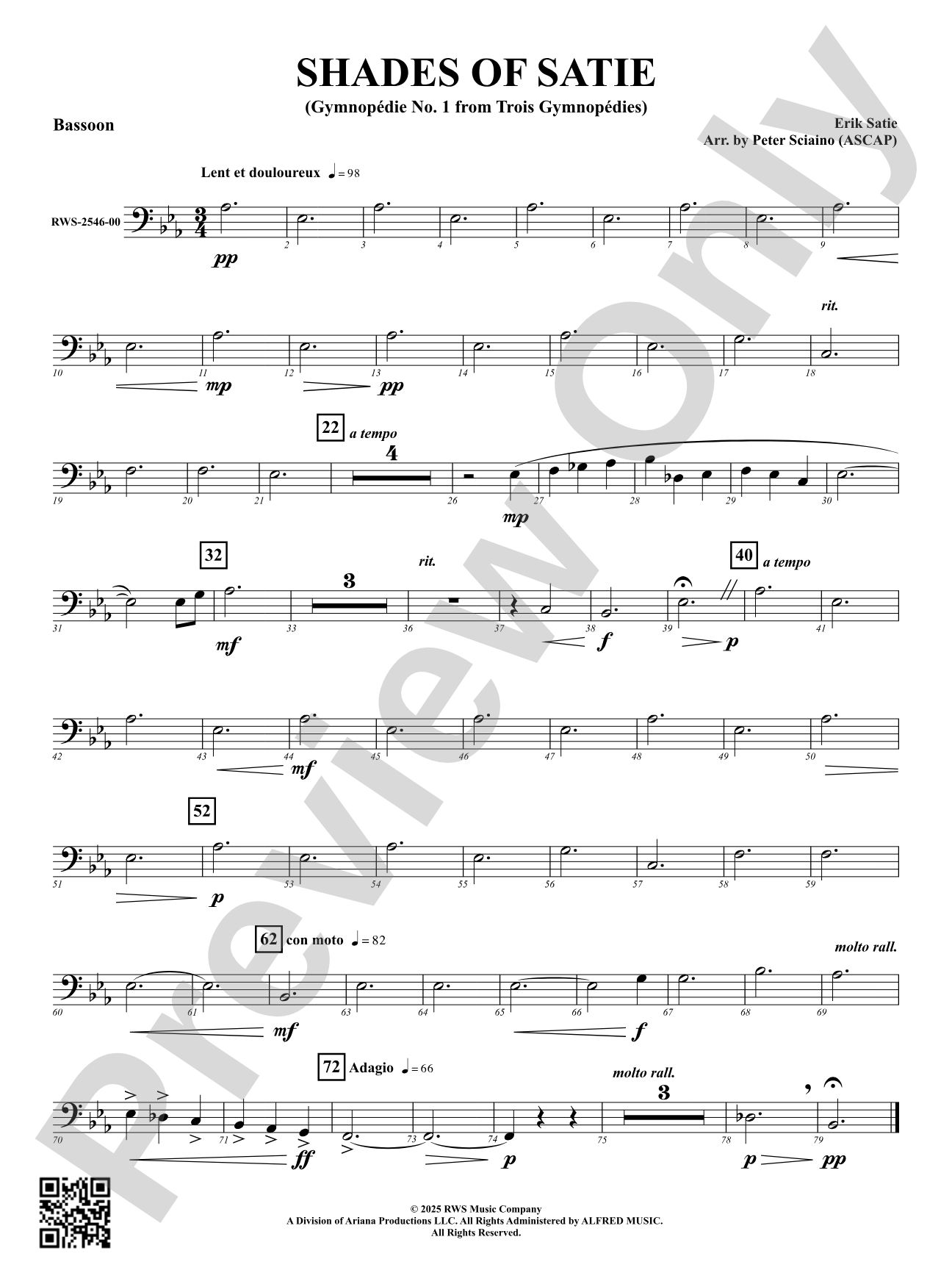
Shades Of Satie (Gymnopédie No. 1 from Trois Gymnopédies): Bassoon Sheet Music Preview

Shades Of Satie (Gymnopédie No. 1 from Trois Gymnopédies): Bassoon

(Gymnopédie No. 1 from Trois Gymnopédies)

By Erik Satie / arr. Peter Sciaino

Grade: 3

Item: 98-PC-RWS2546_B1

Digital Download
$3.99
Description
Shades Of Satie features the famous Romantic era piano work of eccentric French composer Erik Satie. Its simplicity is intentional, revealing profound beauty. The beautiful melody, a single, flowing line of quarter notes, rises and falls like ocean waves, while the long, sustained rhythms create a sense of floating through time.

Shades Of Satie (Gymnopédie No. 1 from Trois Gymnopédies): Bassoon isn't in MakeMusic Cloud just yet...but it could be. Let us know you'd like to see it, and you'll help shape what comes next. In the meantime, start a free trial and dive into thousands of interactive titles your students can play along with today.

Sample Audio
0:00
0:00
Sample Video
Additional Details
Series: RWS - Concert Band
Publisher: RWS Music Company
SKU: 98-PC-RWS2546_B1

More about this title

About the Composer: Erik Satie

Erik Satie (1866-1925) was a French composer and pianist whose deceptively simple works masked profound musical philosophy. He rejected the Romantic era's emotional excess, instead crafting pieces of radical restraint and clarity that influenced composers from Debussy to Philip Glass. His Gymnopédies, written in the 1880s, became his most enduring works, establishing him as a visionary who understood that less could say infinitely more.

Satie's unconventional approach to composition and his often humorous rebellion against musical convention made him a figure apart in late 19th-century Paris. His influence on 20th-century music, minimalism, and contemporary composition remains profound. For music educators, Satie's work demonstrates that musical depth emerges not from complexity but from clarity of intent and sensitive handling of space.

Why we love this

This arrangement captures what makes Gymnopédie No. 1 so teachable at the Grade 3 level: a single, sculpted melody that students can genuinely own, supported by transparent harmonic writing. The accessible Grade 3 scoring allows younger bands to experience the restraint and sophistication that made Satie revolutionary, without sacrificing the piece's meditative power. It's an antidote to overblown repertoire and a reminder that band students deserve encounters with genuine musical artistry.

What to expect

Floating through stillness. The melody rises and falls like gentle waves against a horizon while time seems to slow. There's no urgency here, only the quiet confidence of a musical idea so clear it needs no ornamentation.

Who it's for

Grade 3 concert bands seeking substantial musical experience without excessive technical demand. Directors who want students to engage seriously with Romantic-era repertoire and learn that restraint can be more powerful than virtuosity.

How to get the most out of it

  • Shape the melody as one continuous phrase rather than counting individual quarter notes. Listen for the rise and fall within the longer arc, the way it breathes like a single utterance.
  • Sustain the harmonic backdrop with complete stillness in the lower voices. Any rhythmic impatience will fracture the floating sensation that defines the piece.
  • Control the dynamic throughout; Satie's simplicity demands absolute commitment to every note. Understatement is the opposite of carelessness.
  • Work the balance between the melody and accompaniment in sectional rehearsals first, so players understand how their parts serve the whole rather than competing for attention.

How to use it

Program this early in a concert as a palate-cleansing contrast to busier pieces, or use it as an encore that leaves audiences in reflective silence. It works exceptionally well on festivals seeking contrast and musicianship over technical showiness.

Skills your students will build

  • Sustaining long tones with consistent tone quality and intonation
  • Balancing melody against sustained harmonic accompaniment
  • Shaping a single phrase across an entire piece
  • Understanding musical restraint and the power of simplicity
  • Control of dynamics at soft to moderate volume levels

You May Also Like