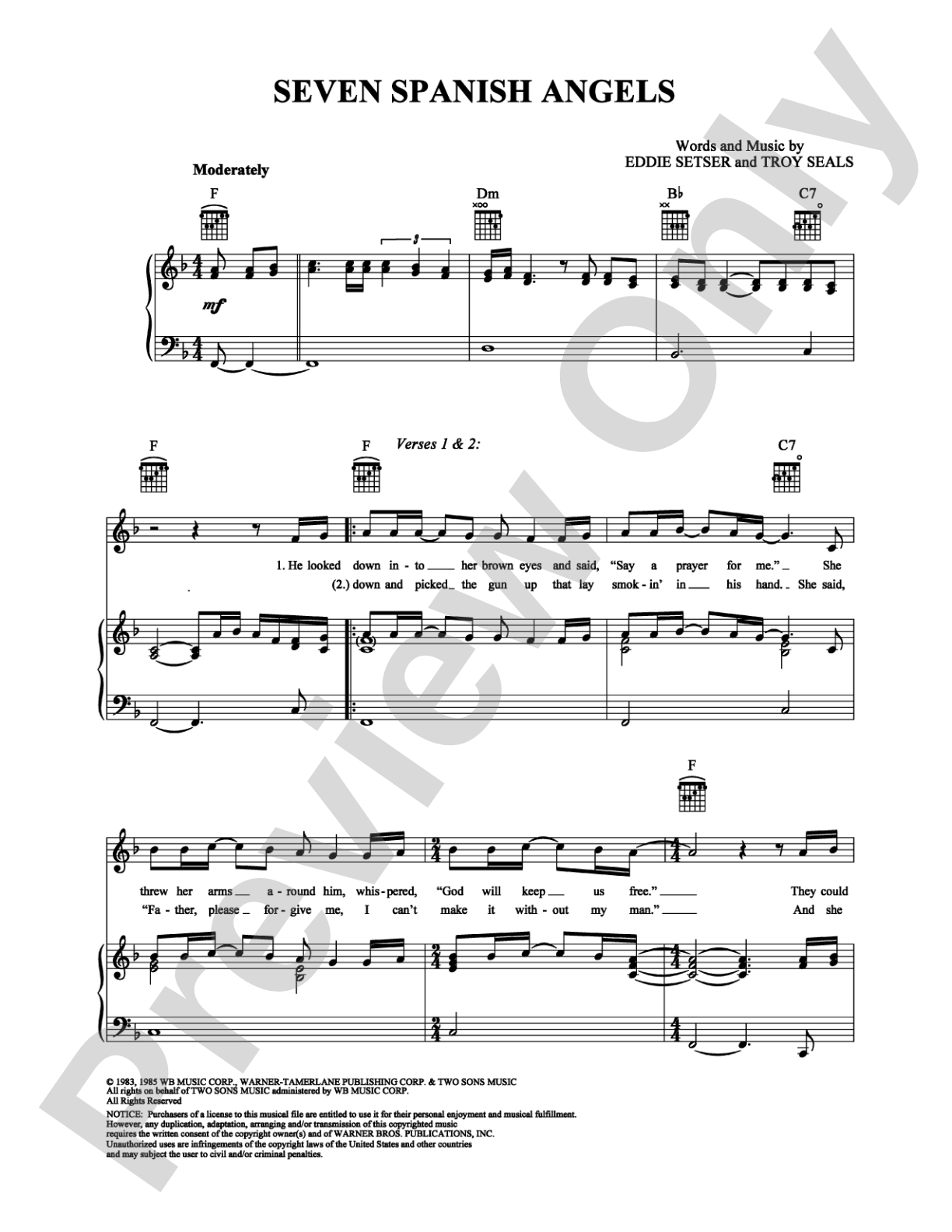
Seven Spanish Angels: Piano/Vocal/Chords Digital Sheet Music

Seven Spanish Angels: Piano/Vocal/Chords Digital Sheet Music

Ray Charles, Eddie Setser, Troy Seals, Willie Nelson

Item: 00-PS-0005646

Digital Download
$3.99
Description

Seven Spanish Angels: Piano/Vocal/Chords Digital Sheet Music isn't in MakeMusic Cloud just yet...but it could be. Let us know you'd like to see it, and you'll help shape what comes next. In the meantime, start a free trial and dive into thousands of interactive titles your students can play along with today.

Sample Audio
No sample audio found.
Sample Video
Additional Details
SKU: 00-PS-0005646

More about this title

About the Artist: Ray Charles

Ray Charles (1930-2004) fundamentally changed American music by dissolving boundaries between country, blues, gospel, and jazz. Born in Albany, Georgia, and blinded by age seven, Charles became a virtuoso pianist and vocalist whose emotional intensity and harmonic sophistication influenced generations of musicians across genres. His 1962 collaboration with Willie Nelson on "Seven Spanish Angels" showcases his ability to inhabit country material with the depth and authenticity he brought to every style he touched.

Willie Nelson (born 1933) stands as one of country music's most enduring songwriters and performers. His gift for melody and his unconventional phrasing made him a bridge between traditional country and broader popular audiences. Nelson's compositions and performances have become standard repertoire for singers learning to navigate country idiom with emotional honesty.

Why we love this

This duet sits at the intersection of country storytelling and sophisticated vocal writing. Ray Charles's phrasing and harmonic sensibility elevate the melody beyond typical country fare, while Willie Nelson's conversational delivery grounds it in genuine emotion. Piano/vocal arrangements of duets like this one give singers the chance to study how two distinct voices can share space without losing their individual character.

What to expect

The song carries the quiet heaviness of a story told late at night. Two voices remembering angels in a moment of loss create an intimate, almost confessional atmosphere. The melody moves simply, allowing the lyrics and the weight of the singers' delivery to carry the emotional work.

Who it's for

Vocalists exploring country repertoire will find this arrangement valuable for understanding how to approach a simple melody with depth and restraint. Pianists accompanying singers in country or crossover styles benefit from seeing how the harmonic foundation supports both the narrative and the vocal delivery. This works equally well for high school or college singers building recital repertoire or adult learners interested in country vocal literature.

How to get the most out of it

  • Study the original recording to hear how Ray Charles and Willie Nelson shape the phrasing differently; their interpretation choices are as much a part of the song's identity as the melody itself.
  • Pay attention to the harmonic movement in the piano part, especially where chords shift to support the vocal line's emotional peaks. The accompaniment isn't just supportive; it's part of the storytelling.
  • If performing this as a duet, resist the urge to sing in unison during the verses. Let each voice settle into its own register and approach the phrasing independently, as the artists do in the recording.
  • Balance the reflective quality of the verses with the emotional swell toward the ending. The song builds gradually rather than through sudden dynamic jumps.

How to use it

Include this in a vocal recital program that explores country songwriting as serious compositional tradition. It pairs naturally with other Nashville standards or with contemporary country art songs. The piece also works as a crossover bridge in programs mixing country, pop, and jazz styles, demonstrating how genre boundaries can be fluid when the artistry is strong.

Skills your students will build

  • Interpreting country phrasing and vocal delivery
  • Reading piano/vocal/chord notation and understanding chord symbols in a country context
  • Balancing straightforward melody with emotional depth
  • Coordinating vocal and piano parts in a duet arrangement
  • Understanding how harmonic movement supports narrative in song

You May Also Like