Seven Hills Overture: Bassoon Sheet Music Preview

Seven Hills Overture: Bassoon

By John Fannin

Grade: 4 (Medium Difficult)

Item: 00-PC-0016449_B1

Digital Download
$3.00
Description
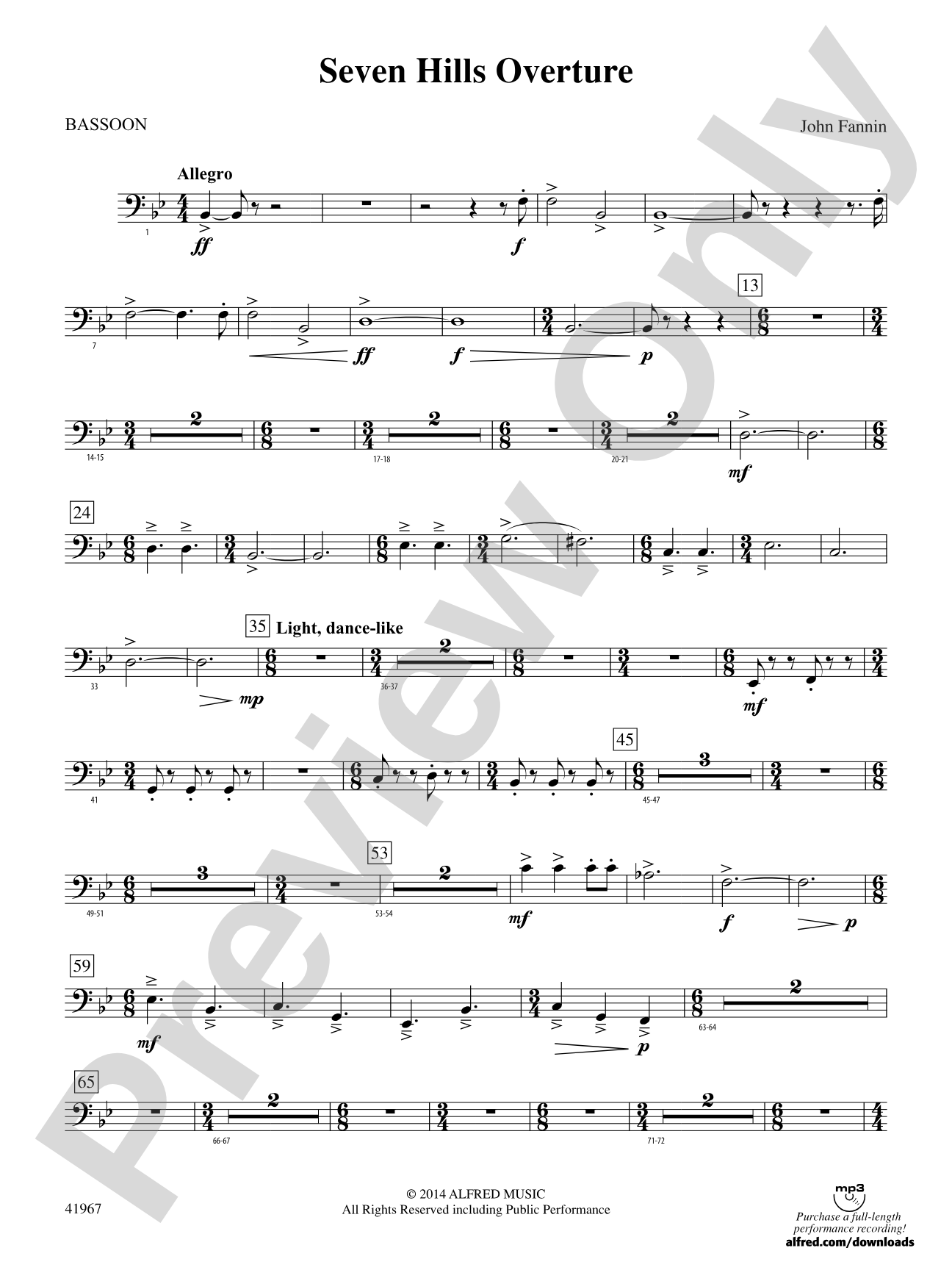
An exciting fanfare that utilizes shifting meter to create a light, happy groove. The title is inspired by the seven hills that surround Bowling Green, Kentucky. (5:00) This title is available in MakeMusic Cloud.

Don't just read it, hear it, play along with it, and watch your students grow with it. In MakeMusic Cloud, Seven Hills Overture: Bassoon comes alive with professional accompaniment, adjustable tempo, and built-in practice tools that turn solo practice into real progress.

Sample Audio
0:00
0:00
Sample Video
Additional Details
Series: Alfred Concert Band
Publisher: Alfred Music
Page Count: 288
SKU: 00-PC-0016449_B1

More about this title

About the Composer: John Fannin

John Fannin

John Fannin shaped the Murray State University band program for 25 years, transforming the Racer Marching Band into a nationally competitive ensemble that performed at the Bands of America Grand National Championships in 2006 and 2012. His tenure at MSU earned him the 2010 Distinguished Professor award, the 2009 KMEA University Teacher of the Year honor, and recognition as an outstanding music educator across the region.

Before joining Murray State in 1995, Fannin directed bands at five schools across New Mexico and Arizona, building strong foundations in instrumental music education. Today he serves as a clinician and guest conductor throughout the United States and internationally, and operates Fannin Musical Productions LLC as a creative resource for high school and college programs. His published works appear with major publishers including Alfred Music.

Why we love this

Fannin crafts a piece that energizes without exhausting your band. The shifting meters create forward momentum and rhythmic interest while remaining transparent enough that students can hear themselves developing ensemble precision. It's the kind of opener that leaves an audience smiling and your musicians engaged from the first downbeat.

What to expect

Bright, forward-moving, and celebratory. The piece maintains an infectious lightness throughout despite its metric complexity, with fanfare textures and harmonic clarity creating an impression of optimism and motion. The Bowling Green landscape inspiration translates into music that feels both grounded and buoyant.

Who it's for

Band directors seeking a Grade 4 piece that challenges rhythmic reading without requiring extreme technical demands. The shifting meter framework appeals to musicians ready to expand their interpretive skills and audiences who appreciate contemporary compositional technique within an accessible idiom.

How to get the most out of it

  • Keep the fanfare articulation crisp and uniform across the entire ensemble, especially in the opening sections where rhythmic clarity defines the character.
  • Don't let the meter changes overwhelm your tempo stability. Lock in your conducting pattern and trust your section leaders to follow; the shifts will feel natural once the pulse is secure.
  • Balance the melody so it sings above the harmonic foundation, and ensure the shifting meters don't create the impression of rushing or dragging through transitions.
  • Use the five-minute runtime strategically on concert programs; it's substantial enough to anchor a set but short enough to maintain audience energy.

How to use it

Program this as your concert opener to establish energy and sophistication from the start, or place it as a contrasting standalone item between heavier works to refresh audience attention. The five-minute length and uplifting character make it equally effective as a festival contest piece or a program centerpiece that showcases your band's rhythmic maturity.

Skills your students will build

  • Reading and performing shifting meters (transitions between duple and triple divisions)
  • Maintaining ensemble pulse through metric modulation
  • Articulation consistency and clarity in fanfare textures
  • Listening for harmonic balance in contemporary band arrangements
  • Interpreting tempo stability when metric density changes

You May Also Like