Serenade From String Quartet in F Sheet Music Preview

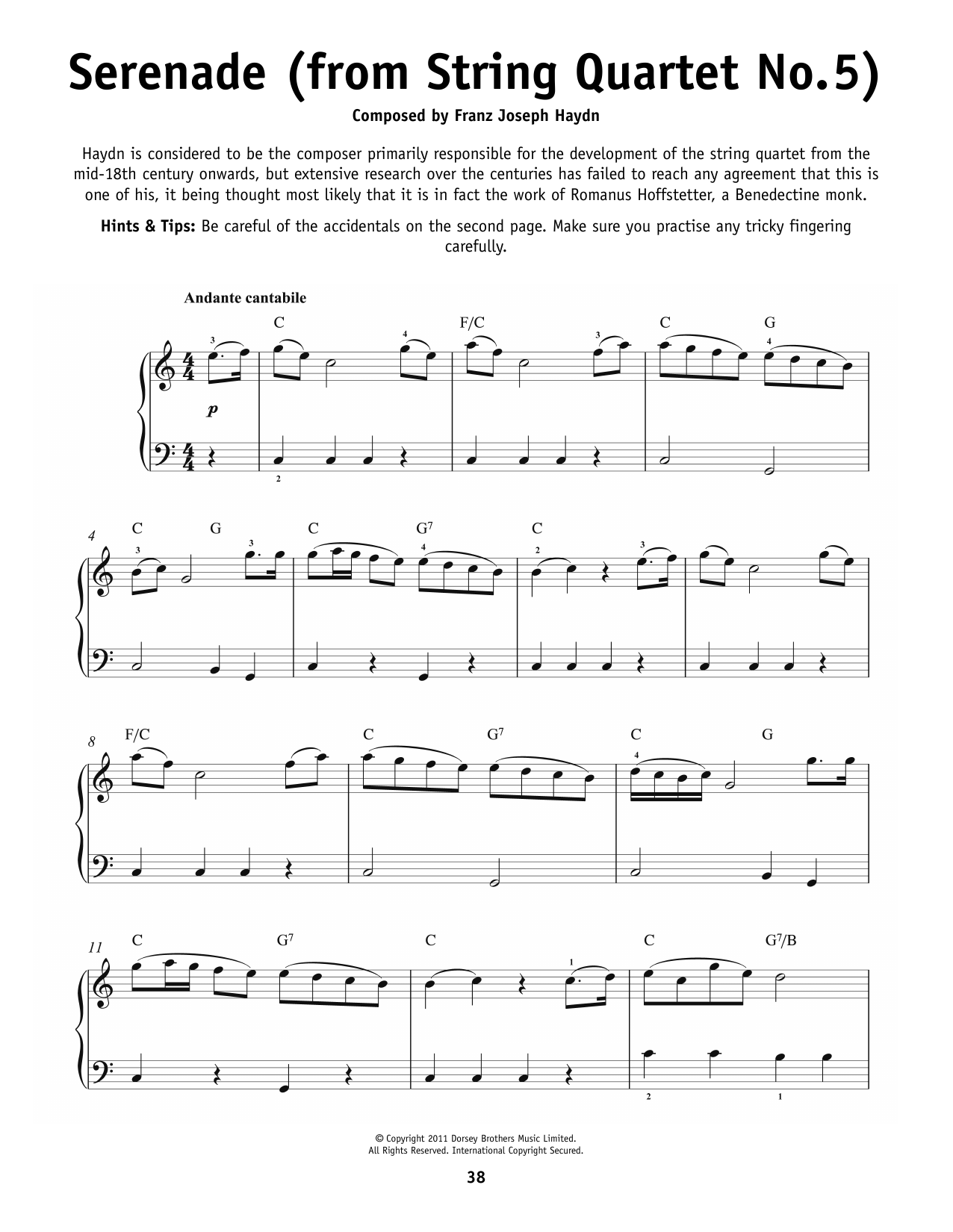
Serenade From String Quartet in F: Really Easy Piano

As performed by Franz Joseph Haydn

Item: 35-DS01588366

Digital Download
$4.99
Description

Discover MakeMusic Cloud: thousands of interactive titles your students can play along with today.

Sample Audio
No sample audio found.
Sample Video
Additional Details
Publisher: Hal Leonard
Page Count: 2
SKU: 35-DS01588366

More about this title

About the Artist: Franz Joseph Haydn

Haydn spent nearly three decades as the Esterházy court composer in Eisenstadt, a role that gave him extraordinary freedom to experiment with instrumental forms. His prolific output across every genre earned him the title "Father of the Symphony," but his string quartets represent some of his most intimate and intellectually sophisticated writing.

The string quartet was still a relatively young form when Haydn took it up, and he shaped it fundamentally through dozens of compositions. His approach combined rigorous development with genuine warmth, never sacrificing clarity for complexity. These works established the template that Mozart, Beethoven, and countless successors would follow.

Why we love this

This serenade sits at an ideal intersection for young string players: the writing is elegant without being dry, and the two-page length means students encounter real thematic development without facing exhaustion. Haydn's gift for clear phrasing and singable lines makes this an excellent vehicle for teaching how to shape a simple melody into something architecturally compelling.

What to expect

Graceful and unhurried, with the kind of 18th-century courtesy that never tips into blandness. The Serenade unfolds with the logic of well-crafted conversation, each phrase leading naturally into the next. There is genuine beauty in Haydn's restraint here, a confidence that a memorable melody and clean harmonic progression need nothing else to move a listener.

Who it's for

Advanced middle school and high school chamber ensembles benefit most from this repertoire. Players need secure intonation and basic chamber balance skills, but the musical rewards for developing these fundamentals here are substantial. It also works beautifully for adult community orchestras seeking accessible Classical-era repertoire with genuine substance.

How to get the most out of it

  • Establish a warm, singing tone from the opening phrase. Haydn expects legato, but the melodic line should still have shape and direction rather than a uniform smoothness.
  • Let the harmonic rhythm guide your tempo choices in longer note values. A slight lean into the downbeat of new harmonic areas will clarify the form without pushing the tempo.
  • Balance ensemble clarity with the lyrical intent. Clear attacks matter, but not at the expense of the vocal quality Haydn built into these lines.
  • Pay close attention to dynamic markings as structural signposts. They often indicate shifts in texture or thematic material that help the listener follow the architecture.

How to use it

This works exceptionally well as a bridge between educational repertoire and concert programming. Pair it with a second-half Romantic chamber work to demonstrate stylistic range in a single concert, or use it as a standalone piece for a chamber music showcase where ensemble balance and intonation matter most. Its brevity also makes it ideal for regional orchestra concerts where you need a brief, polished string interlude.

Skills your students will build

  • Phrasing across longer melodic lines in Classical style
  • Ensemble intonation and vertical balance in four-part writing
  • Recognition of sonata-form fundamentals through direct experience
  • Vibrato control and dynamic shaping in legit playing
  • Chamber music listening and response to other voices

You May Also Like