
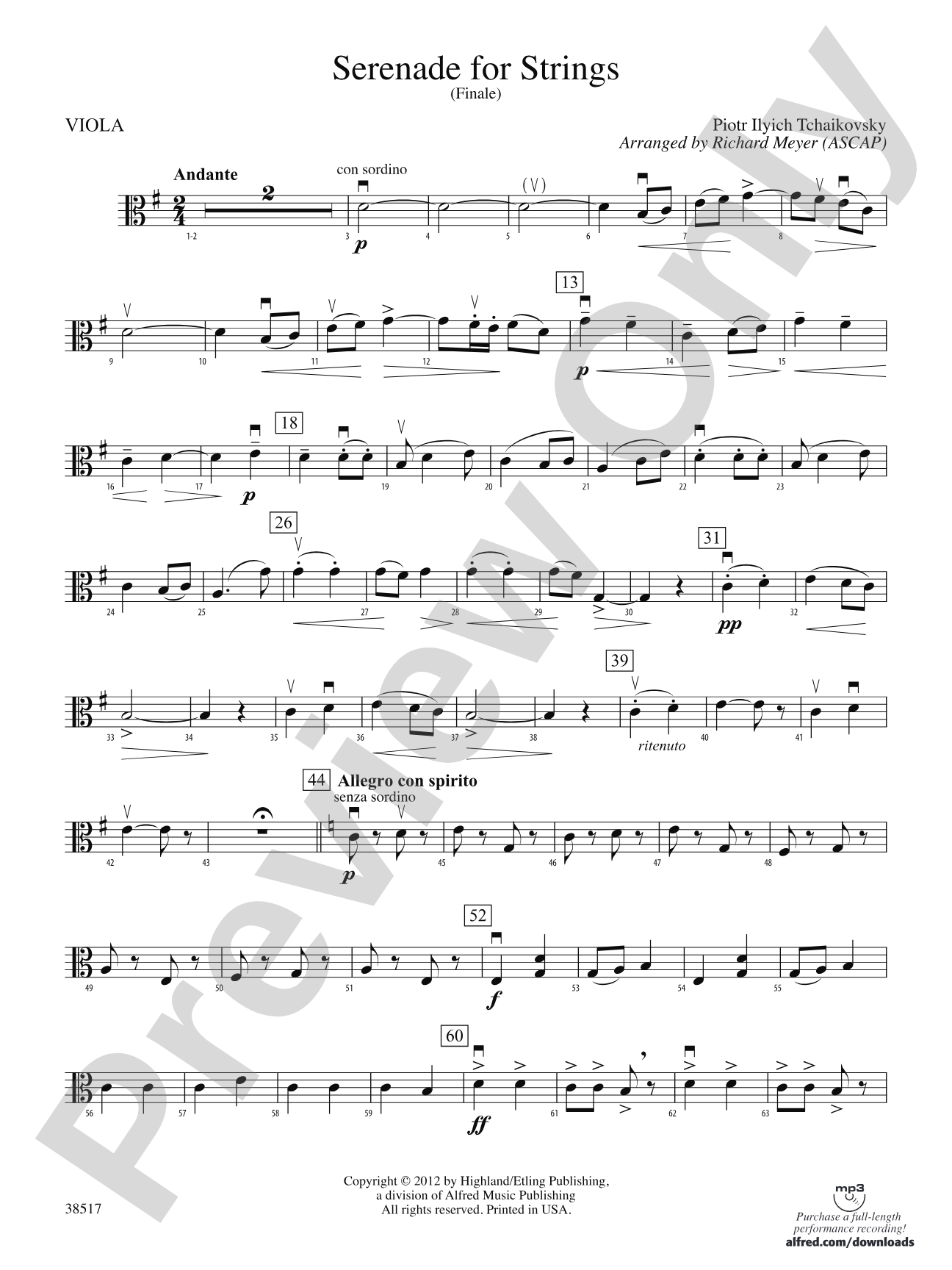

Serenade for Strings: Viola
Finale
By Piotr Ilyich Tchaikovsky [Peter Ilyich Tchaikovsky] / arr. Richard Meyer
Grade: 3
Item: 00-PC-0015559_VA1
$7.99
Pickup currently not available
Description
Very faithful to the original but arranged with the younger player in mind, this setting of an orchestral staple has it all, and is sure to challenge every section of your orchestra. The lyrical opening section will develop their expressive playing and bow control, while the bustling main theme will give everyone's fingers a great technical workout. A terrific way to give your students a taste of musical history, this piece makes a perfect closer or contest selection.


Don't just read it, hear it, play along with it, and watch your students grow with it. In MakeMusic Cloud, Serenade for Strings: Viola comes alive with professional accompaniment, adjustable tempo, and built-in practice tools that turn solo practice into real progress.
Open in the Player
Jump straight in and assign it today.
Start Your Free Trial
Open this title and explore the full library in minutes.
Sample Audio
1
Audio File
--:--
0:00
0:00
Sample Video
Additional Details
Series:
Highland/Etling String Orchestra
Publisher:
Alfred Music
Page Count:
124
SKU:
00-PC-0015559_VA1
More about this title
About the Composer: Piotr Ilyich Tchaikovsky
Pyotr Ilyich Tchaikovsky (1840-1893) stands as one of the Romantic era's most performed composers, whose gift for melody and orchestration made him a bridge between Russian national identity and Western European forms. His works span symphonies, ballets, concertos, and serenades, each marked by direct emotional expression and technical brilliance. For music educators, Tchaikovsky represents an essential voice in the concert repertoire—his music engages young players because it demands real musicianship while remaining immediately rewarding to perform.
Tchaikovsky's orchestral writing revolutionized string writing for educational contexts. His understanding of how to balance technical challenge with musical substance makes his works ideal for developing orchestras. A Serenade for Strings, in particular, showcases his mastery of form and his ability to sustain interest across contrasting sections, offering students a genuine taste of how a mature composer builds a complete musical argument.
Why we love this
Richard Meyer's arrangement respects the integrity of Tchaikovsky's original while making the technical demands accessible to intermediate orchestras. Rather than oversimplifying, this setting preserves the harmonic language and orchestral architecture of the masterwork, which means your students are learning from authentic musical discourse, not a watered-down version. It functions brilliantly as a finale or contest piece because it delivers both immediate lyrical appeal and genuine technical substance in a single performance arc.
What to expect
The opening unfolds with genuine lyricism, inviting players into expressive bow work and sensitive phrasing before the bustling main theme arrives with infectious energy and rhythmic drive. There's a quality of both elegance and delight throughout; the piece feels both substantial and joyful, never ponderous. The arc from lyrical restraint to technical exuberance mirrors the emotional sweep Tchaikovsky built into the original.
Who it's for
String orchestras working at the Grade 3 level who are ready to tackle a serious work from the standard repertoire without losing accessibility. Directors seeking a piece that satisfies both musical and technical growth will find the balance here exactly right. This arrangement serves orchestras that want their students to experience genuine masterworks, not simplified substitutes.
How to get the most out of it
- Shape the opening section's long singing lines by thinking in two-bar phrases; avoid cutting off bow notes too early, as the lyricism depends on sustained tone across the legit passages.
- Establish a clear pulse in the main theme before increasing tempo; once the faster material sits securely, the excitement will emerge naturally rather than feeling rushed.
- Balance the inner voices carefully in the orchestration; Meyer has preserved Tchaikovsky's layering, so secondary melody lines need enough presence to reveal the harmonic color.
- Use the cadential passages to reset intonation collectively; these moments of arrival are natural places to listen as an ensemble and adjust tuning before the next section begins.
How to use it
Program this as a finale when you want to showcase your orchestra's growth throughout the season. Its combination of musical sophistication and crowd appeal makes it an excellent contest selection, particularly for orchestras looking to step into more ambitious literature. Consider pairing it with a lighter opening work or a shorter contemporary piece to build a program that demonstrates range while letting this masterwork claim the closing position it deserves.
Skills your students will build
- Sustained expressive legit playing and refined bow control in lyrical contexts
- Technical accuracy and rhythmic precision in faster passagework
- Reading and executing multiple simultaneous melodic lines and inner voices
- Ensemble balance and intonation adjustment in dense orchestral textures
- Interpretation of Romantic-era orchestration and phrasing conventions