Serenade for String Orchestra: Cello Sheet Music Preview

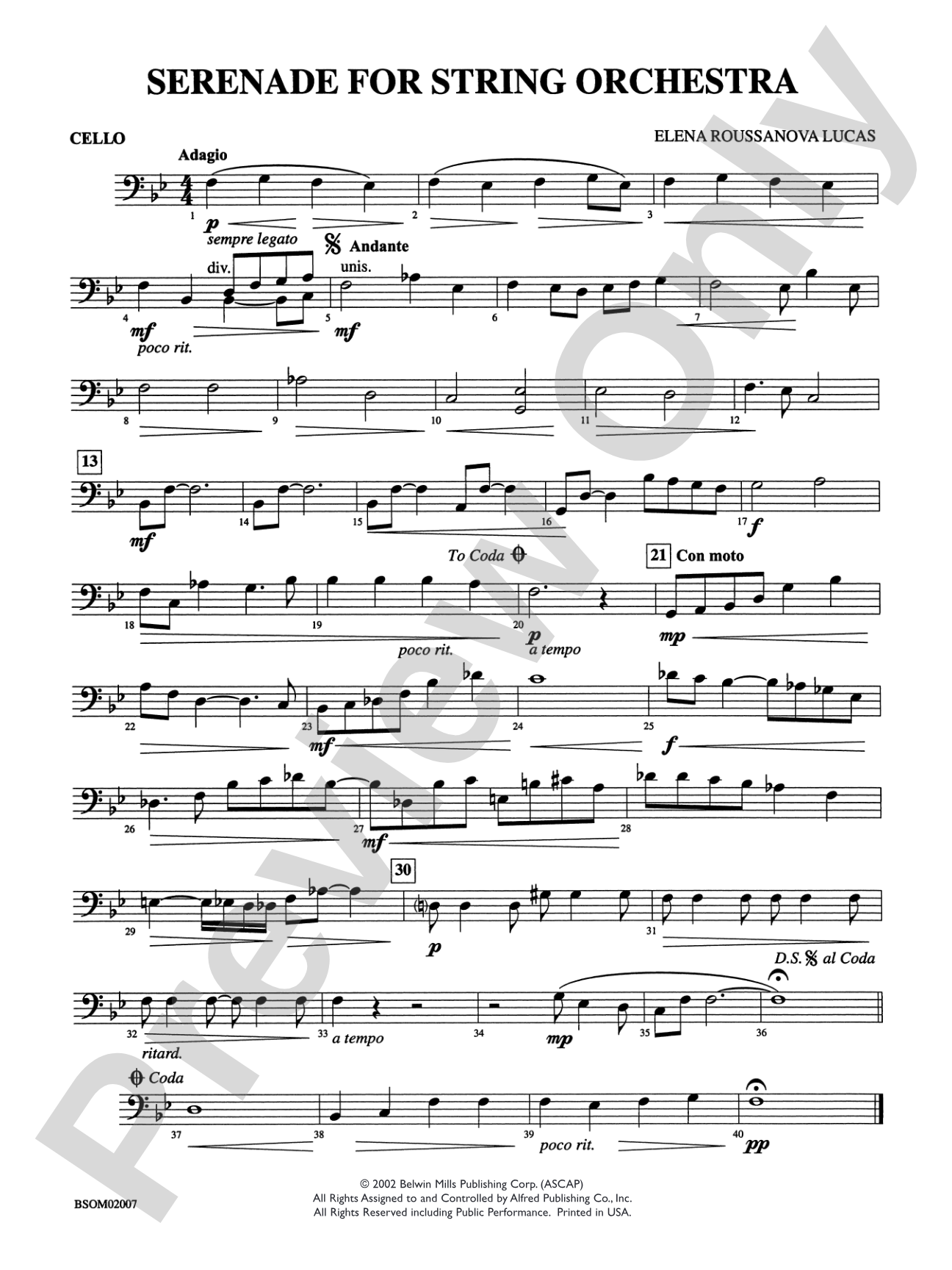
Serenade for String Orchestra: Cello

By Elena Roussanova Lucas

Grade: 2.5

Item: 00-PC-0002272_VC1

Digital Download
$5.99
Description
A fitting introduction sets the stage for the gorgeous melody that interacts throughout the string ensemble. An intriguing center section develops and brings the listener back to the rich beginning theme. A delightful original contribution to the string literature. (3:26)

Don't just read it, hear it, play along with it, and watch your students grow with it. In MakeMusic Cloud, Serenade for String Orchestra: Cello comes alive with professional accompaniment, adjustable tempo, and built-in practice tools that turn solo practice into real progress.

Sample Audio
No sample audio found.
Sample Video
Additional Details
Series: Belwin Intermediate String Orchestra
Publisher: Alfred Music
Page Count: 47
SKU: 00-PC-0002272_VC1

More about this title

About the Composer: Elena Roussanova Lucas

Elena Roussanova Lucas

Elena Roussanova Lucas trained at Moscow's most prestigious institutions, beginning piano studies at age three and advancing through the Central Music School's prodigy program before earning her Red Diploma in Composition from the Tchakovsky Conservatoire. Her teachers included prominent Soviet composers Tihon Khrennikov and Tatiana Choodova, and she holds additional credentials in piano pedagogy from the Ippolitov-Ivanov Music College.

Her compositions have been performed by leading Russian ensembles including The Tchaikovsky State Orchestra of Moscow and The Russian National Orchestra Brass Quintet, as well as by international soloists and companies. As a pianist, she won first prize in a Russia-wide competition sponsored by the Russian Ministry of Culture and has performed extensively across Moscow, Western Europe, and the United States. She currently teaches composition at Boston University and holds membership in the United Russian Composers Union.

Why we love this

This piece reveals itself gradually, unfolding a gorgeous melodic idea that flows naturally across your ensemble's voices without demanding virtuosity. The architecture is satisfying and clear enough for young orchestras to grasp at first reading, yet the central development section offers musical substance that keeps players engaged and gives you real teaching moments about harmonic color and textural balance.

What to expect

Graceful and unhurried, with an opening that feels almost like stepping into a quiet conversation. The main melody carries a Romantic sensibility, intimate in scale but genuinely warm, while the central section adds subtle complexity before resolving back into the familiar comfort of the opening theme.

Who it's for

String orchestras at the intermediate level seeking accessible yet musically substantive repertoire. This works equally well for groups preparing contest or festival performances and for programs wanting straightforward, rewarding literature that doesn't require extensive rehearsal time.

How to get the most out of it

  • Balance the initial introduction carefully; the accompanying voices should support rather than compete with the main melody, which may sit in different instrumental groups as it unfolds.
  • Shape the central section with forward momentum to maintain listener interest during the developmental passage before returning to the opening material.
  • Pay attention to vibrato control in the sustained passages; less vibrato in the introduction allows the pure melody to speak, while fuller vibrato can enhance the richer return to the main theme.

How to use it

Pair this with a contrasting baroque or contemporary work to create an interesting program arc; its lyrical character and moderate length (3:26) make it an ideal companion piece. It also fits naturally into a string-focused concert or serves as an excellent choice for festival competitions where judges appreciate compositional craft and ensemble musicianship over technical fireworks.

Skills your students will build

  • Sustaining long melodic phrases across the ensemble while maintaining pitch and tone consistency
  • Listening for and balancing inner voices against the primary melodic material
  • Shaping harmonic progressions to create forward motion and harmonic color
  • Responding to textural changes between the exposition, development, and recapitulation sections
  • Coordinating articulation and vibrato choices to support the overall musical architecture

You May Also Like