
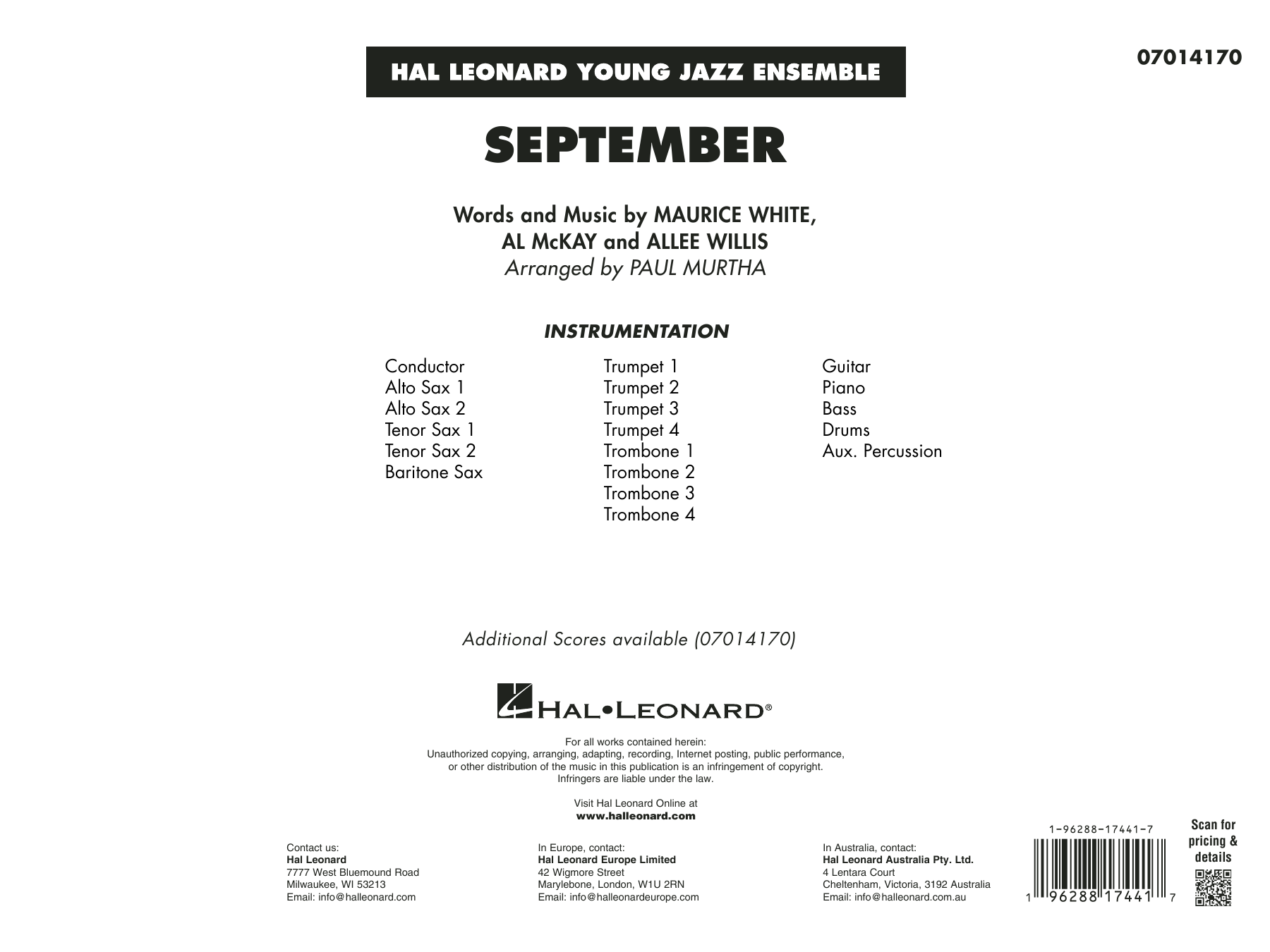

September (arr. Paul Murtha): Jazz Ensemble Conductor Score & Parts
As performed by Earth, Wind Fire / Arranged by Paul Murtha
Grade: 3
Item: 35-PK01371716
$50.00
Pickup currently not available
Buy Extra Parts (Digital PDF Download)
Parts Added to Cart!
Description
Still one of the funkiest tunes ever written, here is Earth, Wind Fire's "September" in a version for younger bands. Paul Murtha expertly captures the infectious groove of the original. You simply can't go wrong with this one!


September (arr. Paul Murtha): Jazz Ensemble Conductor Score & Parts isn't in MakeMusic Cloud just yet...but it could be. Let us know you'd like to see it, and you'll help shape what comes next. In the meantime, start a free trial and dive into thousands of interactive titles your students can play along with today.
Request This Title
Tell us you want it.
Start Your Free Trial
Explore everything that's ready to play right now.
Sample Audio
No sample audio found.
Sample Video
No sample videos found.
Additional Details
Publisher:
Hal Leonard
SKU:
35-PK01371716
More about this title
About the Artist: Earth, Wind Fire
Earth, Wind Fire emerged in the 1970s as architects of a sound that fused funk, soul, R&B, and jazz into something entirely their own. Their precision arranging, infectious grooves, and horn sections became the blueprint for what popular music could accomplish when musicians with classical training brought their skills to contemporary idioms. The band's influence extends far beyond their era; their records remain teaching tools for understanding how to build arrangements with depth, texture, and rhythmic sophistication.
For music educators, Earth, Wind Fire's catalog offers something rare: music that students genuinely want to play, built on harmonic and rhythmic principles worth serious study. The band's attention to detail in every layer of the arrangement, from the bass line to the horn voicings, demonstrates that popular music and musical craftsmanship are not opposing concepts.
Why we love this
Paul Murtha's treatment preserves what makes "September" irresistible: that syncopated bassline, the layered horn hits, the rhythmic precision that makes the whole thing lock. At Grade 3, this doesn't condescend to the ensemble; it gives younger players real groove vocabulary and genuine cooperative challenge without overwhelming them. Your students will walk into the rehearsal already knowing the melody, which frees everyone to focus on ensemble cohesion, intonation across the sections, and what it means to play funk with accuracy.
What to expect
Propulsive and tightly woven. The arrangement pulls you forward from the opening hit, with every voice doing something essential to the groove. There's brightness in the horn color, precision in the rhythm section work, and that satisfying sense of things clicking into place once the ensemble finds its pocket. It sounds like the original in spirit while living comfortably in an ensemble context.
Who it's for
Jazz ensembles at the intermediate level, particularly those ready to move beyond simplified chart territory into real groove and section writing. This works for middle and high school bands seeking contemporary repertoire with legitimate musical substance. It's equally valuable for adult community bands or college jazz combos looking to program something with broad appeal that doesn't sacrifice musicianship.
How to get the most out of it
- Establish the groove in sectional rehearsals before bringing everyone together. The rhythm section needs absolute clarity on where the backbeat lives; lock the bass and drums first, then layer the horns.
- Record a rehearsal once you have the basic structure solid, then listen as an ensemble. Groove-based music reveals timing issues faster when you hear yourselves objectively.
- Balance the horn section so the top line (trumpets) doesn't dominate the harmonic texture. These voicings matter; the trombones and saxes need room to define the sonority.
- Treat the dynamic marks as integral to the funk, not as an afterthought. The accents and sudden shifts in volume are what give the arrangement its character and energy.
How to use it
This is perfect for a concert where you want to acknowledge popular music seriously without sacrificing credibility. Pair it with a standard or a contemporary small ensemble piece to show range. It also works beautifully as a finale or as part of a themed program exploring funk and R&B influences on jazz; audiences recognize it immediately, which gives your musicians the lift that comes from playing something people love.
Skills your students will build
- Syncopated rhythmic reading in funk contexts
- Sectional balance and blend within horn textures
- Groove pocket awareness and rhythmic precision
- Ensemble cohesion across multiple simultaneous rhythmic layers
- Interpretation of dynamic accents as expressive, not merely mechanical