
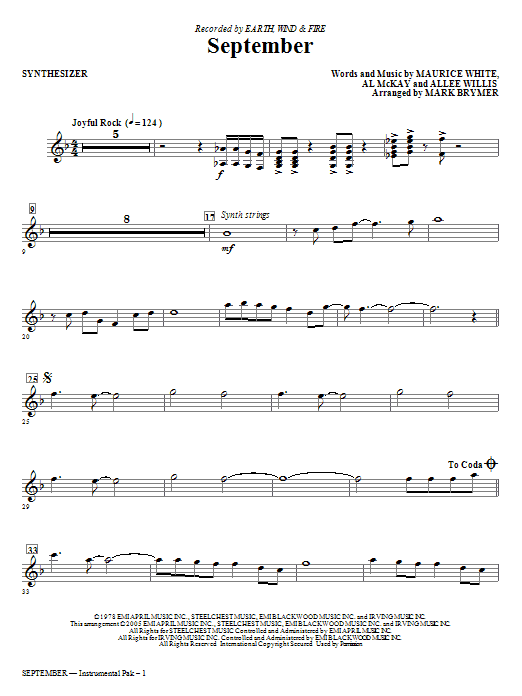

September (arr. Mark Brymer): Choral Instrumental Pak
As performed by Earth, Wind Fire / Arranged by Mark Brymer
Item: 35-PK00026805
$30.00
Pickup currently not available
Buy Extra Parts (Digital PDF Download)
Parts Added to Cart!
Description
This 1979 Hot 100 hit by Earth Wind and Fire still sizzles! Straight-forward vocal writing and a hot horn chart make it perfect for pop showcases any time of year. Performance Time: Approx. 2:25.


September (arr. Mark Brymer): Choral Instrumental Pak isn't in MakeMusic Cloud just yet...but it could be. Let us know you'd like to see it, and you'll help shape what comes next. In the meantime, start a free trial and dive into thousands of interactive titles your students can play along with today.
Request This Title
Tell us you want it.
Start Your Free Trial
Explore everything that's ready to play right now.
Sample Audio
No sample audio found.
Sample Video
No sample videos found.
Additional Details
Publisher:
Hal Leonard
SKU:
35-PK00026805
More about this title
About the Artist: Earth, Wind Fire
Earth, Wind and Fire emerged in the early 1970s as architects of a boundless fusion sound that merged funk, soul, jazz, and Latin influences into something wholly their own. Led by Maurice White, the ensemble became one of the most commercially successful and musically adventurous bands of their era, earning nine Grammy Awards and selling millions of records worldwide. Their innovation lay not just in musicianship but in conceptual ambition: every album felt like a complete artistic statement, with arrangements that treated the ensemble as a unified instrument rather than a collection of soloists.
For music educators, Earth, Wind and Fire represents a masterclass in orchestration and energy management. Their charts demand precision, intonation sensitivity, and genuine ensemble listening. "September" exemplifies why their music endures in pop and jazz curricula: it swings, it grooves, and it refuses to feel dated despite nearly five decades passing since its release.
Why we love this
Brymer's arrangement preserves the infectious groove that made "September" inescapable while keeping the vocal line singable for real students. The horn chart crackles with the precision and sass of the original, giving young brass players something genuinely cool to aspire toward rather than simplified fakery.
What to expect
Unstoppable momentum wrapped in sophisticated arranging. The piece radiates the kind of joyful confidence that makes audiences smile before the first phrase ends, yet the harmonic movement and orchestration demand respect from anyone paying close attention. It sounds effortless and complex at once.
Who it's for
Any director programming a pop, Broadway, or concert jazz showcase who needs a high-energy piece that engages both singers and instrumentalists equally. Combo voicings mean this works for smaller ensembles and doesn't require a full choir, making it ideal for mobile programming or integrated concert settings.
How to get the most out of it
- Keep the rhythm section locked on the funk pocket. This arrangement lives or dies by groove consistency, not by individual virtuosity.
- Balance the horn lines carefully so they sit behind the vocal melody; the chart's power comes from unified color, not individual players breaking through.
- Nail the articulation patterns in the horn section. Brymer's comping figures need crisp attacks and controlled releases to capture that Earth, Wind and Fire snap.
- Let the recorded accompaniment do the heavy lifting on groove orientation during early rehearsals. Once the ensemble finds its footing, pull back and let students own the pocket.
How to use it
Place this mid-set during a pop showcase or concert jazz program to reset the room's energy without sacrificing musical substance. It works beautifully opposite a ballad or classical number, proving that popular music can flex serious arranging muscles while remaining utterly accessible.
Skills your students will build
- Funk rhythm pocket and groove awareness
- Syncopated articulation patterns in brass writing
- Balancing multiple melody and counter-melody lines
- Singing with rhythmic precision against syncopated accompaniment
- Reading and interpreting contemporary pop arrangement conventions