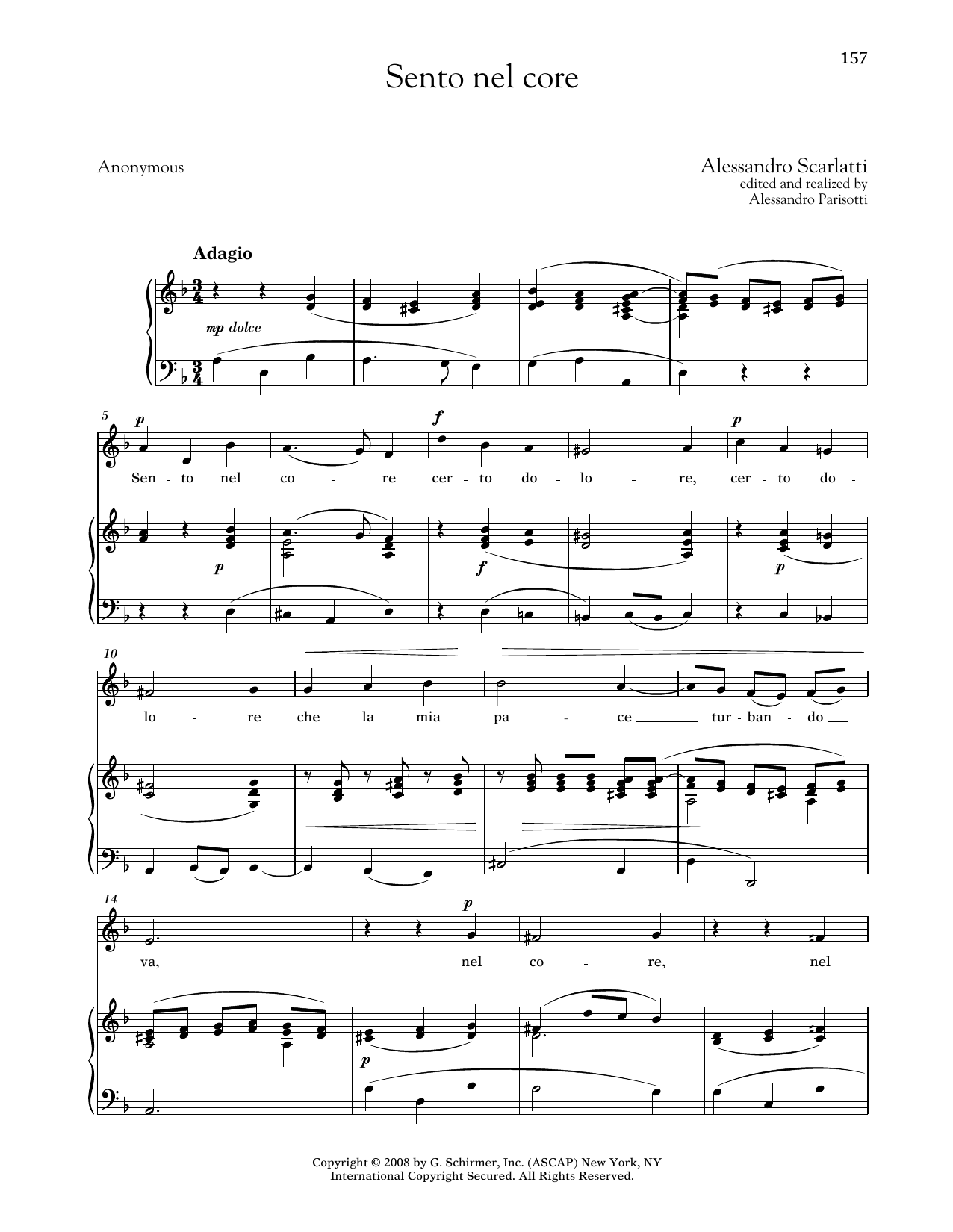
Sento Nel Core (Medium Low Voice) Sheet Music Preview

Sento Nel Core (Medium Low Voice): Piano Vocal

Edited by Alessandro Parisotti (ed.)

Item: 35-DS01579704

Digital Download
$5.99
Description

Sento Nel Core (Medium Low Voice): Piano Vocal isn't in MakeMusic Cloud just yet...but it could be. Let us know you'd like to see it, and you'll help shape what comes next. In the meantime, start a free trial and dive into thousands of interactive titles your students can play along with today.

Sample Audio
No sample audio found.
Sample Video
Additional Details
Publisher: Hal Leonard
Page Count: 5
SKU: 35-DS01579704

More about this title

About the Creator: Antonio Caldara

Antonio Caldara (1670-1736) was a prolific Italian composer who spent much of his career in Venice and Vienna, where he served as vice Kapellmeister at the imperial court. His output spanned operas, oratorios, and vocal chamber works, making him one of the most performed composers of his generation across Europe.

Why we love this

This aria sits in that sweet spot where it sounds effortlessly elegant without demanding extreme vocal range or technical fireworks. The writing lets a singer's musicality shine through; the accompaniment supports without overwhelming, making it ideal for students who are developing interpretive maturity but don't yet have the chops for heavier Baroque material.

What to expect

Warmth and restraint in equal measure. The melody unfolds with grace and inner dignity, never rushing or indulging, while the harmonies beneath suggest quiet confidence. This is music that values refinement over spectacle, inviting the listener into an intimate emotional space.

Who it's for

Singers at the upper intermediate to early advanced level who are ready for solo repertoire beyond simple art songs but not yet tackling the dramatic demands of later Baroque or Classical arias. This works well for voice students preparing recitals, singers exploring the Italian vocal tradition, or soloists needing a confident showpiece that demonstrates musical maturity.

How to get the most out of it

  • Shape the melodic line with gentle crests rather than aggressive peaks; this piece rewards legato singing and a sense of inevitable forward motion.
  • Balance the voice against the keyboard so the piano's harmonic language (Caldara's real strength) remains audible without competing for attention.
  • Let the text inflection guide your phrasing; Caldara sets Italian naturally, so follow the vowel shapes and consonant placements rather than imposing an external phrase structure.

How to use it

Program this as a solo recital opener or as part of a Baroque vocal evening that mixes Caldara with Pergolesi, Scarlatti, and Vivaldi. It also works beautifully as a bridge piece in a concert that spans Baroque and Classical periods, showing how Italian vocal writing continued to evolve in the early 18th century.

Skills your students will build

  • Sustaining long-lined Baroque melody without modern vibrato excess
  • Coordinating breath placement with text and harmonic cadences
  • Interpreting Italian prosody in melodic phrasing
  • Balancing solo voice against a realized keyboard part

You May Also Like