
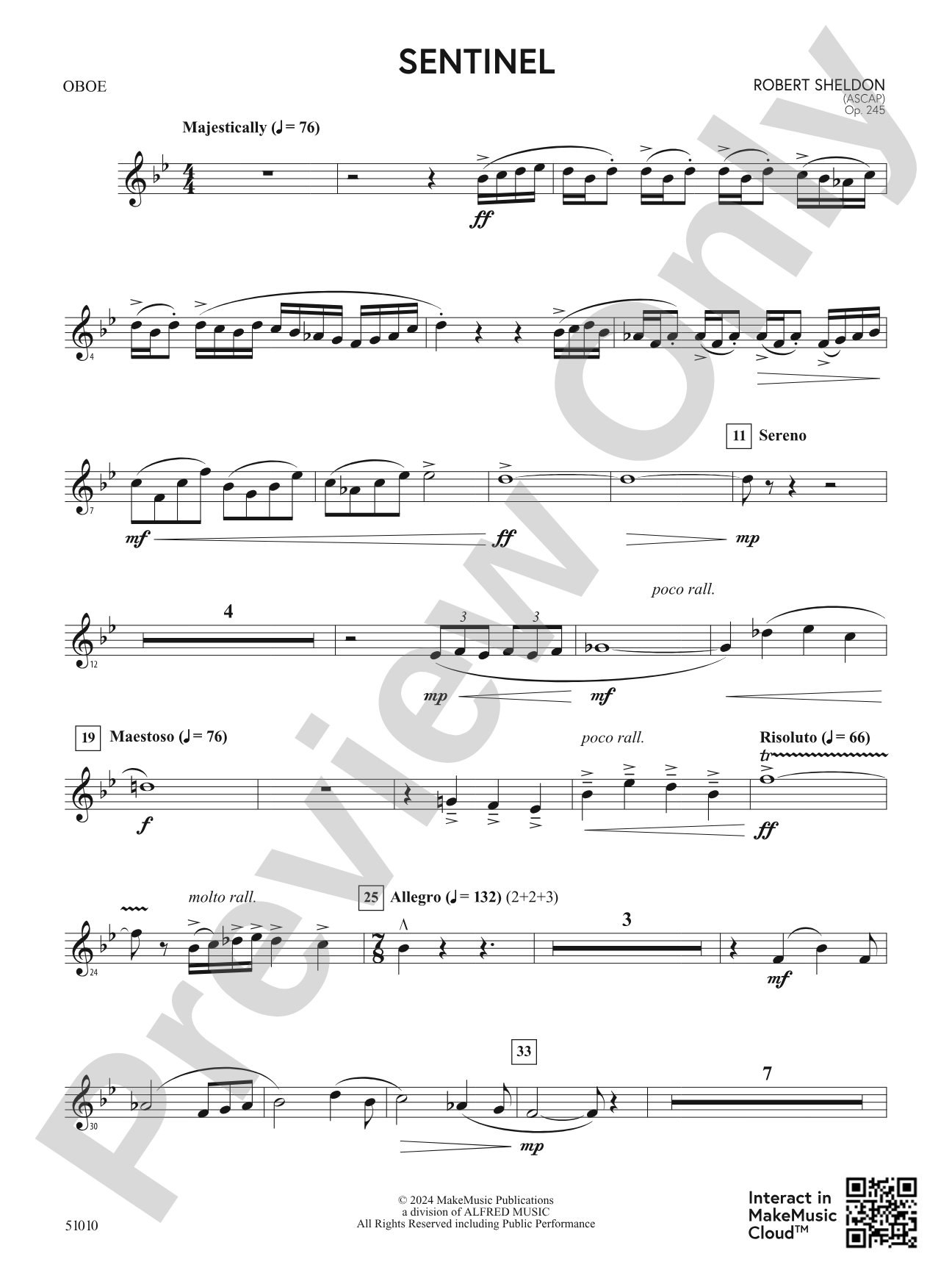

Sentinel: Oboe
By Robert Sheldon
Grade: 3
Item: 00-PC-0019223_O1
$3.00
Pickup currently not available
Description
Sentinel is a musical portrait of a lighthouse that conjures scenes of calm waters at sunrise, recreational boaters, beachgoers, and the powerful storms that come ashore. Opening fanfares give way to a carefree melody before an aggressive statement in low voices announces the storm's arrival. A dynamic work by Robert Sheldon. (4:45)


Don't just read it, hear it, play along with it, and watch your students grow with it. In MakeMusic Cloud, Sentinel: Oboe comes alive with professional accompaniment, adjustable tempo, and built-in practice tools that turn solo practice into real progress.
Open in the Player
Jump straight in and assign it today.
Start Your Free Trial
Open this title and explore the full library in minutes.
Sample Audio
1
Audio File
--:--
0:00
0:00
Sample Video
Additional Details
Series:
MakeMusic Symphonic Band
Publisher:
MakeMusic Publications
SKU:
00-PC-0019223_O1
More about this title
About the Composer: Robert Sheldon

Robert Sheldon stands among the most widely performed composers of wind band literature in the world. His works appear regularly on state and national contest programs, and his music is performed by ensembles across multiple continents. Beyond composing, Sheldon has shaped music education through his role as lead author of Sound Innovations for Concert Band and through his extensive guest conducting work with All-State and Regional Honor Bands.
A recipient of honors from the American School Band Director's Association, Phi Beta Mu, and the American Society of Composers, Authors and Publishers, Sheldon's compositions consistently balance accessibility with artistic substance. He maintains an active commission schedule and has conducted his works in Carnegie Hall, Orchestra Hall, Boston Symphony Hall, the Sydney Opera House, and the Kennedy Center. In 2020, VanderCook College of Music awarded him an honorary doctorate in recognition of his contributions to music education and composition.
Why we love this
Sentinel delivers sophisticated musical storytelling at a level that Grade 3 ensembles can actually execute. Sheldon uses clear harmonic and textural changes to paint each scene (sunrise calm, recreation, gathering storm), which gives your students concrete musical anchors while they're learning to shape phrasing and respond to conductor gestures. The programmatic structure also makes it work beautifully as a festival or contest selection where your band's musicality and ensemble blend genuinely serve the narrative.
What to expect
Sentinel unfolds like a day at the shore told through orchestral color and momentum. The opening fanfares suggest light breaking across water, the middle melody carries the warmth of a lazy afternoon, and then the harmonic language darkens and thickens as the storm advances. By the final section, the full band creates genuine dramatic tension that mirrors the power of weather rolling in from the sea.
Who it's for
Grade 3 concert bands that want a programmatic work with real musical substance and clear compositional architecture. Sheldon's writing gives developing ensembles multiple opportunities to practice ensemble cohesion, dynamic control, and stylistic variety without overwhelming them with technical demands.
How to get the most out of it
- Shape the opening fanfares with deliberate space between phrases so the "lighthouse beam" character emerges clearly; resist the urge to push through them.
- Let the carefree melody breathe naturally; this section is where your audience relaxes, so instruct players to find a conversational tone rather than a relentless pulse.
- Balance the aggressive storm statement in the low voices carefully against the full ensemble; the drama comes from clarity and weight, not volume alone.
- Use the recorded accompaniment to lock section entrances during the storm transition, since the harmonic rhythm shifts significantly in that passage.
How to use it
Sentinel works as a contest selection that showcases your band's musicality and ability to shape a narrative arc across four and a half minutes. It also programs effectively as a standalone concert opener or as part of a thematic set about nature or visual art, where directors might pair it with other programmatic works that explore different environments.
Skills your students will build
- Responding to and executing conductor tempo and dynamic gestures within programmatic storytelling
- Balancing section entrances and managing textural transitions (particularly during the storm announcement)
- Shaping melodic lines with direction and phrasing rather than mechanical pulse
- Recognizing and executing meter changes to support musical imagery
- Ensemble blend and intonation across full-band fortissimo passages